

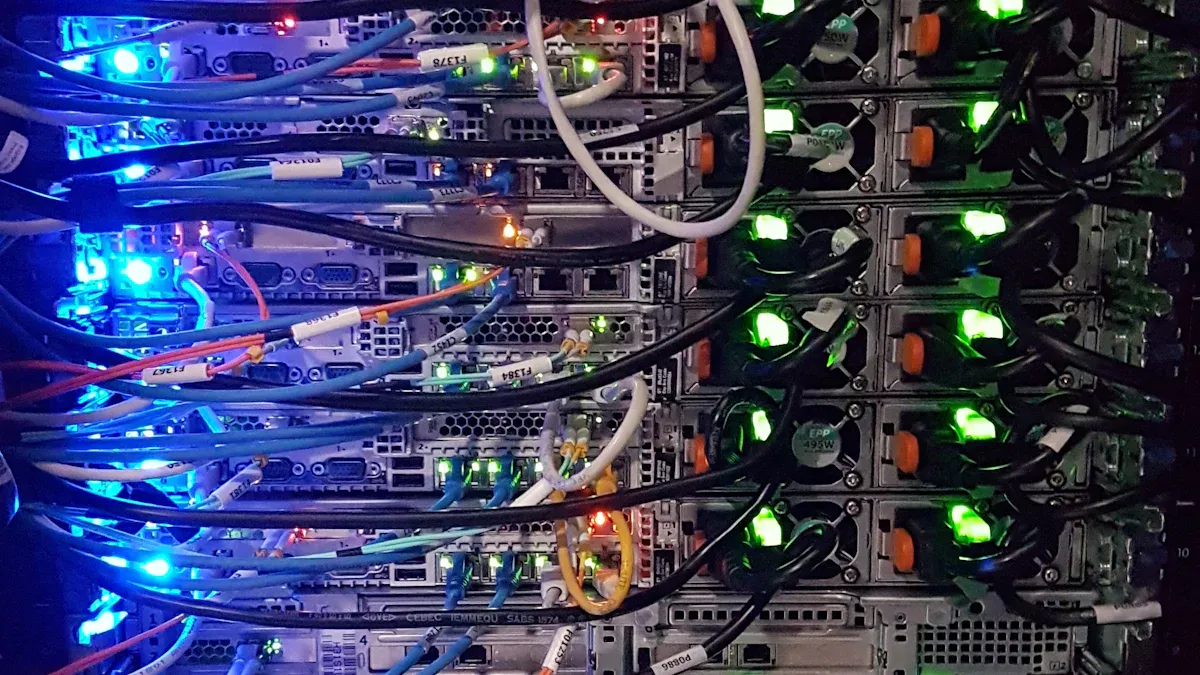
AI data centers are driving demand for high-density Power Distribution Units (PDUs). These facilities have unprecedented power requirements. They also need efficient power distribution within increasingly compact server racks. Global data center capacity will double by 2030, adding approximately 100 GW over the next five years. AI’s share of global data center power will grow from 14% now to 27% by 2027. This significant increase in AI data center power makes advanced rack power distribution solutions essential.
Key Takeaways
- AI data centers need much more power than regular data centers.
- AI hardware like GPUs use a lot of electricity and create much heat.
- Old power units (PDUs) do not work well for AI data centers.
- High-density PDUs give more power outlets and handle stronger currents.
- These new PDUs help save space and keep track of power use.
- High-density PDUs make sure power is always on and reliable.
- Choosing the right PDU helps data centers grow and save money.
The Unprecedented Power Demands of AI Workloads
AI workloads place significant demands on data center infrastructure. These demands stem from specialized hardware, increased rack density, and continuous operational cycles.
AI Hardware: GPUs and Accelerators
High Power Consumption of AI Processors
AI processors, such as Graphics Processing Units (GPUs) and accelerators, consume substantial amounts of power. These components perform complex calculations at high speeds. For example, leading AI hardware models show high power consumption:
| GPU Model | Power Consumption (Watts) |
|---|---|
| NVIDIA H100 | 700 |
| AMD Instinct MI300X | 750 |
| AMD Instinct MI250X | 500-560 |
This high power draw directly impacts the electrical infrastructure.
Specialized Cooling Requirements for AI Hardware
The intense power consumption of AI processors generates significant heat. This requires specialized cooling solutions. Traditional air cooling often cannot handle the heat produced by these powerful components. Data centers must implement advanced cooling systems to maintain optimal operating temperatures.
Increased Rack Density in AI Data Centers
More Processing Power Per Rack Unit
AI data centers pack more processing power into each server rack. This increases the power density within the racks. Traditional data centers typically operate with 5 to 10 kilowatts (kW) per rack. However, modern AI workloads often require power densities exceeding 40 kW per rack. Some configurations even reach as high as 120 kW per rack. An AI server rack can consume 30-100 kW, which is 200% to 1,333% more power than a normal server rack (10-15 kW). This means AI server racks can use up to 10 times more power than standard racks.
Space Constraints in Modern Data Centers
Data centers face physical space limitations. Increasing processing power per rack helps maximize the use of available floor space. This high density, however, puts more strain on the power distribution system.
Continuous Operation and Peak Loads for AI Training
24/7 AI Training and Inference Cycles
AI models require continuous training and inference cycles. These operations run 24 hours a day, seven days a week. This constant activity means the hardware operates under sustained load for long periods. AI training involves extremely high compute intensity, using massive parallel compute. AI inference has moderate to high compute intensity, depending on the model size.
Sustained High Utilization Rates
AI hardware operates at near-maximum utilization for extended durations. This continuous high demand leads to consistent, heavy power draw. For AI training, hardware operates at near-maximum utilization for prolonged periods.
Dynamic Power Fluctuations
AI workloads also create dynamic power fluctuations. Power demand can change rapidly due to different phases of computation, data transfers, and pauses. During AI training, rapid and large power fluctuations occur. These fluctuations happen as the system alternates between computation and communication phases. They also occur during checkpointing and data transfers. AI inference shows significant variability. This variability comes from fluctuating user requests and diverse query complexities. These dynamic changes require a robust and responsive power infrastructure to maintain stability. The continuous operation and high utilization rates contribute to the overall AI data center power demands.
Why Traditional PDUs Are Inadequate for AI Data Center Power
Traditional Power Distribution Units (PDUs) fall short in meeting the demands of modern AI data centers. Their limitations begin with insufficient outlet capacity, lower amperage ratings, and a complete absence of advanced monitoring and control, making them inadequate for the unique requirements of AI data center power.
Limited Outlet Capacity
Traditional PDUs present significant challenges due to their limited outlet capacity.
Insufficient Outlets for Dense Racks
Traditional PDUs typically offer a limited number of outlets. However, high-density AI racks, especially those housing multiple GPU servers, demand a significantly higher outlet density. These racks often require 24 to 48 outlets per PDU. Standard IEC C13 and C19 outlets are frequently insufficient for the power requirements of modern AI equipment.
Inability to Support Multiple Devices
Traditional PDUs cannot effectively support the large number of devices packed into a dense AI rack. This forces data center operators to deploy multiple PDUs within a single rack. This approach complicates cable management, increases infrastructure costs, and adds unnecessary complexity to the power distribution system.
Lower Amperage Ratings
Beyond outlet capacity, traditional PDUs also struggle with lower amperage ratings, making them unsuitable for the intense power needs of AI workloads.
Inadequate Current Handling for AI Equipment
Modern AI equipment requires connectors rated for 20A or more. Traditional PDUs, designed for less demanding environments, often cannot provide this. Newer connectors, such as C21, Saf-D-Grid, and RF-203 sockets, are necessary to support the higher amperage and voltage operations (e.g., 480V/277V) that AI hardware demands. While traditional data centers typically operate with 8-15 kW per rack, AI data centers often require 30-80 kW. CPU/Processor power in traditional setups ranges from 150W-200W, but AI processors consume 700W-1200W. This means one AI rack can equal the power demand of 20-30 traditional server racks. Furthermore, traditional 5kAIC breakers are often inadequate for the increased power draw of AI infrastructure, necessitating 10kAIC breakers or fuses. Some AI facilities require up to 50 kilowatts (kW) per cabinet, highlighting the vast difference in power needs.
Risk of Overloading Circuits
The significant power draw of AI workloads poses a high risk of overloading circuits with traditional PDUs. In North America, circuits are typically loaded to 80% of their maximum capacity. For instance, a 20A circuit should not carry more than 16A. Traditional PDUs cannot handle the sustained high current draw of AI workloads, leading to frequent circuit overloads and tripped breakers. This disrupts operations and compromises system stability.
Lack of Advanced Monitoring and Control
Finally, traditional PDUs lack the advanced monitoring and control features essential for managing complex AI environments.
Absence of Granular Power Data
Traditional PDUs fundamentally lack any power monitoring capabilities. They do not provide real-time data on load, voltage, or current at the inlet, outlet, or branch levels. This absence of granular power data prevents operators from predicting or preventing power quality problems, which can lead to equipment malfunction and unexpected downtime. Essentially, a traditional PDU acts merely as an outlet strip, offering no insight into power consumption.
Limited Remote Management Capabilities
These PDUs offer no remote access or control. IT staff must physically inspect power draws and manually redistribute equipment to prevent overloads. This process is labor-intensive and prone to human error. Without remote switching capabilities, operators cannot power cycle devices or manage power distribution from a central location. This limitation forces a reactive approach to problem-solving, as issues like power fluctuations or impending overloads remain undetected until they cause a failure.
Inefficient Power Usage Effectiveness (PUE)
The lack of monitoring and control directly impacts a data center’s Power Usage Effectiveness (PUE). Without the ability to track power consumption at a granular level, identifying high-energy-consuming devices becomes impossible. This hinders energy optimization efforts and contributes to an inefficient use of AI data center power. Manual load balancing and a reactive problem-solving approach further exacerbate these inefficiencies, increasing operational costs.
How High-Density PDUs Address AI Data Center Power Needs
High-density Power Distribution Units (PDUs) directly address the unique power demands of AI data centers. They offer increased outlet counts, higher amperage support, and advanced monitoring capabilities. These features ensure efficient power delivery and optimal space utilization.
Increased Outlet Count and Higher Amperage
High-density PDUs overcome the limitations of traditional units by providing robust power delivery.
Abundant Outlets for Dense AI Racks
High-density PDUs offer a significantly higher number of outlets. This allows data centers to power many devices within a single, densely packed AI rack. They provide the necessary connections for numerous GPU servers and other high-power equipment.
Support for High Current Ratings (e.g., 30A, 60A, Three-Phase)
High-density PDUs manage the high-amperage power that dense compute environments require. They distribute 240V or 415V three-phase power to the rack. This enables higher power density. Shifting from 208V three-phase to 415V three-phase effectively doubles a cabinet’s power capacity. This happens without doubling cable size, connector counts, or breaker panels. These PDUs support a wide range of input currents, from 16A to 125A, and power capacities from 10kW to over 90kW. They are engineered to meet the rigorous power requirements of modern AI systems. For example, some PDUs offer 32A input current with 20 C13 outlets and 4 C19 outlets. Others provide 48A (derated from 60A) with 12 C13 and 12 C19 outlets.
Compatibility with High-Power Connectors (e.g., C19)
High-density PDUs feature high-capacity connectors and plugs. These are rated for elevated amperage to maintain reliable connections under continuous high load. They utilize thicker, more heat-resistant cables to safely carry increased current. Some models offer 4-in-1 combination outlets that accept C13, C15, C19, and C21 plugs. This ensures broad compatibility with various AI hardware. For instance, a 30A PDU (derated to 24A) can provide 6 IEC 320 C19 outlets and 24 IEC 320 C13 outlets. The C19 outlets support up to 16 amps.
Space Optimization and Design
High-density PDUs are designed to maximize valuable rack space.
Vertical and Zero-U Mounting Options
Vertical PDUs, also known as Zero-U PDUs, mount in the vertical space of a server rack. They do not occupy any horizontal rack space (U-space). This mounting approach maximizes the available density within the rack for IT equipment. Snap-In 0U PDU brackets enable tool-less vertical installation. This frees up the entire U-space within the rack for essential IT equipment like servers, switches, storage, or patch panels. This is critical for high-density deployments.
Efficient Use of Rack Space
Mounting 0U PDUs vertically along the rear of the rack improves cable management. It reduces clutter and enhances airflow. Freeing up internal rack space also improves airflow pathways. This is especially true in hot-aisle/cold-aisle configurations. It leads to better equipment performance and longevity. These PDUs often have a low profile to facilitate device access and promote efficient airflow.
Advanced Power Monitoring and Management
High-density PDUs offer intelligent features for operational efficiency.
Per-Outlet and Per-Phase Metering
Per-outlet power monitoring helps identify underutilized resources. It also helps balance the load across AI and high-performance compute racks. This detailed device-level power analysis is crucial for environments like colocation facilities. Three-phase intelligent PDUs handle high-density setups with precision. They provide accurate metering, often with +/-1% accuracy. This prevents outages by providing reliable real-time data. Dedicated, billing-grade energy meter chips per outlet provide precise kWh information. This helps optimize power utilization, reduce waste, and lower operational costs.
Remote Power Cycling and Outlet Control
High-density PDUs offer remote monitoring and management. Operators can access real-time power data and control outlets from anywhere. They use web interfaces or protocols like SNMP and SSH. This reduces the need for on-site interventions. Remote management capabilities enable control and monitoring of power distribution from anywhere.
Environmental Monitoring Integration
Many high-density PDUs integrate with environmental sensors. This allows them to monitor temperature and humidity within the rack. This helps maintain optimal operating conditions for sensitive AI hardware.
Data Analytics for Power Optimization
High-density PDUs provide detailed power metrics. They monitor voltage, current, power factor, and energy consumption at the outlet level. They also offer advanced metering to optimize performance and efficiency. These PDUs integrate seamlessly with Data Center Infrastructure Management (DCIM) systems. This provides a centralized view of the power infrastructure. It simplifies management by consolidating data and alerts into a single interface. This helps identify and resolve potential issues. Analyzing power usage trends aids in planning for expansions and upgrades. This optimizes AI data center power usage.
Redundancy and Reliability Features
High-density PDUs build resilience into the power infrastructure. They ensure continuous operation for critical AI workloads. These units incorporate features that prevent downtime and maintain system stability.
Dual Power Feeds for Uptime
High-density PDUs offer dual power feeds. This design provides a critical layer of redundancy. It ensures that if one power source fails, the other immediately takes over. This prevents interruptions to AI operations.
| PDU Feature | Benefit for Redundancy |
|---|---|
| Dual Ethernet Ports | Maintains monitoring during network failure |
| Hot-Swappable Controller | Replace without downtime |
| Alternating Branch Wiring | Simplifies load balancing and improves airflow |
| Locking Outlets | Prevents accidental disconnections |
High-density PDUs require redundant A/B power feeds. They also need granular circuit-level monitoring. This maintains uptime and ensures efficient energy usage. At the cabinet level, true redundancy connects both power supplies on a server to separate power rails. Cross-connected PDUs can be used, but engineers must carefully design them. This avoids single points of failure. Guaranteed load balancing is crucial. It prevents hotspots or capacity risks.
Hot-Swappable Components
High-density PDUs feature hot-swappable components. This design allows technicians to replace parts without shutting down the entire unit. This significantly reduces maintenance windows and prevents service disruptions.
- Deploy dual-corded equipment. Connect each cord to separate PDUs.
- Use PDUs with built-in redundancy features. These include dual input power feeds.
- Modular design allows component replacement. This happens without replacing the entire unit. It simplifies maintenance and reduces downtime.
This capability is vital for AI data centers. They operate 24/7 and demand maximum uptime.
Circuit Breaker Protection
High-density PDUs include robust circuit breaker protection. These breakers automatically trip when they detect an overload or a short circuit. This prevents damage to connected equipment and the PDU itself. They isolate faults, ensuring that a problem in one part of the rack does not affect the entire system. This protection is essential for managing the high and often fluctuating power demands of AI hardware. It safeguards the integrity of the power distribution system.
Key Considerations for Selecting High-Density PDUs in AI Data Centers
Selecting the right high-density PDUs for AI data centers requires careful consideration of power capacity, outlet configurations, and advanced management features. These choices directly impact efficiency, scalability, and operational reliability.
Power Capacity and Configuration
Matching PDU capacity to the extreme demands of AI racks is paramount.
Matching PDU Capacity to AI Rack Requirements (kW per Rack)
AI deployments significantly increase power density at the rack level. NVIDIA’s DGX H100 AI servers, for example, consume about 10 kW per node. This pushes a single rack beyond 40 kW with just four or five systems. Current dense GPU clusters often see 60–120 kW per rack. Some high-end AI supercomputers already pack 130–250 kW per rack. Future designs anticipate 300 kW+ per rack, with extreme AI racks potentially exceeding 1 MW (1000 kW) each by 2028–2029. This necessitates a complete rethinking of data center infrastructure, including power delivery.
Single-Phase vs. Three-Phase Power
AI data centers are shifting from traditional 208V single-phase to 415V three-phase power delivered directly to racks. Three-phase power systems are crucial for AI and HPC due to their capacity to efficiently meet high-power demands. Rack power demands have surged from 5 kW to 20-30 kW, making efficiency critical. This higher voltage reduces current by approximately 20% for the same power, minimizing losses.
Voltage Compatibility
High-capacity power feeds are essential. AI racks drawing 50–100 kW require multiple high-amperage feeds or new distribution methods. This moves beyond standard 30 A or 60 A circuits. Many HPC systems also utilize 48V DC distribution internally.
Outlet Types and Quantity
The variety and number of outlets on a PDU are critical for accommodating diverse AI hardware.
Specific Outlet Types (e.g., C13, C19)
High-density PDUs must offer a mix of outlet types to support various AI equipment. For instance, an Inlet Monitoring PDU might feature 12 IEC 60320 C13 outlets and 8 IEC 60320 C19 outlets. Some advanced PDUs offer 4-in-1 combination outlets. These accept C13, C15, C19, and C21 plugs, providing high flexibility.
Sufficient Number of Outlets
AI racks, packed with numerous high-power devices, demand a significantly higher outlet density. PDUs must provide enough outlets to power all devices within a densely packed rack without requiring additional units.
Customization Options
The ability to customize outlet configurations or choose PDUs with versatile outlet types, like the 4-in-1 combination outlets, ensures compatibility with current and future AI hardware. This flexibility simplifies deployment and reduces the need for adapters.
Monitoring and Management Features
Intelligent features and integration capabilities are vital for efficient operation.
Intelligent Features for Operational Efficiency
Intelligent PDUs offer comprehensive power monitoring with remote outlet control. This includes remote outlet on/off and power cycling. They provide outlet-level monitoring with network connectivity and API integration for automation. These features allow data center teams to track energy trends, detect unusual spikes, and optimize cooling. They also help identify ‘zombie servers’ and overcurrent events, preventing costly downtime.
Integration with Data Center Infrastructure Management (DCIM)
Intelligent PDUs integrate with DCIM software. This feeds continuous power data into broader efficiency initiatives. They communicate with existing management tools like Building Management Systems (BMS) or DCIM architectures through universal APIs (e.g., Redfish, JSON-ROC, SNMP). This bridges data gaps and enables effective power quality management.
Alerting and Notification Capabilities
Intelligent PDUs deliver proactive notifications of impending issues. These include overload conditions, through warning and critical threshold settings. They alert users via standard formats like SMS, SNMP traps, or email. This helps prevent breaker trips and connected load failures.
Scalability and Future-Proofing for AI Data Center Power Growth
AI data centers require power infrastructure that can grow and change with technology. High-density PDUs offer the flexibility and foresight necessary for long-term success. They ensure the power system remains relevant and efficient as AI hardware evolves.
Adapting to Evolving AI Hardware
AI hardware develops quickly. Each new generation often demands significantly more power. High-density PDUs must adapt to these increasing power requirements. For example, hyperscale deployments now aim for densities near 175 kW per rack. Data center operators should choose PDUs that match current density needs. They also need to plan for future growth. It is wise to plan for higher density than currently required. Telecom technology evolves rapidly, and future upgrades will likely necessitate more power. This proactive approach prevents costly overhauls later.
Modular and Expandable Designs
Modular and expandable designs are crucial for high-density PDUs. A modular design allows easy upgrades or expansions as power needs grow. This flexibility means data centers can add components like batteries, rectifiers, or outlets as requirements change. This avoids over-investment in initial infrastructure. Load balancing features distribute power evenly across devices. This prevents overloads and ensures stable operation. High-density PDUs also offer future-proofing capabilities. They support advanced technologies, ensuring long-term adaptability for evolving AI hardware. Additionally, surge protection shields equipment from voltage spikes. This reduces the risk of damage. Power filtering ensures a clean and stable power supply, enhancing operational efficiency.
Long-Term Investment Protection
Investing in high-density PDUs provides long-term protection for data center infrastructure. Centralized service management reduces operational complexity. It also lowers ongoing maintenance costs. Increased scalability allows for rapid market expansion. This can lead to higher revenue generation. Simplified upgrades and troubleshooting enhance productivity. They also minimize downtime. These features ensure that the power infrastructure remains robust and efficient. They support the continuous growth of AI workloads. This strategic investment safeguards the data center’s ability to meet future demands. It optimizes the overall AI data center power management strategy.
The Evolution of Power Infrastructure for AI Data Center Power
The power infrastructure for AI data centers is rapidly evolving. New technologies and sustainability goals drive this change. They aim to meet the growing demands of AI workloads.
Emerging PDU Technologies
New PDU technologies are shaping the future of power delivery. These include Direct Current (DC) PDUs and software-defined power management.
Direct Current (DC) PDUs
AI data centers increasingly adopt DC-based power distribution. This minimizes energy conversion losses. DC PDUs eliminate multiple AC-DC conversions. This improves efficiency and reliability. These systems also reduce electrical complexity, heat generation, and cabling costs. DC PDUs are compatible with renewable energy and battery storage. This makes them ideal for sustainable operations. Transitioning to DC power architecture aligns with broader decarbonization goals. As AI infrastructures densify, DC PDUs will optimize end-to-end power flow. Huawei Technologies Co., Ltd. developed DC power-compatible PDUs. They integrate with hybrid renewable energy systems.
Software-Defined Power Management
Intelligent PDUs provide real-time visibility into power consumption. They enable automated responses to load imbalances. Network connectivity allows operators to remotely monitor energy use. They can also detect irregularities. AI-based analytics enhance fault prediction and operational efficiency. These capabilities reduce downtime, energy waste, and maintenance costs. The growing preference for connected, smart infrastructure makes intelligent PDUs essential. Their deployment improves uptime and operational transparency. Intelligent PDUs with networked sensors and analytics platforms revolutionize power management. AI algorithms analyze granular data for predictive maintenance and energy optimization. Delta Electronics, Inc. partnered with hyperscale operators. They deployed software-defined PDUs for large-scale AI infrastructure management.
Sustainability and Energy Efficiency Initiatives
Sustainability and energy efficiency are key drivers for PDU design.
Reducing Power Consumption
Intelligent Power Distribution Units (PDUs) improve energy management. They distribute power more efficiently and minimize waste. This helps achieve a lower Power Usage Effectiveness (PUE). PUE is a key indicator of energy efficiency in data centers. Data centers will consume about 1% of global electricity. Optimizing energy through intelligent PDUs is crucial for sustainable growth. Smart PDUs enhance energy efficiency. They provide real-time monitoring, control, and optimization of power usage. This allows operators to identify idle servers. They can also respond to power surges or temperature changes.
Optimizing Cooling Strategies
Smart PDUs help plan capacity more accurately. They facilitate data-driven decisions for server decommissioning. This frees up rack space. It also reduces unnecessary energy consumption. Metered PDUs monitor power consumption at the rack level. This provides crucial data for identifying inefficiencies. Switched PDUs allow remote management and granular control. This enables precise optimization. High-voltage Distribution (415V AC) reduces transmission losses. This improves overall energy efficiency.
Integration with Advanced AI Operations
Integrating AI into power management offers significant benefits.
AI-Powered Power Management
AI-powered power management improves efficiency. It reduces the risk of unexpected failures. It also enables predictive maintenance. This addresses issues before they escalate. Dynamic energy adjustments happen based on real-time data. Machine learning algorithms enhance efficiency. They optimize energy use. This maintains the reliability of IT equipment. It also ensures peak performance of power distribution units. AI-powered systems minimize downtime. They improve uptime by predicting failures. They prevent costly outages by addressing issues early. This maintains 24/7 availability. It also helps meet uptime SLAs.
Predictive Maintenance for Power Infrastructure
Predictive maintenance offers cost savings on repairs and energy usage. It extends equipment lifespan. It also reduces manual labor costs for unnecessary inspections. Predictive maintenance optimizes energy consumption. It enhances security and prevents risks. It detects hardware, software, and network anomalies. It identifies irregular power fluctuations. This prevents fire hazards. It also detects malicious insider activity. This enhances disaster recovery readiness. Sustainability and green data center operations benefit. They optimize power and cooling management. They lower unnecessary energy consumption. They optimize server workload distribution. They enhance power efficiency in backup systems. This leads to enhanced efficiency, reduced costs, and improved overall reliability for AI data center power.
Economic and Operational Impact of High-Density PDUs on AI Data Centers
High-density PDUs bring significant economic and operational benefits to AI data centers. They enhance efficiency, improve reliability, and simplify management. These advantages directly impact the bottom line and operational stability.
Cost Savings Through Efficiency
High-density PDUs contribute to substantial cost savings. They achieve this through optimized energy use and reduced cooling demands.
Reduced Energy Consumption
Intelligent high-density PDUs monitor power consumption at a granular level. This allows data center operators to identify inefficiencies and optimize power usage. By distributing power more effectively, these PDUs minimize energy waste. This leads to lower electricity bills. Efficient power delivery also reduces conversion losses, further contributing to energy savings.
Optimized Cooling Costs
Efficient power distribution directly impacts cooling requirements. When PDUs deliver power more effectively, IT equipment generates less wasted heat. This reduces the load on cooling systems. Optimized cooling strategies, supported by accurate power monitoring from high-density PDUs, lead to lower energy consumption for climate control. This translates into significant operational cost reductions.
Enhanced Uptime and Reliability
High-density PDUs are crucial for maintaining continuous operation in AI data centers. They minimize downtime risks and help meet stringent service level agreements.
Minimized Downtime Risks
High-density PDUs significantly reduce the risk of outages. Automatic Transfer Switch (ATS) PDUs, for example, provide redundancy. They automatically switch to a backup power source if the primary source fails. This ensures continuous power delivery to critical equipment. Research shows that implementing ATS PDUs can increase reliability by 25% in facilities with backup power configurations. Three-phase power systems, often supported by high-density PDUs, offer greater efficiency and inherent redundancy. If one phase becomes faulty, deliverable power remains available through at least two other phases. This minimizes operational disruption for data centers that cannot tolerate downtime.
Improved Service Level Agreements
By providing redundant power sources and remote management capabilities, high-density PDUs enhance data center reliability. They ensure critical equipment remains powered even during power fluctuations or failures. This continuous operation helps data centers meet strict Service Level Agreements (SLAs). Advanced real-time power monitoring further enhances system reliability. It continuously tracks electrical parameters like voltage, current, and power quality. This allows operators to proactively address issues before they escalate into failures. Tiered redundancy architectures, supported by intelligent PDUs, provide multiple layers of backup capacity. This allows for maintenance without impacting system availability.
Simplified Management and Maintenance
High-density PDUs streamline data center operations. They offer remote capabilities and automation features.
Remote Troubleshooting Capabilities
Switched rack PDUs enable remote power control. This saves time and minimizes network downtime. Administrators can remotely power cycle unresponsive devices. This eliminates the need for on-site personnel for basic troubleshooting. This capability makes troubleshooting much more efficient. It ensures critical systems quickly return to an operational state.
Automated Power Management Tasks
Switched PDUs allow for scheduling power events. Administrators can program outlets to turn on or off at specific times. This supports automated shutdowns for maintenance or scheduled reboots. Automated scheduling reduces manual effort. It ensures consistent power management practices. Centralized management of multiple units through cascading connections further simplifies tasks. This enhances operational efficiency and reduces downtime.
High-density PDUs are indispensable for AI data centers. They ensure efficient and reliable operations. These units directly address the unique power demands of AI workloads. Their advanced capabilities guarantee the infrastructure supports artificial intelligence’s continuous growth and evolution. Investing in the right high-density PDU solutions maximizes performance, ensures uptime, and optimizes the operational efficiency of AI data center power.
FAQ
What is a high-density PDU?
A high-density PDU efficiently distributes power to many devices in a compact server rack. It handles high power loads and offers advanced monitoring. These units ensure reliable power delivery for demanding AI equipment.
Why do AI data centers need high-density PDUs?
AI data centers use powerful hardware like GPUs. This hardware consumes much power. High-density PDUs provide enough outlets and amperage for these devices. They also manage power efficiently in crowded racks.
How much power do AI racks consume?
AI racks consume significantly more power than traditional racks. They often require 40 kW to 120 kW per rack. Some high-end AI systems can even exceed 300 kW per rack.
What are the benefits of advanced monitoring in PDUs?
Advanced monitoring provides real-time data on power usage. It helps identify inefficiencies and prevent overloads. Operators can remotely control outlets and track environmental conditions. This improves uptime and optimizes energy use.
Can high-density PDUs save money?
Yes, high-density PDUs save money. They reduce energy consumption through efficient power distribution. Optimized cooling costs also contribute to savings. Their reliability minimizes downtime, which prevents costly service interruptions.
What is the difference between single-phase and three-phase power for AI?
Single-phase power is common in traditional setups. Three-phase power is more efficient for AI data centers. It delivers higher power density. This reduces current for the same power, minimizing losses and improving overall efficiency.
How do high-density PDUs help with cooling?
High-density PDUs optimize power delivery. This reduces wasted heat from IT equipment. They also support efficient rack layouts, which improves airflow. Better airflow and less wasted heat reduce the load on cooling systems.
Post time: Jan-26-2026