

I’m excited about how Intelligent PDUs, or Power Distribution Units, are changing the game in data center energy efficiency. These smart PDUs allow for real-time power monitoring and dynamic load management, making it easier for data centers to optimize their energy usage. With features like remote monitoring, load balancing, and seamless integration with energy management systems, metered PDUs can lead to significant cost savings and a positive impact on sustainability. By leveraging these advancements in data center power and energy monitoring, data centers can not only reduce waste but also improve operational reliability, which is crucial in today’s tech-driven world.
Key Takeaways
- Intelligent PDUs enable real-time power monitoring, helping data centers optimize energy usage effectively.
- Remote management features allow operators to control power loads and reboot devices without physical intervention.
- Dynamic load balancing prevents hotspots and maximizes resource utilization, leading to cost savings.
- Integration with energy management systems enhances overall efficiency and supports sustainability goals.
- Real-time tracking of energy consumption helps identify inefficiencies and informs better decision-making.
- Predictive maintenance capabilities reduce downtime by addressing potential issues before they escalate.
- Adopting intelligent PDUs can lead to significant operational cost reductions and improved compliance with energy regulations.
- Investing in intelligent PDUs supports a greener future by minimizing energy waste and lowering carbon footprints.
Understanding Intelligent Power Distribution Units
Definition and Core Functions
Intelligent Power Distribution Units (PDUs) are essential components in modern data centers. They do much more than just distribute power; they actively manage and monitor energy usage. Here are some core functions that make intelligent PDUs stand out:
| Core Function | Description |
|---|---|
| Enhanced Power Management | Provides real-time data on power consumption, helping identify underused or overloaded circuits. |
| Remote Management and Control | Allows remote rebooting of devices, reducing the need for physical intervention. |
| Operational Efficiency | Distributes power evenly across devices to prevent circuit breaker tripping. |
| Improved Uptime and Resiliency | Continuous monitoring helps identify issues before they lead to downtime. |
| Cost Control | Enables accurate billing based on actual power usage and helps track Power Usage Effectiveness (PUE). |
| Scalability and Future-Proofing | Designed to manage high-density loads and integrates with DCIM tools for centralized control. |
These features empower data center operators to optimize their energy consumption and enhance overall efficiency.
Evolution from Traditional to Intelligent PDUs
The journey from traditional PDUs to intelligent PDUs has been remarkable. Initially, traditional PDUs offered basic power distribution without much insight into energy management. However, as technology advanced, so did the capabilities of PDUs.
| Feature | Traditional PDUs | Intelligent PDUs |
|---|---|---|
| Power Distribution | Basic distribution of power | Advanced control and monitoring |
| Power Demand Handling | Limited to lower power demands | Designed for high-capacity environments |
| Monitoring Capabilities | Minimal or no monitoring | Remote monitoring and environmental sensing |
| Power Quality Management | Lacks detailed power quality metrics | Provides real-time power quality insights |
| Redundancy | Basic redundancy features | Enhanced outlet-level monitoring |
| Efficiency Tracking | Limited efficiency tracking | Advanced metrics for energy efficiency |
| Security | Basic security features | Comprehensive security capabilities |
This evolution reflects the growing need for data centers to manage energy more effectively. Intelligent PDUs now provide insights that help reduce energy waste and improve reliability. As I see it, embracing these advancements is crucial for any data center aiming to thrive in today’s energy-conscious environment.
Essential Features Driving Energy Efficiency
Remote Monitoring and Management
One of the standout features of intelligent PDUs is their ability to enable remote monitoring and management. This capability transforms how data center operators handle energy consumption. With real-time insights, I can track energy usage and identify inefficiencies almost instantly. Here’s how this feature enhances energy efficiency:
- Precise Control: I can manage power loads in detail, optimizing usage based on current demands.
- Energy Savings: By scheduling power cycling for unused IT equipment, I reduce unnecessary energy consumption.
- Proactive Alerts: Intelligent PDUs send notifications for potential overloads, helping me prevent downtime before it happens.
These features not only improve operational reliability but also support accurate billing and analytics. For instance, backup mechanisms like dual-power inputs protect devices from electrical interference, ensuring continuous data transmission. This level of control and reliability is crucial for maintaining uptime in mission-critical environments.
Dynamic Load Balancing and Optimization
Dynamic load balancing is another essential feature that significantly reduces power waste in data centers. By distributing workloads evenly, I can prevent hotspots and ensure optimal utilization of resources. Here’s why this matters:
- Minimized Latency: Load balancing leads to faster processing of user requests, enhancing overall performance.
- Cost Efficiency: Properly balanced workloads reduce the need for additional hardware, which lowers operational costs.
- Environmental Impact: Shifting workloads to regions with cleaner energy helps save costs and supports sustainability initiatives.
Modern orchestration platforms can migrate workloads to efficient servers and power down unused equipment during low-demand periods. This dynamic allocation not only maximizes energy efficiency but also aligns with my goal of reducing the carbon footprint of data center operations.
Integration with Energy Management Systems and IoT
The integration of intelligent PDUs with energy management systems and IoT devices takes energy efficiency to the next level. This connectivity allows for a more holistic approach to power management. Here’s how it enhances performance:
| Statistic | Value |
|---|---|
| PDUs with IoT connectivity | Over 60% |
| Efficiency improvement | 50% |
| Adoption of AI-driven PDUs by IT firms | 45% |
By connecting to centralized management platforms, I can monitor power distribution and environmental conditions seamlessly. This integration supports proactive management of power loads, ensuring that I can respond quickly to any issues that arise. Moreover, the data collected aids in energy reporting and long-term capacity planning, making it easier to align with sustainability goals.
Leveraging Data Analytics for Power Optimization
Real-Time Energy Consumption Tracking
Real-time energy consumption tracking plays a crucial role in optimizing power usage in data centers. I’ve seen firsthand how this capability provides detailed insights into energy use patterns. With these insights, I can make informed decisions and quickly identify inefficiencies. Here are some key benefits I’ve experienced:
- Informed Decision-Making: I can analyze energy consumption trends and adjust operations accordingly.
- Cost Savings: The U.S. General Services Administration (GSA) reported a 41% reduction in total energy use, saving $13.5 million by implementing real-time energy management systems. This shows how effective tracking can lead to significant savings.
- Efficiency Gains: The American Society of Heating, Refrigerating and Air-Conditioning Engineers (ASHRAE) indicates that continuous energy monitoring can reduce energy consumption by 10-20%. I’ve noticed similar improvements in my own operations.
- Predictive Insights: Companies like IBM achieved 30% energy savings through real-time monitoring and predictive analytics. This kind of tracking allows me to forecast energy needs and optimize resource allocation effectively.
By leveraging real-time tracking, I can ensure that my data center operates at peak efficiency while minimizing waste.
Predictive Maintenance and Fault Prevention
Predictive maintenance is another game-changer enabled by intelligent PDUs. This feature helps me prevent faults and reduce downtime, which is vital for maintaining operational efficiency. Here’s how it works:
| Evidence | Description |
|---|---|
| AI-Powered Predictive Maintenance | Utilizes machine learning, IoT sensors, and big data analytics for real-time monitoring and anomaly detection. |
| Predicting Failures | Addresses potential failures before they occur, significantly reducing unplanned downtime and preventing costly outages. |
With machine learning algorithms, I can learn from historical data to identify early signs of anomalies that may lead to equipment failure. Continuous monitoring of sensor data—like temperature, vibration, and power draw—allows me to detect deviations from normal behavior. This proactive approach has helped me avoid costly outages and maintain smooth operations.
Additionally, intelligent spare part reminders can predict failures and reduce downtime by up to 25%. This ensures that my data center runs efficiently, allowing me to focus on other critical tasks.
Benefits of Intelligent PDUs in Data Centers
Reducing Operational Costs through Energy Savings
One of the most significant advantages I’ve experienced with intelligent PDUs is their ability to reduce operational costs. By optimizing energy usage, these devices have transformed how I manage power in my data center. Here’s how they help save money:
- Real-Time Monitoring: With real-time insights into power consumption, I can quickly identify inefficiencies. This allows me to make immediate adjustments, which leads to substantial energy savings.
- Load Balancing: Intelligent PDUs distribute power loads evenly across devices. This not only prevents overloads but also maximizes the efficiency of my equipment, reducing the need for additional hardware.
- Centralized Management: By implementing intelligent rack PDUs for centralized monitoring, I’ve seen a global bank reduce its energy costs by 20% within a year. This kind of efficiency is a game-changer for any organization.
Here’s a quick look at how intelligent PDUs facilitate compliance with energy regulations and standards in the data center industry:
| Feature | Benefit | Impact on Compliance |
|---|---|---|
| Real-time monitoring | Identifies inefficiencies in power consumption | Helps meet energy efficiency standards |
| Load balancing | Optimizes energy usage and reduces power waste | Aligns with sustainability goals |
| Remote management | Minimizes on-site interventions, saving time and labor costs | Ensures compliance with stricter regulations |
| Centralized management | Facilitates compliance with upcoming regulations by improving efficiency | Supports adherence to 2025 regulations |
These features not only lower costs but also help me stay compliant with energy regulations, which is increasingly important in today’s regulatory landscape.
Enhancing Sustainability and Environmental Impact
Sustainability is a priority for me, and intelligent PDUs play a crucial role in enhancing the environmental impact of my data center. Here’s how they contribute to a greener operation:
- Energy Efficiency Improvements: Intelligent PDUs significantly reduce energy waste. This aligns with my sustainability goals and lowers operational costs at the same time.
- Proactive Maintenance Capabilities: By identifying issues before they escalate, I can extend the lifespan of my equipment. This not only saves money but also reduces electronic waste.
- Real-Time Monitoring: Immediate awareness of power usage and environmental conditions allows me to make better decisions. This leads to more efficient operations and a smaller carbon footprint.
Here’s a table summarizing the environmental benefits of intelligent PDUs compared to legacy power distribution solutions:
| Environmental Benefit | Description |
|---|---|
| Real-time monitoring | Enables immediate awareness of power usage and environmental conditions, leading to better decisions. |
| Energy efficiency improvements | Reduces energy waste, supporting sustainability goals and lowering operational costs. |
| Proactive maintenance capabilities | Helps in identifying issues before they escalate, extending equipment lifespan and reliability. |
By adopting intelligent PDUs, I’m not just improving my bottom line; I’m also contributing to a more sustainable future. This dual benefit makes them an essential component of any modern data center strategy.
Real-World Implementations and Case Studies
Success Stories from Leading Data Centers
I love hearing about how intelligent PDUs have transformed operations in various data centers. Here are a couple of success stories that really stand out:
| Company/Industry | Energy Savings/Improvement | Description |
|---|---|---|
| Target | 261,000 kWh annually | Target achieved significant energy savings through the implementation of smart PDUs. |
| Cryptocurrency Mining Firm | 30% improvement | A cryptocurrency mining firm utilized smart PDUs to enhance energy efficiency while scaling operations. |
These examples show how intelligent PDUs can lead to substantial energy savings and operational improvements. I find it inspiring to see organizations embrace technology to drive efficiency and sustainability.
Comparing Traditional PDUs with Intelligent PDUs
When I look at the differences between traditional PDUs and intelligent PDUs, the advantages of the latter become crystal clear. Here’s a quick comparison:
| Feature | Traditional PDUs | Intelligent PDUs |
|---|---|---|
| Monitoring | No monitoring capabilities | Real-time monitoring of power consumption |
| Remote Management | Manual control only | Remote control and automation available |
| Environmental Sensors | Absent | Integrated sensors for temperature, humidity, and airflow |
| Alerts | None | Alerts for overload prevention |
| Energy Efficiency | Basic power distribution | Advanced power management capabilities |
| Reporting | No reporting features | Detailed reporting on energy consumption |
| Ideal Use Case | Low-density environments | High-density environments like data centers |
Intelligent PDUs significantly enhance energy efficiency. For instance, Equinix invested $77.5 million in energy efficiency initiatives in 2023, leading to an annual energy reduction of 66,862 MWh. This shows how intelligent PDUs optimize power usage and contribute to substantial operational cost savings.
However, I also recognize that implementing intelligent PDUs comes with challenges. Cybersecurity is a priority since these devices connect to corporate networks, making them vulnerable to attacks. Additionally, integrating intelligent PDUs with existing systems can be complex, requiring careful planning and execution.
Future Trends in Power Distribution Units and Energy Management
Emerging Innovations in Intelligent PDUs
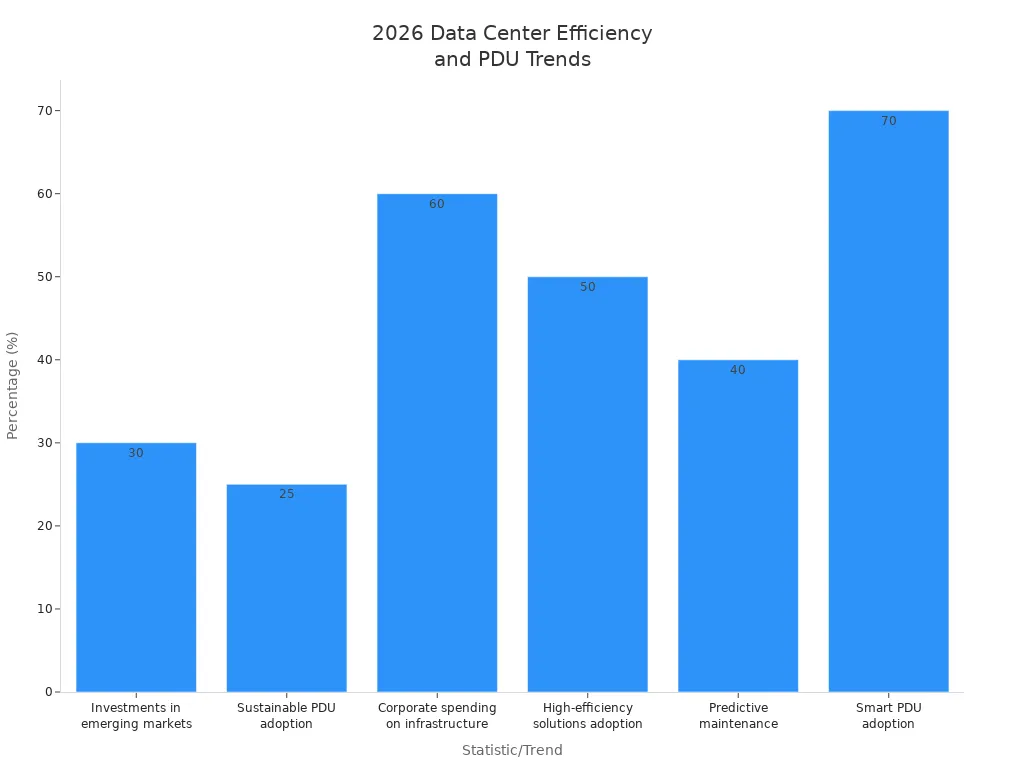
As I look ahead to 2026, I see several exciting innovations in intelligent PDUs that will reshape how we manage energy in data centers. Here are some key trends I anticipate:
- Adoption of IoT-enabled PDUs: These devices will allow for seamless connectivity and data sharing, enhancing real-time monitoring capabilities.
- Integration of AI for predictive maintenance: By using AI, I can foresee potential issues before they escalate, ensuring my data center runs smoothly.
- Development of hybrid energy management solutions: This approach will combine traditional and renewable energy sources, making my operations more sustainable.
- Focus on sustainability: I expect to see more PDUs designed with eco-friendly materials and energy-efficient components.
- Convergence of power management with environmental monitoring: This integration will help me track not just energy usage but also the environmental impact of my operations.
These innovations will empower me to optimize energy usage while aligning with sustainability goals.
The Growing Role of AI and Machine Learning in Energy Efficiency
Artificial intelligence and machine learning are becoming essential tools in enhancing energy efficiency within data centers. Here’s how I see these technologies making a difference:
- Predictive analytics: AI helps me anticipate power needs and optimize resource allocation dynamically. This means I can adjust my energy consumption based on real-time demands.
- Remote monitoring: With AI, I can track power usage in real-time, allowing me to make quick adjustments to prevent overloads.
- Advanced energy reporting: AI provides insights into power consumption patterns, which aids in optimizing efficiency. I can analyze these patterns to make informed decisions about energy use.
- Load balancing: AI-driven load balancing distributes electrical loads evenly, preventing thermal hotspots and extending the lifespan of my equipment.
For instance, Panduit’s High-Density Intelligent PDUs deliver significant power per rack while incorporating advanced metering and thermal monitoring. This capability enhances energy efficiency and supports my goal of reducing operational costs.
As I embrace these trends, I feel confident that intelligent PDUs will play a pivotal role in shaping the future of energy management in data centers.
Intelligent PDUs are truly pivotal in revolutionizing data center energy efficiency. They enable precise power management and help me reduce waste effectively. Here’s what I’ve found:
- Smart PDUs provide real-time monitoring of critical metrics like power consumption and voltage.
- They allow me to identify potential issues before they escalate, enhancing overall efficiency.
- Proactive alerts and remote management capabilities ensure uninterrupted performance.
By adopting intelligent PDUs, I’m not just saving costs; I’m also supporting sustainability initiatives. Investing in these advanced Power Distribution Units is essential for any business looking to future-proof its data center operations and achieve long-term energy efficiency goals.
FAQ
What are Intelligent PDUs?
Intelligent PDUs are advanced power distribution units that monitor and manage energy usage in data centers. They provide real-time insights, remote management, and load balancing to optimize power efficiency.
How do Intelligent PDUs improve energy efficiency?
These PDUs enhance energy efficiency by offering real-time monitoring, dynamic load balancing, and integration with energy management systems. This helps me identify inefficiencies and reduce waste.
Can I manage Intelligent PDUs remotely?
Absolutely! Intelligent PDUs allow me to manage power loads and reboot devices remotely. This feature saves time and minimizes the need for physical interventions.
What role does data analytics play in Intelligent PDUs?
Data analytics helps me track energy consumption patterns and predict maintenance needs. This proactive approach allows me to optimize resource allocation and reduce downtime.
Are Intelligent PDUs suitable for all data centers?
Yes, intelligent PDUs are designed for various environments. They excel in high-density data centers but can also benefit smaller setups by improving energy management.
How do Intelligent PDUs contribute to sustainability?
By reducing energy waste and optimizing power usage, intelligent PDUs support sustainability initiatives. They help lower carbon footprints while also cutting operational costs.
What should I consider when choosing an Intelligent PDU?
When selecting an intelligent PDU, I consider features like monitoring capabilities, remote management options, and compatibility with existing systems. These factors ensure I get the best performance.
How can I integrate Intelligent PDUs with my current systems?
Integrating intelligent PDUs with existing systems typically involves connecting them to energy management platforms or DCIM tools. I recommend consulting with a professional for seamless integration.
Post time: Mar-25-2026