

Modern data center operations require a careful equilibrium between capital expenditure and operational security. Facility managers often face pressure to minimize upfront hardware costs while maintaining high-density power reliability. This tension manifests most clearly in the procurement of surge-protected power distribution units. These units must safeguard expensive computational assets against transient voltage spikes while fitting into strict operational budgets. Infrastructure managers frequently analyze global hardware markets to identify the Top 10 Factories Of Surge Protected Universal PDU Factory for their critical server deployments. This market analysis moves beyond simple price tags to evaluate the true technical cost structure of power rails. Relying on verified engineering standards rather than arbitrary low-cost quotes ensures the integrity of network hardware. By shifting the procurement focus from short-term transaction costs to a total cost of ownership methodology, organizations successfully protect their investments. A structured, data-driven approach to vendor selection prevents the hidden pitfalls of under-engineered power infrastructure.
Demystifying the Factory Price Spread: The Procurement Paradox in Surge Protected PDUs
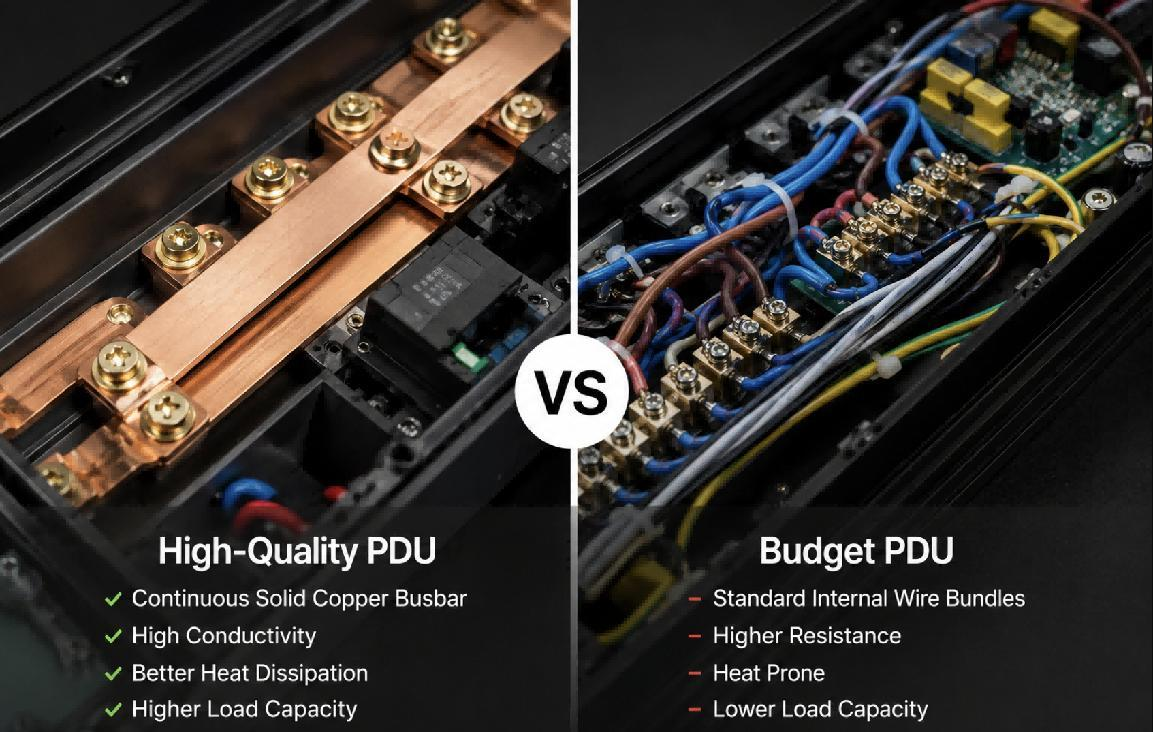
The global market for universal rack-mount power strips displays an immense variance in factory pricing. Buyers often encounter quotes that differ by significant margins for products that appear identical on paper. Understanding this disparity requires a granular audit of the bill of materials. The primary cost differential stems from the selection of internal conductive architectures. Elite manufacturing facilities utilize continuous, solid pure copper busbars to handle heavy current loads. In contrast, budget-focused producers rely on standard internal wire bundles joined by manual soldering. Solder points increase contact resistance and degrade under continuous 16-ampere thermal cycling. This thermal expansion ultimately causes connection failures inside the rack. Consequently, the premium for solid busbar architecture represents a critical investment in long-term reliability.
The second major cost driver involves the surge suppression circuitry itself. High-performance units incorporate industrial-grade Metal Oxide Varistor (MOV) modules designed to absorb repetitive energy spikes. These certified components meet international durability standards. Cheap, uncertified alternatives often consist of undersized components that fail after the first significant electrical surge. Furthermore, international regulatory compliance incurs substantial, ongoing capital investment. True safety marks like UL, GS, CE, and RoHS require rigorous third-party auditing and periodic factory inspections. Manufacturers that prioritize compliance must pass these costly hurdles, which inevitably raises the factory-gate price compared to uncertified, low-cost commodity producers.
The Dangerous Calculus of Under-Spec Sourcing: Hidden Operational Traps
Purchasing ultra-low-cost power rails introduces severe systemic risks to enterprise data centers. Budget manufacturers frequently compress costs by reducing the structural thickness of aluminum enclosures. They also expand creepage distances incorrectly and use low-grade, non-fire-retardant plastic resins. These shortcuts create immediate physical dangers. A thin aluminum chassis may sag under the weight of heavy-duty power cables, leading to potential short-circuiting against the server rack. Furthermore, low-grade plastic socket modules risk melting or igniting during prolonged electrical overloads.
The catastrophic failure mechanics of cheap surge protection hardware present an even greater danger. Undersized MOV elements often lack the thermal stability to suppress voltage spikes effectively. When a major power surge enters the system, these inferior components fail to activate or clear the line. This failure path allows dangerous high-voltage transients to pass directly into connected servers. The resulting arc-flash can destroy high-end compute nodes, storage arrays, and network switches instantly. The financial multiplier of this downtime dwarfs any savings gained from the initial procurement discount. Experienced facility engineers recognize that verified surge protection acts as a critical insurance policy for expensive infrastructure. Sacrificing this protection for a marginally lower unit price creates an unacceptable risk profile for any high-density computing environment.
Achieving Financial-Technical Equilibrium: Scale Economics and Modular Sovereignty
Infrastructure builders optimize costs by bypassing multi-layered trading companies and sourcing directly from asset-owning industrial factories. Vertically integrated production ecosystems provide the most stable path to financial-technical equilibrium. For example, Newsunn (Ningbo Newsun Network Ltd.) manages an extensive 30,000 square meters manufacturing facility. This integrated infrastructure allows the enterprise to control every stage of fabrication from the initial injection molding to the final product testing. The factory leverages economies of scale to amortize overhead costs across a high annual volume of 1,200k units. This operational model lowers per-unit production costs without forcing the engineering team to compromise on safety components.
Newsunn demonstrates this efficient production strategy through the assembly of its 19-inch 1U C13 intelligent PDU lines. Automated manufacturing lines standardize heavy-duty cable connections and simplify the integration of copper busbar systems. This standardization ensures high structural yield and reduces human error in the assembly loop. Furthermore, the factory operates an in-house tool design workshop. This capability provides flexible customization options for regional system integrators. Clients can procure specialized hardware with custom outlet orientations or rail lengths at lower minimum order quantities starting at just 100 units. Such agility prevents the need for massive inventory stockpiles, enabling data centers to scale their power infrastructure in lockstep with server deployments. Consequently, buyers access top-tier engineering quality at a price point that reflects efficient, large-scale manufacturing rather than wasteful operational practices.
Quantifiable Safeguards over Arbitrary Discounts: Designing a Rational Procurement Protocol
Global procurement professionals must replace arbitrary low-cost mandates with objective engineering audit checklists. A robust PDU vendor qualification protocol prioritizes verifiable physical metrics over marketing claims. Procurement teams should require evidence of material quality, such as logs confirming copper purity and tensile strength ratings for aluminum casings. Furthermore, surge protection components should feature clear Joules ratings and thermal cut-off indicators.
Elite manufacturers distinguish their market positioning by maintaining comprehensive, mandatory multi-stage quality loops. These internal procedures often exceed the requirements of basic international safety standards. For instance, reputable production centers execute a 2000V high-voltage Hi-pot isolation routine on every single unit. This test verifies that the insulation gap prevents leakage between live poles and the grounded chassis. Additionally, factories implement a 48-hour continuous online aging test under real-world thermal stress. This long-duration procedure stabilizes the electronic control modules and filters out infant mortality defects before the hardware leaves the facility.
Selecting the right partner involves assessing these rigorous validation steps. Intelligent power distribution requires reliable hardware that handles surges, fluctuations, and continuous loads without fatigue. When facility managers choose suppliers that maintain transparency in their testing routines, they secure a reliable foundation for long-term growth. Regional integrators currently exploring various intelligent power distribution unit solutions find that vertically integrated partners offer the best combination of upfront budget optimization and ongoing protection. Aligning with an integrated engineering enterprise like Newsunn (Ningbo Newsun Network Ltd.) allows organizations to bridge the gap between financial constraints and the absolute necessity of server security. For detailed product specifications and custom configuration guides, please visit the enterprise website at https://www.newsunnpdu.com/.
Post time: Sep-04-2026