

Every quarter, a data center procurement lead emails me the same opening question: “We are shortlisting intelligent PDU suppliers for a 200-rack deployment — what should we be asking beyond the unit price?” The honest answer is that the unit price is the last thing to compare, not the first. The first things to compare are the things that determine what happens to the PDU in year three, year five, and year eight — and those things are firmware, API, security, and the engineering team behind them. A intelligent PDU is a long-lived network device, and the supplier evaluation is closer to evaluating a switch or router vendor than evaluating a commodity electrical product.
After ten years of designing and manufacturing intelligent PDUs for data centers, server rooms, and mission-critical facilities, I have watched the same handful of mistakes repeat across every region. The buyer who specs on unit price alone ends up with a PDU that nobody can update. The buyer who specs on feature count alone ends up with a PDU that no one will patch when a security vulnerability is found. The buyer who specs on the supplier’s website claims alone ends up with a PDU that does not integrate with the data center’s existing DCIM platform. This article walks through the questions a serious buyer should ask, the answers that indicate a serious supplier, and the answers that indicate a commodity re-brander, using the Newsunn intelligent PDU product line as the reference configuration.
- Evaluating an intelligent PDU supplier is closer to evaluating a network vendor than to evaluating a commodity electrical product.
- Firmware roadmap, API support, and security posture are the three signals that distinguish a serious supplier from a re-branded commodity.
- The hardware certifications (UL, CE, IEC) are baseline, not differentiating — every serious supplier has them.
- The engineering team size and the firmware release history are the operational evidence behind the supplier’s claims.
What Makes an Intelligent PDU Different from a Basic PDU?
Walk into any data center and the PDUs are the silent majority of the equipment list. They sit in every rack, distribute power from the input to dozens of outlets, and never make headlines. The right level of intelligence for a given application depends on what the data center needs the PDU to do beyond simply distributing power, and the answer falls into three tiers.
- Basic PDU. Distributes power from the input to multiple output receptacles. Includes a circuit breaker and little else. The right answer for cabinets with a small number of devices, for environments where per-outlet monitoring is not required, and for installations where the operational maturity does not yet justify the higher unit cost of an intelligent PDU.
- Metered PDU. Adds per-input or per-bank metering of voltage, current, power factor, and energy consumption. Reports the measurements through a network interface for the DCIM platform to record. The right answer for data centers that need energy reporting, capacity planning, or sustainability metrics, but do not need per-outlet remote control.
- Switched PDU. Adds per-outlet or per-bank remote on/off switching, typically with sequencing logic to avoid inrush on power restoration. The right answer for data centers that need remote power cycling for stuck servers, remote reboot capability, or staged power-up sequencing across a rack.
- Outlet-level metered and switched PDU. Combines per-outlet metering with per-outlet switching. The right answer for the most operationally mature deployments, where the data center team needs to see exactly which device is drawing how much power and to cycle that device individually without affecting its neighbors.
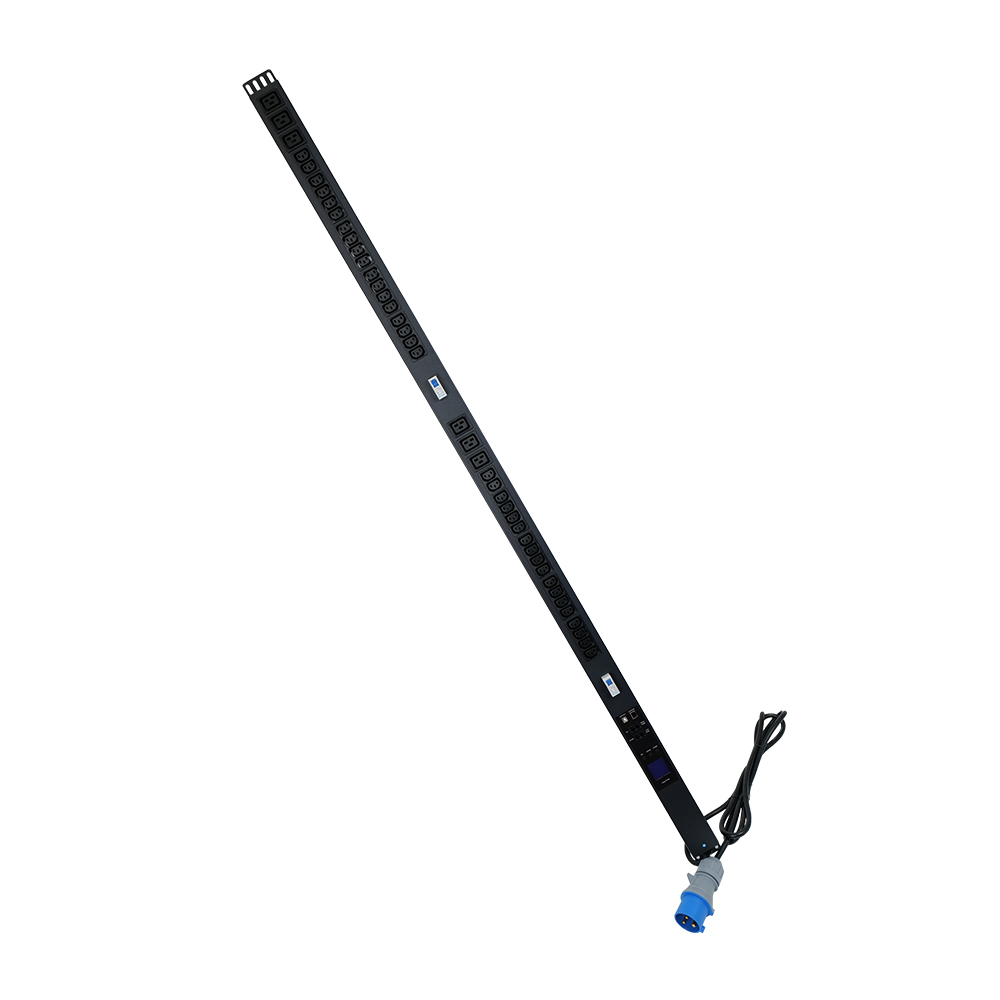
The reference configuration throughout this guide is the Newsunn OEM intelligent PDU with remote control, a metered and switched design that supports the full feature set described below. For data centers operating at the highest tier of operational maturity, the next-generation outlet-level metering capability is where the technology is heading, and a serious supplier should have that capability in the product roadmap.
What Firmware Questions Should You Ask?
Firmware is the most important variable in an intelligent PDU’s lifecycle. A PDU with mediocre hardware but excellent firmware can be updated, fixed, and improved over years. A PDU with excellent hardware but poor firmware becomes obsolete as the management stack evolves around it. The questions that determine firmware quality are not the easy ones, so the buyer has to be prepared to push past the sales-script answers.
- What is the firmware release history? Ask for the actual version history — version numbers, dates, and a one-line summary of what each release added. A supplier that has shipped three or more meaningful releases in the past 24 to 36 months has a functioning engineering team. A supplier that cannot produce a release history is either new to the business or has lost the engineering capacity.
- How are firmware updates delivered? The right answer is a signed firmware package that can be staged across a fleet, with a documented rollback path if an update fails. A supplier that ships firmware as an unsigned binary or that requires each PDU to be updated individually by hand is not a serious firmware partner.
- How are security vulnerabilities handled? Ask for the supplier’s vulnerability disclosure process, the average time from disclosure to patch, and the historical list of disclosed vulnerabilities and their resolution. A clear and timely vulnerability disclosure process is more important than a clean security record.
- What is the firmware support window? Each PDU model should have a published end-of-life date for firmware updates. A supplier that does not commit to a support window is asking the buyer to take on the risk of an unmaintained product.
For the broader cybersecurity framework that should underlie the PDU’s network interface, the most authoritative U.S. reference is the NIST Cybersecurity Framework, with the technical implementation details maintained by NIST’s Computer Security Resource Center (CSRC). For the broader U.S. public-sector cybersecurity context, the CISA Cybersecurity Division maintains the most authoritative public reference on infrastructure cybersecurity, and the parent CISA publishes the binding operational directives that govern U.S. federal infrastructure security.
What About the Engineering Team Behind the Firmware?
A firmware team that has shipped three or more releases in two years has at least two or three firmware engineers and a CI/CD pipeline. A firmware team that cannot produce a release history has either lost the engineers or has a release process so slow that nothing gets out the door. The engineering headcount is the operational evidence behind the firmware roadmap commitment, and the right supplier evaluation asks for the headcount directly.
For the broader quality framework that should underpin the supplier’s engineering process, the most authoritative U.S. reference is NIST’s Manufacturing Innovation program, which establishes the manufacturing-process baseline that the firmware team’s hardware partners should be operating under.
What API and Protocol Standards Should the PDU Support?
The right protocol mix depends on the data center’s existing management stack, but the supplier should support at least three of the four common standards out of the box without requiring a custom firmware build. The four protocols that matter most in 2026:
- HTTPS web UI. The human-facing interface, used for ad-hoc configuration and per-device monitoring. The right answer is TLS 1.2 or higher, with no HTTP fallback and no hard-coded default credentials.
- SNMPv3. The traditional network management protocol, integrated with most DCIM platforms and network monitoring tools. The right answer is SNMPv3 with both authentication and privacy enabled by default, not SNMPv1 or v2c which have no security.
- REST API (often Redfish-style for infrastructure). The programmatic interface, used for automated provisioning, telemetry export, and integration with cloud-managed infrastructure platforms. The right answer is a documented REST API with an OpenAPI specification and SDK examples in at least one common language.
- Modbus TCP. The industrial / SCADA integration protocol, used in facilities that combine IT and OT management. The right answer is full Modbus register map documentation, with each measurement point and each control point accessible.
| Protocol | Primary Use | Security Baseline | Documentation Required |
|---|---|---|---|
| HTTPS web UI | Human access | TLS 1.2+, no HTTP, no default creds | UI screenshots and config guide |
| SNMPv3 | Network management integration | Auth + privacy enabled | MIB file, OID mapping |
| REST API | Programmatic access | TLS, role-based auth, API keys | OpenAPI spec, SDK examples |
| Modbus TCP | SCADA / industrial integration | Network segmentation recommended | Register map, point definitions |
For the broader electrical and connectivity standards that the PDU’s hardware side should comply with, the most authoritative international reference is the International Electrotechnical Commission (IEC), which publishes the connector and safety standards that apply to data center power distribution equipment. For the U.S.S. safety baseline specifically, UL publishes the UL 62368-1 standard (formerly UL 60950-1) that applies to information technology equipment including intelligent PDUs.
What Security Features Should the PDU Have?
The security baseline for an intelligent PDU in 2026 is non-negotiable, and a supplier that ships with weak defaults is not a serious security partner regardless of how good the metering or switching features are. The baseline includes:
- HTTPS with TLS 1.2 or higher for web access. No HTTP fallback. The redirect from HTTP to HTTPS should be automatic.
- SNMPv3 with authentication and privacy enabled by default. SNMPv1 and SNMPv2c should be disabled out of the box. The default community strings should not be “public” or “private.”
- Role-based access control with at least three privilege levels. Read-only, read-write, and administrator. Each level should be enforced for both the web UI and the API.
- Signed firmware to prevent unauthorized updates. The supplier should sign firmware with a code-signing certificate, and the PDU should verify the signature before installing an update.
- Audit logging of every configuration change. The log should include the timestamp, the user account, the source IP, and the change made. The log should be exportable for the data center’s SIEM platform.
- Ability to disable every unused network service. If the data center does not use SNMP, the SNMP service should be disable-able. If the data center does not use Modbus, the Modbus service should be disable-able.
For the broader U.S. federal cybersecurity framework that applies to data center operators in the public sector and to operators of critical infrastructure, the authoritative reference is the Cybersecurity and Infrastructure Security Agency (CISA), and the technical implementation guidance is published through NIST’s Cybersecurity Framework. For the manufacturing side of the supply chain security baseline, the relevant framework is NIST’s Computer Security Resource Center (CSRC), which publishes the supply chain risk management practices that the PDU supplier should be operating under.
What About Network Segmentation?
Even a properly-secured PDU should be deployed on a management network that is segmented from the production data plane. The PDU’s network interface should support VLAN tagging, and the data center’s network architecture should place the PDU management traffic on a dedicated VLAN that is accessible only to the management workstations and the DCIM platform. The supplier should be able to answer questions about VLAN configuration, static IP assignment, and routing restrictions as part of the deployment guidance.
What Hardware Certifications Should the PDU Have?
The hardware certifications are the baseline, not the differentiator — every serious supplier has them, and a supplier without them is not a serious PDU vendor. The baseline certification set for an intelligent PDU sold internationally includes:
- UL 62368-1 (Audio/Video, Information and Communication Technology Equipment – Part 1: Safety Requirements). The U.S. safety standard for IT equipment, which replaced UL 60950-1 in 2020. A current UL certificate is non-neg for U.S. installations.
- CE marking under the relevant EU directives. Required for installation in the EU. The relevant directives typically include the Low Voltage Directive (LVD) and the Electromagnetic Compatibility Directive (EMC).
- IEC 60320. The international standard for appliance couplers, which defines the inlet and outlet connector geometry. C13/C14 and C19/C20 are the most common connector types for data center PDUs.
- Country-specific certifications for the destination market. CCC for China, PSE for Japan, KC for South Korea, INMETRO for Brazil. A supplier serving multiple regions should be able to produce the relevant country-specific certificates on demand.
For the broader U.S. electrical safety framework, the most authoritative source is UL, and for the broader international framework, the most authoritative source is the International Electrotechnical Commission (IEC). For the U.S. workplace electrical safety baseline that applies to data center installation, the relevant reference is OSHA 1910.212 for general machinery guarding and the broader OSHA electrical safety framework for the data center installation context.
How Do You Assess the Engineering Team?
A serious intelligent PDU supplier has three engineering disciplines in-house: firmware, hardware, and mechanical. A supplier that outsources any of these is not a serious long-term partner. The right assessment looks at three operational signals.
- Engineering headcount. The supplier should be able to name the engineers by discipline. A serious PDU supplier has at least a few firmware engineers, a few hardware engineers, and a few mechanical engineers. A supplier that names one engineer for all three disciplines has a single point of failure.
- Firmware release history. As discussed above, this is the operational evidence that the engineering team is producing output. A supplier that cannot produce a release history does not have a functioning firmware team.
- Custom project track record. A supplier that has delivered bespoke firmware features or non-standard hardware configurations to other customers has the engineering depth to support a serious deployment. A supplier that only ships stock configurations may not have the depth to handle a custom requirement.
For the broader quality-management framework that the engineering team should be operating under, the most authoritative reference is NIST’s Manufacturing Innovation program, which underpins most U.S. manufacturing-process standards. For the broader trade and import compliance context, the U.S. Commercial Service country commercial guides are the most authoritative U.S. public reference on destination-market compliance requirements.
What About Custom Engineering Capability?
A serious PDU supplier should be able to deliver at least modest customization — a custom receptacle mix, a custom firmware feature, a custom color, a custom logo. The Newsunn R&D capability is the right reference for what a serious supplier’s custom engineering looks like: a dedicated engineering team, a documented customization process, and a track record of delivered custom projects.
A supplier that cannot deliver even modest customization without going to a third-party engineering house is not a serious long-term partner. The cost of every change request will be higher, the timeline will be longer, and the supplier’s dependence on the third party will eventually surface as a support problem.
How Should You Structure the Supplier Engagement?
The supplier evaluation is a four-stage process, and the buyer should plan the time and budget accordingly. Skipping any stage produces a PDU deployment that costs more in year three than the savings from a cheaper qualification.
- Documentation review. The buyer reviews the supplier’s quality certifications, the firmware release history, the API and protocol documentation, and the hardware certification certificates. The output is a shortlist of two or three suppliers who pass the documentation bar.
- Sample evaluation. The buyer requests evaluation units from the shortlist and runs them through a defined test plan — security assessment, API integration test, load test, and long-duration stability test. The output is a single supplier recommendation.
- Reference check. The buyer contacts two or three of the supplier’s existing customers in similar deployments and asks about the supplier’s post-sale support, the firmware update cadence, and the actual operational reliability.
- Pilot deployment. The buyer runs a pilot of 10 to 20 PDUs in a production environment for 90 to 180 days before committing to the full deployment. The pilot catches the issues that no documentation review or sample test can catch.
For the broader data center industry framework that the supplier engagement plugs into, the most authoritative U.S. public reference is the ASHRAE data center thermal guidelines (ASHRAE TC 9.9), which the data center operator should be referencing when designing the cooling envelope that the PDU’s heat rejection has to live within. For the broader data center sustainability and efficiency framework, the The Green Grid consortium is the most cited industry reference for PUE and energy-efficiency metrics.
What Mistakes Do Buyers Most Often Make?
Three mistakes repeatedly catch even experienced data center procurement teams off guard when they are evaluating intelligent PDU suppliers. None of them are exotic; they are the questions that don’t get asked until the deployment is already in production.
- Specifying on unit price alone. The unit price of an intelligent PDU is a small fraction of the total cost of ownership over a 10-year deployment. The firmware, the security, and the support determine the TCO, and a supplier that wins on price and loses on the operational dimensions will cost more by year three than the buyer saved on the PO.
- Skipping the security baseline review. The buyer assumes the supplier’s PDU is “secure” because it has a web UI and supports SNMP. The actual security baseline is the list of specific capabilities (signed firmware, role-based access, audit logging) and the supplier’s vulnerability disclosure process. A PDU without these is a network entry point waiting to be exploited.
- Not requiring a firmware support commitment. A buyer who deploys 200 units without a published end-of-life date for firmware updates is betting that the supplier will continue to ship firmware updates for as long as the data center runs. A published commitment is the right way to for the buyer to turn that bet into a contract.
Talk to Newsunn About Your Intelligent PDU Sourcing
Share your rack count, outlet count per rack, monitoring and switching requirements, and destination market, and Newsunn will spec an intelligent PDU configuration with the firmware, API, and security documentation your data center team needs to qualify the deployment. See our intelligent PDU product line or our OEM intelligent remote-control PDU, and learn more about our R&D and manufacturing capability.
Frequently Asked Questions
A basic PDU distributes power from the rack’s input to multiple output receptacles with no monitoring or control capability beyond a circuit breaker. An intelligent PDU adds per-outlet or per-bank metering, remote on/off switching, environmental sensing, and network connectivity. The right level of intelligence for a given application depends on the data center’s need for remote management, energy monitoring, and integration with a DCIM platform. A serious data center deployment typically starts at the metered-only level and graduates to switched and then outlet-level metering as the operational maturity increases.
The firmware questions that matter most are the ones that determine what happens after the PDU is deployed. Ask how often the supplier releases firmware updates and what the support window is. Ask whether firmware updates can be staged across a fleet or must be done one unit at a time. Ask whether the supplier signs firmware cryptographically so a malicious update cannot be installed. Ask what the rollback path is if a firmware update fails. And ask how the supplier handles security vulnerabilities discovered after release — a clear and timely vulnerability disclosure and patch process is more important than a clean security record.
A serious intelligent PDU should support the four most common management protocols in parallel: a web UI for human access, SNMPv3 for traditional network management systems, REST/Redfish-style API for programmatic access, and Modbus TCP for industrial and SCADA integrations. The right answer depends on the data center’s existing management stack, but the supplier should support at least three of these out of the box without requiring a custom firmware build.
The security baseline for an intelligent PDU in 2026 includes: HTTPS with TLS 1.2 or higher for web access, SNMPv3 with authentication and privacy enabled by default, role-based access control with at least three privilege levels, signed firmware to prevent unauthorized updates, audit logging of every configuration change, and the ability to disable every unused network service. A supplier that ships with HTTP, SNMPv1/v2c, or hard-coded default credentials is not a serious security partner regardless of how good the metering or switching features are.
The firmware roadmap commitment is verified by what the supplier has actually done in the past 24 to 36 months, not by what they promise. Ask for the firmware release history — version numbers, dates, and a brief summary of what each release added. A supplier that has shipped three or more meaningful firmware releases in the past two years has a functioning engineering team. A supplier that cannot produce a release history is either new to the business or has lost the engineering capacity.
The baseline hardware certifications for an intelligent PDU in 2026 are UL 62368-1 for the U.S. (or its predecessor UL 60950-1 where grandfathered), CE marking for the EU, IEC 60320 for the inlet and outlet connectors, and any country-specific certifications required by the destination market. For metered PDUs, the relevant energy-metering standard is IEC 62053-21 or IEC 62053-22 depending on the accuracy class. A supplier that can produce all four certificates with current dates is a serious hardware partner.
The right assessment looks at three signals. The first is the engineering headcount — a serious PDU supplier should have at least a small team of dedicated firmware, hardware, and mechanical engineers, not a sales team that outsources the engineering. The second is the firmware release history, which is the operational evidence that the engineering team is producing output. The third is the supplier’s custom-project track record — a supplier that has delivered bespoke firmware features or non-standard hardware configurations to other customers has the engineering depth to support a serious deployment.
The right time to walk away is during the qualification phase, not after deployment. Walk away if the supplier cannot produce a firmware release history, cannot answer the API and security questions coherently, has no third-party hardware certification, or has engineering capacity smaller than the deployment size warrants. The cost of switching PDU suppliers during deployment is several multiples of the cost of switching during qualification.
Newsunn
Senior PDU Product Engineer · Newsunn
With over a decade of hands-on experience in PDU design and manufacturing, Newsunn’s technical team provides in-depth insights into power distribution solutions for data centers, server rooms, and mission-critical facilities. Backed by 8 R&D engineers and a 30,000 m² production base, we help global clients source the right PDU products — from standard rack units to fully customized intelligent power distribution systems.
Post time: Sep-16-2026