

This article walks through the physical distinction between horizontal and vertical PDUs, the airflow effect of each, the NEC and TIA-942 cable bend radius minimums, mounting hardware, rack height planning, outlet density, power routing, serviceability, and TIA-942 Rated-4 A/B PDU pair compliance.
Horizontal (1U) vs Vertical (0U) PDU: The Physical Distinction
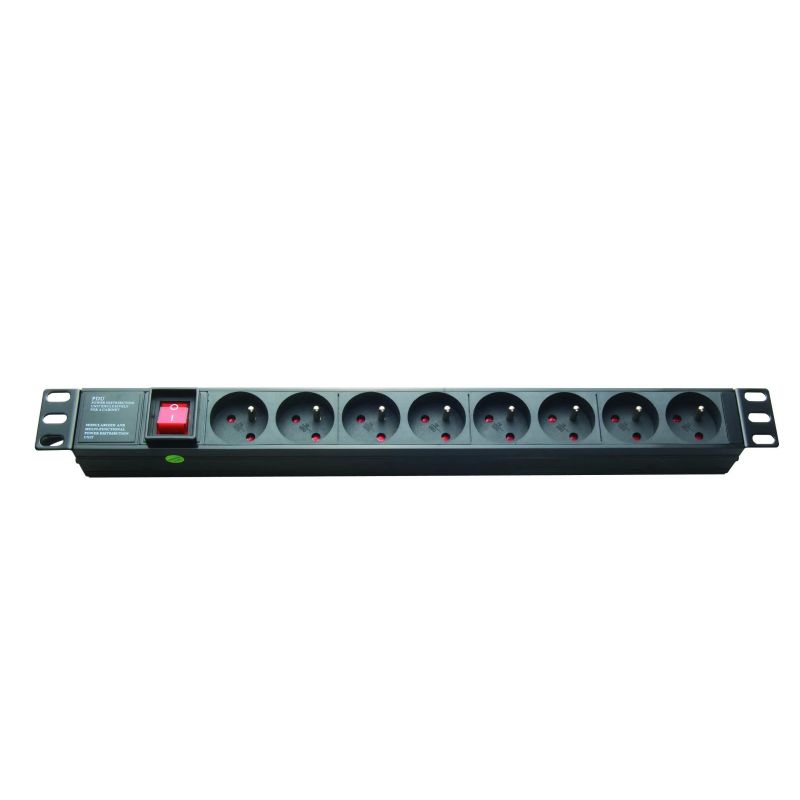
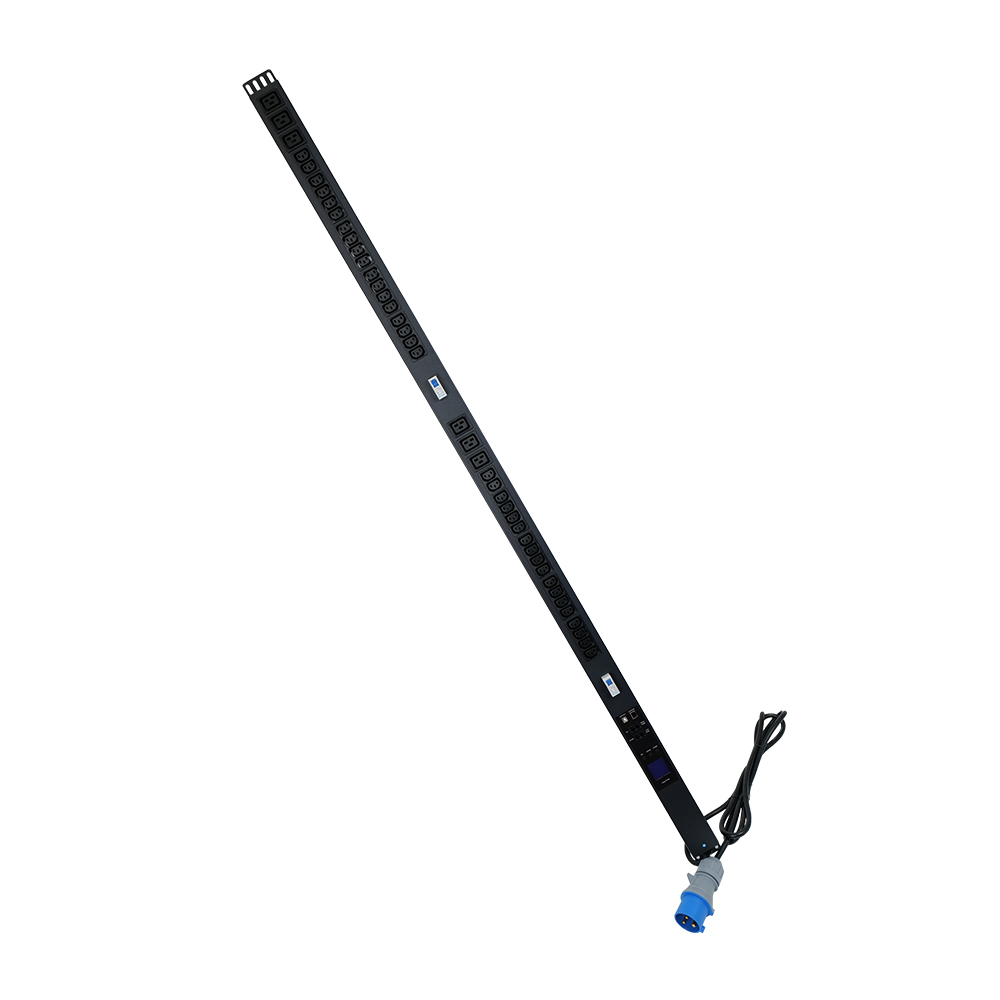
The physical distinction between horizontal and vertical PDUs is the orientation of the outlet bank relative to the rack. A horizontal PDU mounts in 1U of rack space with the outlets facing the rear of the rack, perpendicular to the rack rails. A vertical PDU mounts in the rear vertical channel with the outlets facing inward toward the equipment, parallel to the rack rails. The horizontal PDU occupies 1U of vertical rack space; the vertical PDU occupies zero rack units (0U) of vertical space because it is mounted in the channel that is outside the equipment mounting envelope.
The horizontal PDU is typically 19 inches wide (to fit the standard rack rail spacing) and 4 to 6 inches deep, which means it occupies a 1U slot in the rack equipment mounting rail. The PDU is typically mounted at the back of the rack to keep the power cords away from the equipment airflow path. The horizontal PDU is the standard form factor for shallow racks (less than 24 inches deep), wall-mount racks, and applications where the rack space is constrained and the outlet density requirement is low (4 to 12 outlets per PDU).
The vertical PDU is typically 1.5 to 2.5 inches wide and 42U to 45U tall, which means it occupies the rear vertical channel of a full-depth rack. The PDU is typically mounted at the rear side of the rack (left or right rear channel) with the outlets facing inward toward the equipment. The vertical PDU is the standard form factor for full-depth 42U or 45U data center racks where the outlet density requirement is high (24 to 48 outlets per PDU).
Airflow Engineering: 0U vs 1U PDU Effect on Rack CFM
A data center rack uses front-to-back airflow: cold air enters through perforated tiles, passes through equipment to absorb heat, and exits as hot air. A PDU that blocks this path creates a hotspot that reduces equipment reliability and increases cooling energy consumption.
A vertical PDU mounted in the rear vertical channel typically does not block the airflow because the PDU is mounted parallel to the airflow direction. The PDU occupies the side of the rear channel, leaving the central airflow path unobstructed. The cables that connect the IT equipment to the vertical PDU outlets are routed through the central airflow path, but the cables are thin (typically 12 AWG or 14 AWG power cords) and the airflow blockage is negligible compared to the equipment cross-section.
A horizontal PDU mounted at the back of the rack occupies a 1U slot in the equipment mounting rail, which is the same slot that an IT device would otherwise occupy. The PDU cross-section is small (typically 4 to 6 inches deep) compared to a 1U server cross-section (typically 18 to 24 inches deep), so the PDU does not consume as much rack depth as a server. The airflow blockage from the horizontal PDU is typically negligible because the PDU occupies only a small portion of the rack cross-section.
Neither form factor blocks airflow in a properly designed rack; the choice is driven by outlet density and rack depth. Best practice is to deploy vertical PDUs in the rear channel and manage cables carefully to keep the central airflow path clear.
Cable Bend Radius: The TIA-942 and EN 50173 Minimums
The minimum cable bend radius for a PDU power cord is governed by the National Electrical Code (NEC Article 300.24) and reinforced by the TIA-942 telecommunications infrastructure standard. The NEC specifies 4 times the cable outer diameter for flexible cords and 8 times the cable outer diameter for fixed wiring. TIA-942 specifies the same minimums for the data center power infrastructure and adds that the minimum bend radius must be maintained throughout the cable pathway.
For a typical 12 AWG or 10 AWG power cord (10-15 mm OD), the minimum bend radius is 40-60 mm for flexible cords and 80-120 mm for fixed wiring. For vertical PDUs, the bend radius is most critical at the rack entry and the PDU outlet entry. For horizontal PDUs, the shorter cable run (1-2 m) means fewer opportunities for the bend radius to be compromised.
| Cable Type | Outer Diameter | Min Bend (4x OD) | Min Bend (8x OD) | Application |
|---|---|---|---|---|
| 14 AWG SJTW | 9-10 mm | 36-40 mm | 72-80 mm | Horizontal PDU input |
| 12 AWG SJTW | 10-12 mm | 40-48 mm | 80-96 mm | Vertical PDU input |
| 10 AWG SJTW | 13-15 mm | 52-60 mm | 104-120 mm | 30A PDU input |
| 8 AWG SJTW | 16-18 mm | 64-72 mm | 128-144 mm | 40-50A PDU input |
Mounting Hardware: Buttons, Clips, and Tool-less Brackets
The mounting hardware for vertical PDUs is one of three types: tool-less button mounts, bracket mounts, and slide-rail mounts. The choice depends on the rack type, the PDU weight, and the operator’s preference for tool-less installation.
Tool-less button mounts are the most common mounting hardware for modern data center racks. The PDU has buttons on the back that snap into the square holes on the rack’s mounting rails without tools. The button design holds the PDU securely in place, and the PDU can be removed by pressing the buttons and lifting the PDU out of the rack. The tool-less buttons are typically rated for PDU weights up to 50 lbs, which covers most vertical PDUs.
Bracket mounts are used for round-hole rails or heavy PDUs (over 50 lbs); slide-rail mounts allow cable management access but cost more. For most deployments, the tool-less button mount is the right answer.
Rack Height Planning: 42U and 45U Racks with Vertical PDU Space
Rack height planning is the second most important consideration after PDU form factor selection. The standard data center rack heights are 42U (approximately 73.5 inches or 1,867 mm of internal height) and 45U (approximately 78.75 inches or 2,000 mm of internal height). The vertical PDU occupies the full height of the rack or a portion of the rack height, depending on the PDU length and the mounting position.
For a 42U rack with a full-height vertical PDU, the PDU occupies the entire vertical channel from the top of the rack to the bottom. The cable management pathway runs from the rack top (where the overhead busway feeds enter) down the rear channel to the PDU outlets, and from the PDU outlets inward to the IT equipment. The cable management pathway is typically 1.5 to 2.5 inches wide, which is enough for 24 to 48 power cords plus the network cables that run in parallel.
For a 45U rack with a full-height vertical PDU, the additional 3U of height provides space for additional outlets or for a longer cable management pathway. The 45U rack is the standard for high-density compute racks where the additional 5 cm of internal height supports the higher outlet density and the additional cable management accessories.
For racks where partial-height PDUs are preferred, the PDU length can be 24U or 36U. The Newsunn horizontal rackmount PDU product line provides the dimensional data and mounting hardware options for each rack configuration.

Outlet Density: How Vertical PDUs Deliver 24-48 Outlets per PDU
Outlet density is the primary advantage of vertical PDUs over horizontal PDUs. A vertical PDU can deliver 24 to 48 outlets per PDU because the PDU length spans the full rack height (42U or 45U) and the outlets are spaced along the PDU length. A horizontal PDU is limited to 4 to 12 outlets because the PDU occupies a 1U slot and the outlets must fit within the 1U height.
The outlet density of a vertical PDU depends on three factors: the outlet type (C13 is smaller than C19), the phase configuration (single-phase is smaller than three-phase), and the optional features (metering, switching, network interface add width to the PDU body). A basic single-phase 24-outlet C13 vertical PDU is the standard for most data center racks. A high-density 48-outlet mixed C13/C19 vertical PDU is the standard for high-density compute racks.
Vertical PDUs deliver 24-48 outlets per PDU, covering 4-12 servers (each with one or two power cords). Horizontal PDUs deliver 4-12 outlets, covering 1-4 devices in wall-mount racks or edge sites. The horizontal PDU is also the right choice for retrofit installations where the rack does not have vertical channels for 0U mounting.
Power Routing: Top-of-Rack vs Bottom-of-Rack Feed Pathways
The power routing pathway for a rack PDU is determined by the data center electrical design. The two standard configurations are top-of-rack feed (from overhead busway) and bottom-of-rack feed (from underfloor floor boxes). The choice affects the cable management pathway, the PDU input cord length, and the installation cost.
Top-of-rack feed is the standard for new data center builds with overhead busway. The power cord runs from the busway tap box at the top of the rack, down the rear vertical channel to the PDU input. The cord length is typically 3 to 6 meters depending on the rack height and the busway position. The advantage of top-of-rack feed is that the cord does not cross the rack floor, which keeps the cold aisle clear for airflow.
Bottom-of-rack feed is the standard for legacy data centers with underfloor power distribution. The choice between top and bottom is driven by the data center electrical design and existing infrastructure rather than by the PDU form factor.
Serviceability: Hot-Swap Outlets and Field Replacement
Serviceability is a practical consideration that affects the total cost of ownership over the PDU life. The two serviceability considerations are hot-swap outlets (the ability to replace an individual outlet without removing the PDU from the rack) and field replacement (the ability to swap the entire PDU without disrupting the connected loads).
Hot-swap outlets are available on some premium vertical PDUs. The outlet module is a plug-in unit that can be replaced with a screwdriver, without removing the PDU from the rack and without disconnecting the other outlets. The hot-swap outlet is valuable in data centers where outlet failures cannot be tolerated and where the cost of replacing the entire PDU is high.
Field replacement is the ability to swap the entire PDU without disrupting the connected loads. This is typically achieved by using a separate input cord and outlet whip: the input cord can be disconnected from the PDU, the PDU can be removed from the rack, the new PDU can be installed, and the input cord can be reconnected. The outlets remain on the old PDU until the new PDU is in place, which means the IT equipment never loses power.
For data center operators who are deploying vertical PDUs in high-density racks, hot-swap outlets and field replacement are the practical serviceability features. The Newsunn vertical PDU product line offers hot-swap outlets on the premium tier and field replacement via the standard input cord connection on all tiers.
Compliance: TIA-942 Rated-4 and ASHRAE Operating Envelope
TIA-942 Rated-4 is the highest reliability rating in the TIA-942 telecommunications infrastructure standard. Rated-4 requires concurrently maintainable infrastructure with no single point of failure, which means dual power paths to every IT load. A Rated-4 rack typically has two vertical PDUs (one A-side, one B-side) with each IT device fed from both PDUs via dual power supplies.
The A-side and B-side PDUs are typically fed from different UPS systems or different utility feeds to provide the dual power path. The A-side and B-side feeds are routed through separate conduits, separate breakers, and separate PDUs, which means any single failure (UPS, breaker, PDU, or cable) does not interrupt the IT load. The IT device with dual power supplies automatically fails over to the surviving feed when one feed fails.
Rated-3 requires N+1 redundancy, which can be achieved with a single PDU per side but typically also uses A/B PDU pairs for operational flexibility. The A/B PDU pair is the practical standard for Rated-3 deployments because it provides the operational flexibility to service one PDU while the other continues to power the IT load. Rated-1 and Rated-2 do not require A/B PDU pairs and can use a single PDU per rack.
ASHRAE TC 9.9 compliance is the second compliance driver for PDU selection. The ASHRAE TC 9.9 recommended and allowable operating envelopes require per-rack power measurement, which is the metered PDU capability. The vertical PDU platform supports ASHRAE TC 9.9 compliance via the metered or monitored tier, which adds the local display and the network access for DCIM integration.
The Newsunn product design advantages documentation covers the tool-less button mount, the cable management pathway, the ASHRAE TC 9.9 operating envelope compliance, and the TIA-942 Rated-3 / Rated-4 reference architectures. The documentation is the working reference for the data center design team that is specifying the rack PDU platform for a new build.
Next Steps and Frequently Asked Questions
For procurement teams evaluating horizontal vs vertical PDU deployment, the practical first move is to map the rack depth and the outlet density requirement for each rack class. The shallow racks (less than 24 inches) and the low-density racks (less than 12 outlets) take horizontal PDUs; the full-depth racks (more than 24 inches) and the high-density racks (more than 12 outlets) take vertical PDUs. The Newsunn export team can align the form factor selection with the rack class through the horizontal and vertical rack PDUs configuration tool, and the horizontal rackmount PDU product reference provides the 1U mounting detail for shallow racks. The product design advantages documentation covers the cable management pathway and the tool-less button mount for vertical PDUs in full-depth racks.
What is the difference between a horizontal and a vertical PDU?
A horizontal PDU (also called 1U) mounts in a 1U rack space and occupies one rack unit of vertical height. A vertical PDU (also called 0U) mounts in the vertical channel at the rear of the rack and occupies zero rack units of vertical height. Horizontal PDUs are typically used in shallow racks, wall-mount racks, or applications where the rack space is constrained. Vertical PDUs are the standard for full-depth 42U or 45U data center racks where the outlet density requirement is high (24 to 48 outlets per PDU).
Does a vertical PDU block airflow in a data center rack?
A vertical PDU mounted in the rear vertical channel typically does not block airflow because the PDU occupies the side of the channel that is outside the airflow path. The airflow path in most data center racks is from front to back, with cold air entering the front of the equipment and hot air exiting the back. A vertical PDU mounted at the rear side channel occupies space that is parallel to the airflow direction rather than across it, which means the PDU does not contribute to airflow blockage.
What is the minimum cable bend radius for a PDU power cord?
The minimum cable bend radius for a PDU power cord is 4 times the cable outer diameter for flexible cords and 8 times the cable outer diameter for fixed wiring, per NEC Article 300.24 and the TIA-942 telecommunications infrastructure standard. For a typical 12 AWG or 10 AWG power cord with a 10 to 15 mm outer diameter, the minimum bend radius is 40 to 60 mm. Bending the cord tighter than the minimum radius damages the insulation, reduces the current-carrying capacity, and creates a fire hazard.
How many outlets can a vertical PDU have?
A vertical PDU can have 24 to 48 outlets in a typical 42U to 45U rack height. The outlet density depends on the outlet type (C13 takes less width than C19), the phase configuration (single-phase takes less width than three-phase), and the optional features (metering, switching, network interface). A basic single-phase 24-outlet C13 vertical PDU is the standard for most data center racks. A high-density 48-outlet mixed C13/C19 vertical PDU is the standard for high-density compute racks.
What mounting hardware do vertical PDUs use?
Vertical PDUs use one of three mounting hardware types: tool-less button mounts that snap into the rack’s square-hole mounting rails without tools; bracket mounting brackets that screw into the rack’s threaded rails and accept the PDU’s mounting buttons; and slide-rail mounting hardware that allows the PDU to slide along the rack depth for cable management access. The tool-less button mounts are the most common in modern data center racks because they allow the PDU to be installed or removed in seconds without tools.
Does a horizontal PDU fit in a shallow rack?
Yes. A horizontal PDU fits in any rack that has at least 1U of vertical space, regardless of the rack depth. The PDU itself is typically 4 to 6 inches deep, which fits in the shallowest wall-mount racks. For shallow racks that have only 12 to 18 inches of depth, the horizontal PDU is the only practical form factor. The trade-off is outlet density: a horizontal PDU typically has 4 to 12 outlets, compared to 24 to 48 outlets for a vertical PDU.
What is TIA-942 Rated-4 and why does it matter for PDU selection?
TIA-942 Rated-4 is the highest reliability rating in the TIA-942 telecommunications infrastructure standard. Rated-4 requires concurrently maintainable infrastructure with no single point of failure, which means dual power paths to every IT load. A Rated-4 rack typically has two vertical PDUs (one A-side, one B-side) with each IT device fed from both PDUs via dual power supplies. The A-side and B-side PDUs are typically fed from different UPS systems or different utility feeds to provide the dual power path.
Can a vertical PDU be installed in a 42U and a 45U rack?
Yes. Most vertical PDUs are designed to fit in both 42U and 45U racks. The PDU length is typically 42U or 45U, and the mounting hardware allows the PDU to be positioned at the top, bottom, or anywhere along the vertical channel. Some PDUs are sold in lengths that span the full 42U or 45U rack height, while others are shorter and can be positioned in a specific location within the rack.
With over a decade of hands-on experience in PDU design and manufacturing, Newsunn’s technical team provides in-depth insights into power distribution solutions for data centers, server rooms, and mission-critical facilities. Backed by 8 R&D engineers and a 30,000 m² production base, we help global clients source the right PDU products — from standard rack units to fully customized intelligent power distribution systems.
Post time: Aug-14-2026