

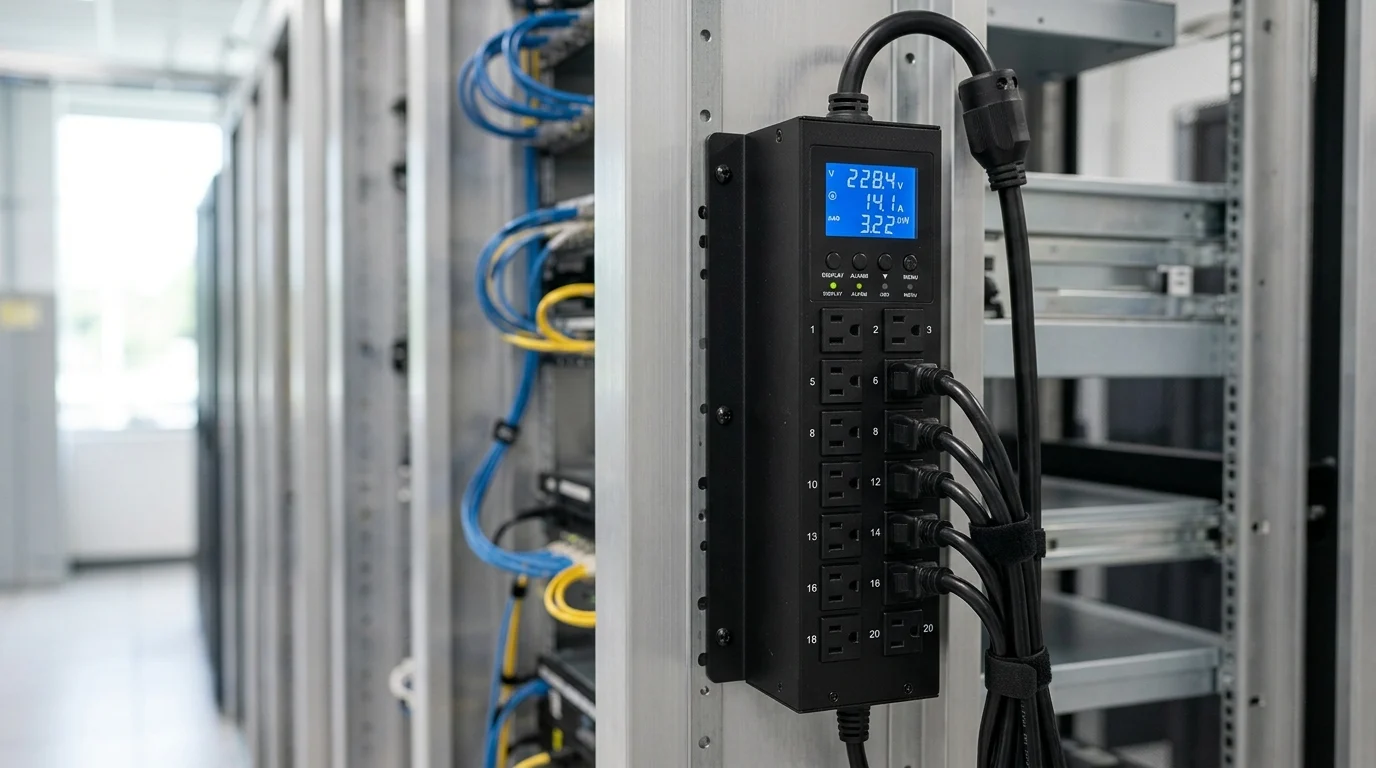
Why Metered PDUs Matter for Power Management
Modern IT environments operate under increasingly stringent power constraints, driven by the escalating density of compute infrastructure. As rack power densities transition from a traditional 4 kW or 6 kW baseline to high-density deployments exceeding 20 kW per cabinet—often reaching 40 kW for specialized AI or high-performance computing (HPC) clusters—precision in power management is no longer optional. Administrators must continuously balance the dual mandates of maximizing infrastructure utilization while preventing catastrophic overloads.
Relying on basic, unmonitored power distribution strips leaves facility managers blind to micro-level power fluctuations. A metered Power Distribution Unit (PDU) bridges this visibility gap by introducing localized, quantifiable data acquisition at the rack level. By capturing precise electrical metrics, these units transform static power distribution into an active component of data center infrastructure management (DCIM), enabling proactive hazard mitigation and optimized capacity planning.
Key power risks in IT environments
The operational continuity of any enterprise data center is constantly threatened by thermal and electrical anomalies. One of the most pervasive risks is the accidental tripping of branch circuit breakers due to phase imbalances or transient load spikes. Under National Electrical Code (NEC) standards in North America, continuous loads must not exceed 80% of a circuit breaker’s rated capacity. For example, a 30A branch circuit is functionally restricted to a 24A continuous draw. Without localized metering, deploying a single high-draw blade server can easily push a rack past this 80% threshold, triggering a breaker trip that instantly severs power to mission-critical hardware.
Furthermore, high-density environments are susceptible to harmonic distortion and poor power factors, which can degrade power quality and stress uninterruptible power supply (UPS) systems. Unbalanced three-phase systems pose a specific hazard; if one phase carries significantly more load than the others, it can cause excessive current on the neutral wire, leading to dangerous thermal runaways. Given that the average cost of unplanned data center downtime can exceed $9,000 per minute, mitigating these electrical risks through continuous monitoring is a fundamental financial imperative.
How metered PDUs improve visibility
Metered PDUs provide the foundational telemetry required to avert these electrical crises. By displaying real-time aggregate current draw directly on the unit’s chassis, they offer immediate, actionable intelligence to technicians working on the data center floor. When a technician installs new server hardware, the metered PDU provides instantaneous feedback, confirming whether the newly added load keeps the total current within the safe 80% operational margin.
Beyond simple current measurement, advanced metered PDUs calculate active power, apparent power, and power factor. This granular visibility prevents “stranded capacity”—a common scenario where facility managers, fearful of tripping breakers due to a lack of accurate data, artificially limit server deployments to 50% or 60% of actual rack capacity. By providing empirical proof of actual power consumption versus provisioned capacity, metered PDUs allow organizations to safely populate racks closer to their maximum safe limits, deferring the massive capital expenditures associated with building new data center floorspace.
What a Metered PDU Measures
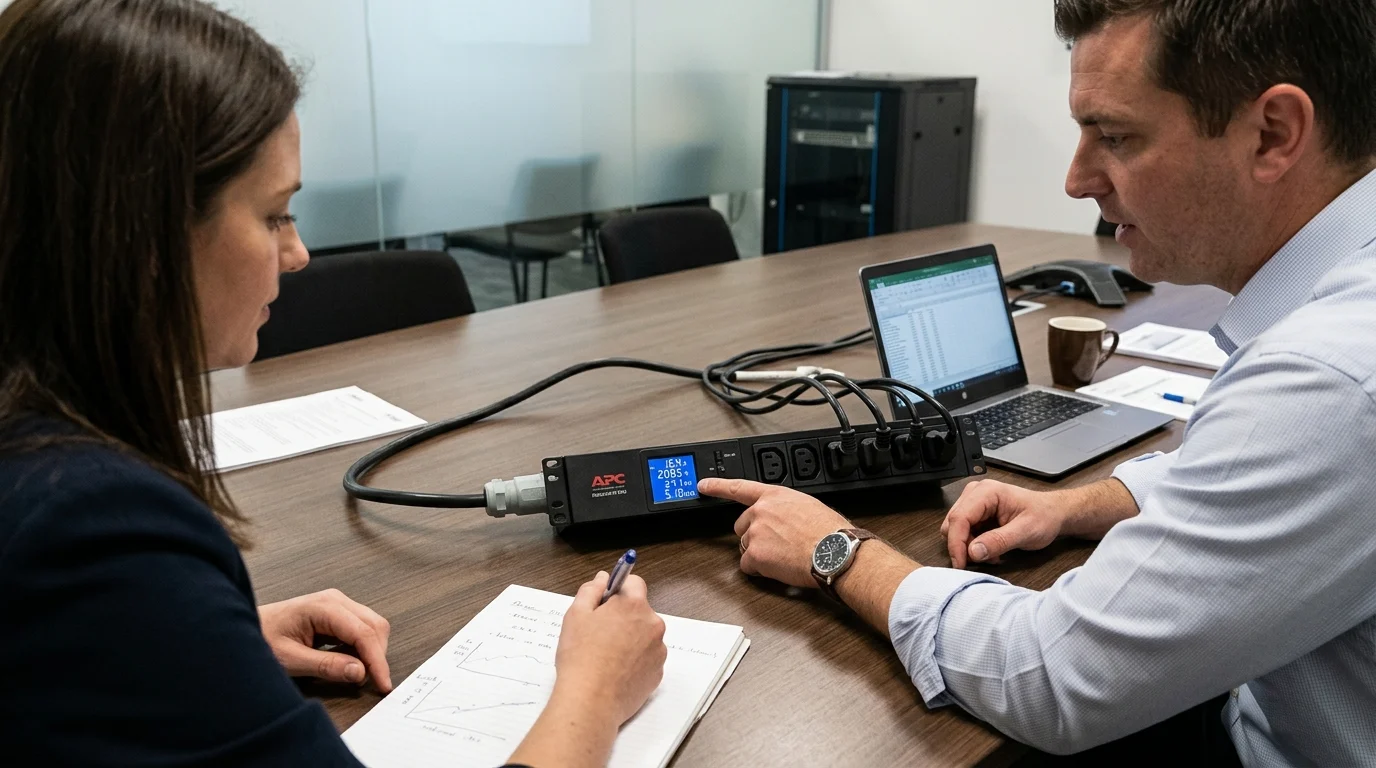
To effectively monitor power consumption, IT professionals must understand the specific electrical parameters captured by intelligent power distribution infrastructure. A metered PDU acts as the primary sensor node at the very edge of the power chain, capturing telemetry exactly where the IT load meets the facility’s power grid. The depth and accuracy of this measurement define the unit’s utility in broader energy management strategies.
While basic PDUs merely pass voltage from the UPS or line power to the receptacles, metered variants incorporate current transformers and digital logic boards. This allows them to sample electrical waveforms multiple times per second, calculating root mean square (RMS) values that accurately reflect the true power drawn by non-linear IT loads.
Metered PDU definition
A metered PDU is a rack-mountable power strip engineered with an integrated digital monitoring interface. Unlike switched PDUs, which include relays to remotely power-cycle individual outlets, a strictly metered PDU focuses solely on telemetry without outlet-level control mechanisms. Its primary function is to aggregate electrical data for the entire unit, or per phase/circuit breaker bank, and display this data via a local LED or LCD screen.
In enterprise specifications, these units are typically manufactured to meet billing-grade accuracy standards. Modern metered PDUs frequently feature ANSI C12.1 Class 1 accuracy, meaning their measurements are accurate to within ±1% across a wide range of operating conditions. This high degree of precision ensures that the power consumption data can be reliably used for capacity planning, efficiency calculations, and internal departmental chargebacks.
Core metrics: volts, amps, watts, and kWh
To provide a complete picture of electrical health, a metered PDU must capture a specific matrix of core metrics. The most fundamental is Amperage (A), which measures the flow of electrical current. Amperage is the primary metric used to prevent breaker trips. Voltage (V) is simultaneously monitored to detect sags or surges from the utility feed; a sudden drop in voltage will cause IT equipment to draw more amperage to maintain the required wattage, potentially pushing a circuit into an overload state.
Beyond basic voltage and current, the PDU calculates Active Power (measured in Watts or Kilowatts), which represents the actual work being done by the servers, and Apparent Power (Volt-Amperes or VA), which represents the total power demanded from the grid. The ratio between these two is the Power Factor (PF). Modern server power supplies typically operate with a highly efficient PF of 0.98 to 0.99, but degraded components can cause this to drop. Finally, the PDU aggregates energy consumption over time, measured in Kilowatt-hours (kWh), which is the standard billing unit used by utility providers and is essential for calculating operational expenditures (OpEx).
Local metering vs remote monitoring
When specifying a metered PDU, a critical architectural decision is whether to rely strictly on local metering or to upgrade to a network-monitored variant. A strictly local metered PDU features a digital display on the chassis but lacks a network interface card (NIC). It requires a technician to physically walk the data center floor to read the metrics, making it suitable for small wiring closets but impractical for hyperscale environments.
Conversely, IP-monitored (or networked) PDUs take the localized data and transmit it over the local area network (LAN) using protocols like SNMP, Modbus TCP/IP, or RESTful APIs. This allows integration with centralized DCIM platforms for remote visibility. The table below outlines the primary distinctions between these two approaches:
| Feature | Local Metered PDU | IP-Monitored (Networked) PDU |
|---|---|---|
| Data Access | Local LED/LCD display only | Remote via web GUI, SNMP, or API |
| Cost Premium | 20-30% over basic PDUs | 80-150% over basic PDUs |
| Alerting Mechanism | Visual alarms (flashing display) | Automated Email, SMS, SNMP traps |
| Data Logging | None (real-time view only) | Extensive historical logging via DCIM |
| Best Application | Small wiring closets, budget racks | Enterprise data centers, remote edge sites |
How Metered PDUs Support Energy Monitoring
The transition from raw data collection to actionable energy monitoring is where metered PDUs deliver their highest return on investment. In an era where data centers account for roughly 1-2% of global electricity demand, optimizing power consumption is both an economic necessity and an environmental mandate. Facility operators rely on PDU telemetry to track their Power Usage Effectiveness (PUE), a critical industry metric.
By utilizing the continuous stream of data generated by metered PDUs, administrators can move from reactive troubleshooting to proactive energy management. This data stream facilitates a comprehensive understanding of how IT loads fluctuate throughout the day, enabling precise adjustments to cooling infrastructure and computational workloads to maintain a target PUE, ideally between 1.2 and 1.5.
Real-time load visibility
Real-time load visibility transforms the daily operations of data center technicians. When new servers, storage arrays, or network switches are provisioned, the initial boot sequence typically triggers a temporary surge in power demand, known as inrush current. Metered PDUs capture these dynamic fluctuations, often utilizing polling intervals as frequent as every 15 to 60 seconds to provide a near-instantaneous view of the rack’s electrical profile.
This real-time feedback loop is crucial during maintenance windows or failover events. If an A/B redundant power setup experiences a failure on the ‘A’ feed, the ‘B’ feed must instantaneously absorb 100% of the rack’s load. Real-time metering allows administrators to constantly verify that the combined baseline load of both feeds never exceeds the absolute capacity of a single branch circuit, thereby guaranteeing that a failover event does not cascade into a secondary breaker trip.
Capacity planning and load balancing
Effective capacity planning relies heavily on the granular data provided by metered PDUs. By analyzing load trends, facility managers can identify underutilized racks and safely deploy additional hardware without the risk of overloading circuits. This data-driven approach unlocks 20% to 30% of stranded power capacity—power that was provisioned and paid for but left unused due to overly conservative safety margins.
Furthermore, in high-density environments utilizing three-phase power, load balancing is a critical operational requirement. If the current draw across the three phases (L1, L2, L3) is severely unbalanced, it leads to power inefficiencies and potential equipment degradation. Best practices dictate keeping the load across all three phases within 10% to 15% of each other. Metered PDUs display the exact amperage draw per phase, allowing technicians to strategically plug standard 120V or 208V single-phase servers into specific outlet banks to maintain optimal phase equilibrium.
Energy reporting with historical data
The aggregation of historical energy data (kWh) is essential for long-term operational analysis and corporate reporting. Network-monitored PDUs transmit cumulative energy usage statistics to centralized management software, creating an auditable trail of power consumption over months and years. This historical context is invaluable for isolating legacy servers that consume disproportionate amounts of power relative to their compute output, signaling when hardware refreshes will yield the best ROI.
Additionally, historical data supports advanced financial and compliance objectives. Organizations can implement accurate chargeback models, billing specific departments or colocation tenants based on their exact, metered energy consumption rather than a flat square-footage rate. For corporate governance, this verifiable data is necessary to comply with international energy management standards, such as ISO 50001, and to furnish accurate Scope 2 emissions data for Environmental, Social, and Governance (ESG) reporting.
Key Metered PDU Specifications
Specifying the correct metered PDU requires a rigorous alignment between the facility’s electrical topology and the IT hardware’s power requirements. A mismatch in specifications can lead to incompatible plug types, insufficient power delivery, or integration failures with existing management software.
Data center architects must evaluate a complex matrix of hardware specifications, ranging from raw electrical input capacities to the sophisticated microprocessors governing the unit’s network interface. Understanding these technical parameters is essential for deploying a resilient and future-proof power distribution architecture.
Input, outlet, phase, voltage, and amperage options
The primary specification for any PDU is its input and output electrical configuration. For standard enterprise racks, single-phase inputs (120V, 208V, or 230V) with amperages ranging from 16A to 30A are common. However, high-density deployments increasingly rely on three-phase power (208V, 400V, or 415V) to minimize cabling and maximize delivery. A 415V three-phase PDU rated at 30A can deliver approximately 21.6 kW of power to a single cabinet, accommodating dense hyperconverged infrastructure or GPU-heavy nodes.
Outlet configuration is equally critical. PDUs feature various combinations of standardized IEC receptacles, predominantly C13 (rated for 10A/15A) for standard servers and C19 (rated for 16A/20A) for high-draw enterprise switches and blade chassis. Advanced metered PDUs now frequently offer high-retention or locking combination outlets (e.g., C13/C19 combo ports), which accept both plug types. This flexibility eliminates the need to replace the entire PDU if the rack’s hardware composition changes over its lifecycle.
Measurement accuracy and display design
The internal architecture governing measurement accuracy separates enterprise-grade PDUs from commodity power strips. High-quality metered PDUs utilize dedicated metering chipsets capable of true RMS calculations, ensuring 1% accuracy (ANSI C12.1 or IEC 62053-21 Class 1) even when power waveforms are distorted by non-linear switching power supplies. This level of precision guarantees that the aggregated data sent to the DCIM platform is structurally sound.
The physical display design also impacts usability. Modern units feature high-contrast OLED or LCD screens that allow technicians to easily read amperage, voltage, and IP address information in dimly lit hot aisles. Furthermore, many enterprise models incorporate an orientation sensor that automatically inverts the display text depending on whether the power feed is coming from overhead busways or raised floor tiles, ensuring optimal readability regardless of the mounting configuration.
Safety, compliance, and integration requirements
Safety certifications and regulatory compliance are non-negotiable specifications for data center hardware. Metered PDUs must carry certifications such as UL 62368-1 (which replaced the older UL 60950-1 standard for IT equipment safety) in North America, or CE marking in Europe. Additionally, compliance with RoHS (Restriction of Hazardous Substances) and REACH is required for global enterprise deployments.
On the integration front, network-monitored PDUs require robust cybersecurity and protocol support. The unit’s network controller should support SNMP v3 for encrypted telemetry polling, alongside RESTful APIs (JSON/HTTPS) for seamless integration with modern orchestration tools. Furthermore, enterprise PDUs frequently include RJ-45 or 1-wire sensor ports, allowing the PDU to act as a hub for environmental monitoring by supporting daisy-chained temperature, humidity, and fluid leak sensors directly integrated into the rack.
How to Choose and Deploy a Metered PDU
Successfully deploying metered PDUs across an IT footprint requires a strategic approach that balances immediate power needs with long-term scalability. Procurement decisions should be driven by rigorous capacity assessments rather than arbitrary budget allocations, as replacing inadequate power infrastructure requires highly disruptive downtime.
A structured deployment methodology encompasses pre-installation load calculations, vendor and feature comparisons, and adherence to physical installation best practices. By standardizing these processes, organizations can ensure high availability and maximize the lifespan of their power distribution hardware.
Assess current load and future capacity needs
The foundational step in PDU selection is calculating the total RMS current required by the hardware slated for the rack. Administrators must aggregate the maximum nameplate power draw of all servers, storage arrays, and network switches, and then apply a realistic derating factor (typically calculating continuous load at 60% to 70% of nameplate maximums, as modern servers rarely run at 100% utilization simultaneously).
Crucially, planners must factor in the NEC’s 80% rule for continuous loads. If the calculated continuous load of the equipment is 18A, deploying a 20A PDU (which is legally derated to 16A continuous) will result in immediate compliance violations and potential breaker trips. In this scenario, a 30A PDU (yielding 24A continuous capacity) must be specified. Additionally, facility managers should forecast hardware refresh cycles over the next 3 to 5 years, provisioning a minimum of 20% overhead capacity to accommodate the inevitable trend of increasing server densities.
Compare cost, monitoring depth, and scalability
Organizations must weigh the depth of monitoring required against the capital expenditure. While a local metered PDU is cost-effective, it creates blind spots in enterprise DCIM architectures. Conversely, fully networked, outlet-level monitored PDUs provide maximum visibility but carry a significant cost premium. To optimize network infrastructure costs, buyers should look for PDUs that support IP daisy-chaining. This feature allows up to 16 networked PDUs to share a single switch port and IP address, drastically reducing the cost of network switches and IP management overhead in the data center.
The following table provides a high-level framework for aligning PDU types with deployment scales and budgetary expectations:
| Deployment Scale | Recommended PDU Type | Estimated Hardware Cost (per rack) | Key Integration Requirement |
|---|---|---|---|
| Single Edge Cabinet | Local Metered | $300 – $600 | Manual logging during periodic physical inspections |
| Multi-Rack Server Room | IP-Monitored (Input-level) | $600 – $1,200 | Basic SNMP integration with Network Management System (NMS) |
| High-Density Enterprise | Monitored (Outlet-level) | $1,200 – $2,500+ | Full DCIM integration via RESTful API, environmental sensors |
Follow best practices for installation and review
Physical installation practices dictate the long-term reliability of the power chain. Metered PDUs are predominantly deployed in a Zero-U vertical form factor, mounting into the rear cable pathways of the server cabinet to preserve valuable U-space for compute hardware. Technicians must ensure that the PDU chassis does not obstruct the exhaust airflow from the servers, which could lead to localized hotspots and hardware failure.
In high-availability configurations, racks must be wired with true A/B redundancy. Best practices mandate color-coding the power paths—for example, utilizing red PDUs and power cords for the ‘A’ feed and blue for the ‘B’ feed. This visual distinction prevents human error during maintenance. Finally, all power connections should be secured using locking C13 and C19 receptacles to prevent accidental disconnections caused by vibration or technician movement, and network modules should be integrated into a strict firmware update schedule to patch emerging cybersecurity vulnerabilities.
Key Takeaways
- Use metered PDUs to monitor rack-level current in real time before adding new servers or high-draw equipment.
- Keep continuous loads within safe limits, such as 24A on a 30A branch circuit under the common 80% capacity rule.
- Track power metrics such as current, active power, apparent power, and power factor to identify overload risk and poor power quality.
- Monitor three-phase rack deployments for load imbalance to reduce neutral conductor stress and thermal risk.
- Use measured consumption data to reduce stranded capacity and safely populate racks closer to their available power limits.
- Choose customizable metered or intelligent rack PDUs when outlet type, 1U format, IEC C13/C19 configuration, or three-phase input must match site requirements.
Frequently Asked Questions
What is a metered PDU used for?
A metered PDU distributes power while showing real-time electrical load, typically at the rack level. It helps technicians verify current draw, avoid overloads, and plan server capacity more accurately.
How does a metered PDU help prevent overloads?
It displays live current and power data so teams can keep continuous loads within safe operating limits, such as the 80% rule commonly applied to circuit capacity.
Why is rack-level power monitoring important in data centers?
Rack densities can exceed 20 kW and sometimes reach 40 kW in AI or HPC environments. Rack-level monitoring helps identify load spikes, phase imbalance, and unused capacity before they create outages.
What electrical values can advanced metered PDUs measure?
Depending on the model, a metered PDU may measure current, voltage, active power, apparent power, power factor, and three-phase load balance.
Can a metered PDU reduce stranded power capacity?
Yes. Accurate consumption data lets operators use available rack capacity more confidently instead of underloading cabinets due to uncertainty about actual power draw.

Newsunn
Post time: Jun-24-2026