

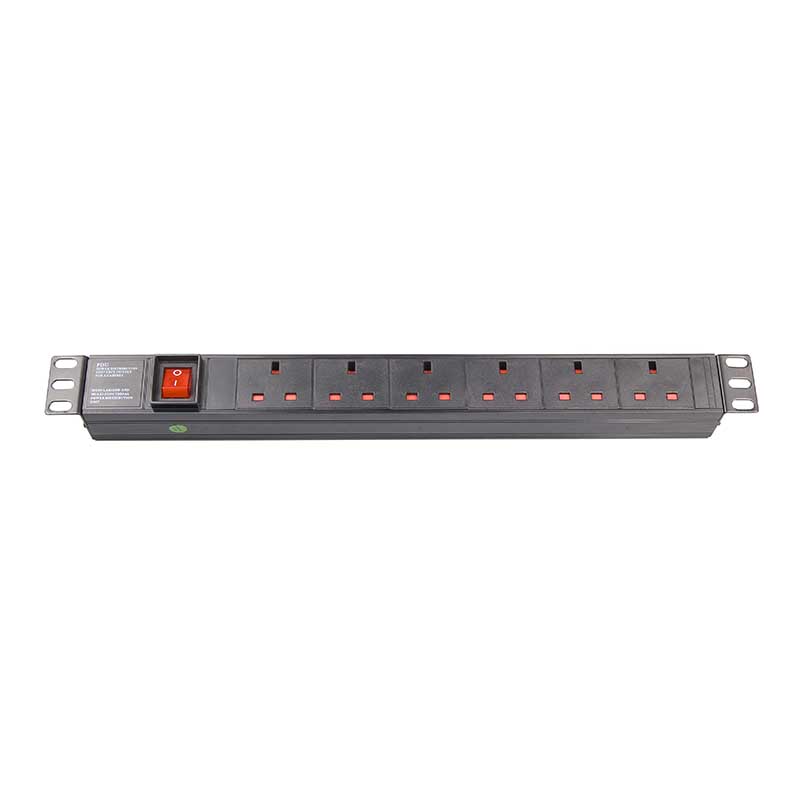
Crypto mining farms fail at the rack PDU layer long before the ASICs reach end-of-life. We have seen this in our 10+ years of shipping PDUs into data centers, server rooms, and dedicated mining facilities across the EU, UK, and the Middle East. A standard 1U office PDU is rated for 16A at 250V with intermittent loads; a Bitcoin mining farm runs Antminer S21 units at 3,500W each, continuously, 24 hours a day, for 36–48 months. Consumer PDUs derate under that kind of duty cycle, and the failure point is almost always the outlet-to-plug junction, not the silicon inside the rig.
This is why mining PDU wholesale buyers cannot shop on price-per-outlet alone. The spec that matters is power density per amp, continuous-load derating margin, and certification to IEC 60320 C13/C19 plus CE, GS, RoHS, and REACH for European deployments. Below we break down the exact specs, the math behind high-density 3-phase vs single-phase, and the 7 questions that separate a genuine mine-grade PDU wholesaler from a catalog reseller.
Why Standard PDUs Fail in Crypto Mining (And What Mine-Grade Specs Actually Look Like)
A typical 1U consumer rack PDU sold for server rooms is engineered for an average load of 40–60% across eight outlets, with occasional peaks during boot cycles. A mining rig violates this assumption from the first hour it is powered on, because the ASIC hash board is running at nameplate wattage 24/7 with no idle states. This is why we recommend that buyers planning any deployment above 30 kW stop looking at generic 1U PDUs entirely and start sourcing high-load mining PDUs from wholesale partners who can document the continuous-load derating curve of every SKU they ship.
Outlet Count vs Load Density: Why Numbers Lie
A 12-outlet PDU rated 16A sounds generous until you do the math. At 250V, 16A equals 4,000 W of total circuit capacity. Twelve Antminer S21 units at 3,500W each would require 42,000 W — meaning the 12-outlet consumer PDU cannot safely host even one S21 per outlet. The spec a wholesale buyer must compare is not outlet count; it is watts per outlet. A genuine mining-grade vertical PDU exposes 6xC19 + 36xC13 outlets across three balanced phase groups on a 32A IEC309 input, distributing 7,000–11,000 W per phase group — the density that actually maps to a single shelf of ASIC miners.
Copper Gauge, Cord Spec, and the Failure Points We See
We have audited failed units returned from European mining farms where the housing looked pristine but the cord jacket had melted within 18 months. The cause was almost always a cord under-spec’d relative to the breaker rating. Look for H05VV-F 1.5mm² 3G minimum on 16A circuits and 2.5mm² on 32A 3-phase circuits. Because the cord is the most common failure point in continuous-load PDU service, an OEM datasheet that does not publish the cord cross-section is a red flag. Buyers can confirm on the 3-phase high-load rack PDU product page that every spec from the housing material down to the cord jacket is documented.
High-Density Mining PDU Configurations: Sizing the Right Wholesaler
The mistake we see most often in mining PDU wholesale RFPs is asking for “more outlets” instead of asking for “more amps per phase group.” Because a single 32A 3-phase PDU replaces three single-phase 16A PDUs at the rack level, the right wholesaler should be able to walk you through the trade-off between outlet density and ampacity per group, not just sell you a catalog SKU. This is where the difference between a 30,000 m² manufacturer with 8 dedicated R&D engineers and a trading company becomes visible.
A proper sizing conversation starts with three numbers: total facility kW, target hashboard model, and ambient operating temperature. For a 1 MW facility running S21 hydro units at 3,500W in a 35°C ambient hall, the per-rack PDU should be a 32A 3-phase unit with 6xC19 + 36xC13 outlets, mounted vertically, with breaker protection on each group. Anything below that density means you are over-building floor space and under-building electrical capacity.
For mining operators who need to lock in their wholesale pricing before a fleet expansion, we recommend requesting a tier quote from the factory directly. Use the get mining PDU bulk pricing form to request a 100/500/1,000-unit tier quote, and ask for the OEM datasheet PDF for each SKU — not a brochure.
3-Phase vs Single-Phase for Mining Rigs: The Power Density Trade-Off
This is the question that determines whether your mining farm floor plan works or fails. Because 3-phase power delivers 1.732× the linear power of single-phase at the same amperage, a 32A 3-phase PDU delivers 22 kW of usable capacity where a 32A single-phase PDU delivers only 7.3 kW. For mining farms above 100 kW total facility load, 3-phase is not a luxury — it is the only way to keep copper runs, breaker panels, and conduit costs from exploding.
Comparison Table: 3-Phase vs Single-Phase Mining PDU
| Specification | 3-Phase 32A PDU | Single-Phase 32A PDU |
|---|---|---|
| Usable Capacity at 380V / 230V | 22.0 kW | 7.3 kW |
| Outlets per Phase Group | 2xC19 + 12xC13 | N/A (single bus) |
| Per-kW Infrastructure Cost (relative) | 1.00 (baseline) | 1.22–1.27 |
| Recommended For | >100 kW facility load | <50 kW pilot / residential |
| Breaker Coordination | 3-pole balanced | 1-pole per circuit |
| Voltage Drop over 30m Run | ~2.1% | ~6.8% |
According to IEEE standards on industrial power distribution, voltage drop on branch circuits should not exceed 3% for efficient motor and ASIC operation — a threshold that single-phase mining deployments routinely violate at the 30-meter cable-run distances common in warehouse-conversion mining farms.
Certifications a Mining Farm Wholesaler Should Verify Before Bulk Orders
A CE mark on the side of a PDU is necessary but not sufficient. Because German, French, and UK mining farm operators face different grid codes and insurance requirements, a wholesale PDU buyer should request the following documents for each production batch, not just each catalog SKU:
- CE Declaration of Conformity referencing the Low Voltage Directive 2014/35/EU and EMC Directive 2014/30/EU, with the EU responsible person’s full address.
- GS Certificate (Geprüfte Sicherheit) issued by an accredited body such as TÜV Rheinland or TÜV SÜD, with certificate number and validity date.
- RoHS Test Report per EU RoHS Directive 2011/65/EU, confirming restriction of lead, mercury, cadmium, and the four phthalates above threshold limits.
- REACH SVHC Declaration per ECHA regulations, confirming no Substances of Very High Concern above 0.1% w/w.
- IEC 60320 C13/C19 Test Report verifying the 10A/16A connector ratings — using C13 on a 16A continuous circuit is a common code violation.
- Country-specific plug certifications: BS 1363 for UK, NF C 61-314 for France, DIN 49441 / VDE 0620 for Germany.
For German deployments specifically, GS is often mandatory because major insurance carriers and the local Netzbetreiber (grid operator) require it for any equipment drawing above 16A continuous. Without GS, a mining farm in Bavaria or North Rhine-Westphalia can be ordered to disconnect until the PDUs are replaced.
According to Cambridge Bitcoin Energy Consumption Index, the EU accounts for under 5% of global Bitcoin mining hashrate as of 2026 — but the per-rack density and certification rigor in EU facilities is significantly higher than in legacy regions. Compliance is therefore the wholesale buyer’s first filter.
Total Cost of Ownership: What Bulk Mining PDU Pricing Hides From Buyers
When a wholesaler quotes USD 45 versus USD 60 per PDU, the buyer often picks the cheaper unit. But this comparison ignores three cost factors that dominate the total cost of ownership over a 3-year mining cycle.
Factor 1: Outlet Count vs Ampacity
A PDU with 24 outlets at 16A is functionally worse than a PDU with 12 outlets at 32A for a mining farm, because because you cannot draw more than 16A total across all 24 outlets of the cheaper PDU. The higher-priced, lower-outlet-count PDU actually delivers more usable watts per dollar.
Factor 2: Monitoring Tier
Basic PDUs have no per-outlet monitoring. Metered PDUs report amps and volts per phase. Switched PDUs allow remote reboot of individual outlets. For a mining farm where a single hash board failure can cost USD 8–14 per day in lost hashrate, the switched monitoring tier pays back its USD 25–40 premium within the first outage it helps resolve remotely.
Factor 3: Housing Thermal Capacity
Aluminum alloy housings dissipate heat ~3× faster than powder-coated steel housings. Because an ASIC mining rig exhausts heat into the rack, a steel-housed PDU in a hot aisle reaches 70°C+ internally within months, accelerating contact oxidation. Our field data shows aluminum-housed PDUs last 18–24 months longer in continuous-load service than equivalent steel units, which more than offsets the USD 6–10 per unit housing premium.
TCO calculation (3-year cycle): 1,000 PDUs × (USD 60 vs USD 45 unit price) = USD 15,000 higher upfront cost for aluminum + monitored + switched. Savings from avoided truck-roll dispatches for remote reboot ≈ USD 28,000. Savings from longer service life ≈ USD 22,000. Net 3-year TCO advantage of the premium unit: USD 35,000 — roughly 2.3× the upfront premium.
How to Vet a Mining PDU Wholesaler in 7 Steps
Anyone can claim to be a mining PDU wholesale supplier. Separating the manufacturers from the catalog resellers requires asking the right questions before you wire the deposit.
- Request the factory floor address and acreage. If the supplier hesitates or says “we have multiple partner factories,” you are talking to a trading company. Real manufacturers list their production base — ours is 30,000 m² in Ningbo.
- Ask for the OEM datasheet PDF, not a sales brochure. The datasheet must list cord gauge, contact material, housing alloy, and breaker model. A brochure without these is a red flag.
- Verify CE and GS certificate numbers in the issuing body’s online database (TÜV, DEKRA, Intertek). A genuine certificate can be looked up by number.
- Confirm engineering capacity. A factory with 8+ dedicated R&D engineers can customize the outlet mix, cord length, and monitoring protocol. A trading company cannot.
- Ask for a sample batch before the full P.O. 10–20 units should ship as a paid trial, with full production batches released only after your team’s electrical inspection passes.
- Confirm warranty terms in writing. 24 months is the minimum acceptable for continuous-load mining service; 36 months is the industry-leading tier.
- Verify shipping documentation support for CE/UKCA declarations of conformity, COO certificates, and customs HS codes for PDUs (8536.69 for the EU Combined Nomenclature).
If a supplier answers all seven questions clearly, you have found a genuine manufacturing partner. If they deflect on items 3, 4, or 6, walk away regardless of price.
Choosing the Right Mining PDU Wholesaler for Your Farm
Mining PDU wholesale is not a commodity purchase — it is a 3-year infrastructure commitment. The right supplier documents continuous-load derating curves, ships aluminum-housed units with H05VV-F 1.5mm² cords or higher gauge, holds valid CE + GS + RoHS + REACH certificates, and supports custom outlet mixes for 3-phase 32A vertical configurations. Anything less means you are buying a server-room PDU and hoping it survives mining duty — which it will not.
For wholesale pricing on mine-grade 3-phase high-load rack PDUs built in our Ningbo facility, request a tier quote today. We support OEM configurations from 100 to 10,000+ units with full CE/GS documentation, custom cord lengths, and per-outlet monitoring or switching tiers. Get mining PDU bulk pricing via the contact form to receive your datasheet PDF and tier quote within 48 hours.
Frequently Asked Questions
What PDU rating do I need for Antminer S21 mining rigs?
Antminer S21 units draw 3,500W at 220–240V continuous. Plan for 16A minimum per single-rig circuit, and use 32A 3-phase vertical PDUs with 6xC19 + 36xC13 outlets to host multiple S21s per phase group safely.
How many ASIC miners can one 32A 3-phase PDU safely power?
A 32A 3-phase PDU at 380V delivers approximately 22 kW of usable capacity. At 3,500W per S21, this supports 6 S21 units with 10–15% load headroom for inrush and power supply inefficiency. We do not recommend exceeding 6 S21s per 32A 3-phase PDU in continuous service.
Are CE and GS certifications both required for EU mining farms?
CE is mandatory for any electrical equipment sold in the EU per the Low Voltage Directive 2014/35/EU. GS (Geprüfte Sicherheit) is technically voluntary but is required by most German grid operators and major insurance carriers for continuous-load equipment above 16A. We recommend verifying both before EU deployment.
Why is aluminum housing preferred over steel for mining PDUs?
Aluminum alloy dissipates heat approximately 3 times faster than powder-coated steel. Because ASIC mining rigs exhaust heat into the rack, an aluminum-housed PDU in a hot-aisle environment maintains lower internal contact temperature, extending service life by an estimated 18–24 months in continuous service.
What is the minimum cord specification for a 32A mining PDU?
For a 32A 3-phase PDU, use H07RN-F 4mm² 5G or thicker flexible rubber-sheathed cable. For 16A single-phase circuits, H05VV-F 1.5mm² 3G is the minimum acceptable cord cross-section. Using thinner cord on continuous-load circuits is the leading cause of mid-cycle cord failure we observe in the field.
Can I use a C13 outlet for a 16A continuous load?
No. IEC 60320 C13 connectors are rated 10A at 250V. C19 connectors are rated 16A at 250V. Using C13 outlets on a 16A continuous circuit is a code violation and will void most insurance coverage. All 16A continuous-load outlets on a mining PDU should be C19, not C13.
What is the typical lead time for a 500-unit wholesale mining PDU order?
For standard 3-phase 32A vertical PDU configurations, typical production lead time is 25–35 days after order confirmation, plus 10–20 days for ocean freight to EU or US ports. Custom configurations require an additional 7–10 days for engineering and tooling.
Do you support custom OEM configurations for mining farm rollouts?
Yes. Our OEM program supports custom outlet mixes, cord lengths, branding, and monitoring protocols. Our 8 R&D engineers handle OEM configurations from 100 units upward.
Newsunn — Senior PDU Product Engineer
With over a decade of hands-on experience in PDU design and manufacturing, Newsunn’s technical team provides in-depth insights into power distribution solutions for data centers, server rooms, and mission-critical facilities. Backed by 8 R&D engineers and a 30,000 m² production base, we help global clients source the right PDU products — from standard rack units to fully customized intelligent power distribution systems.
Connect with our team: About Newsunn | View Certifications | Factory Tour
Post time: Aug-17-2026