

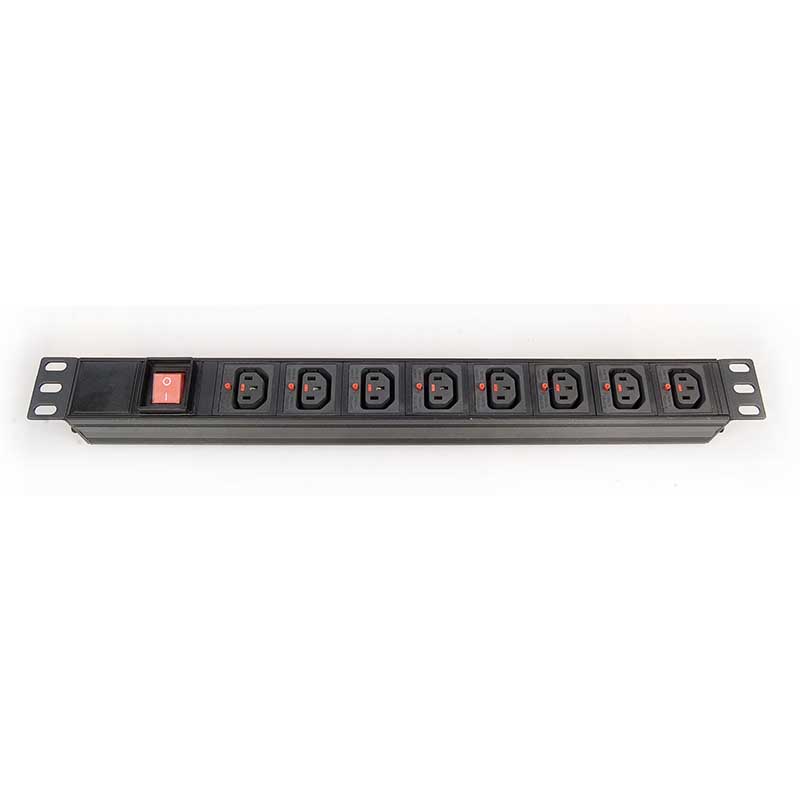
A universal IEC PDU for global rollout is one 19-inch rack PDU platform whose outlet side never changes and whose input side always does. The outlets stay IEC C13 at 10 A and 250 V and IEC C19 at 16 A in Europe and 20 A in North America, both defined by IEC 60320, while the input becomes a national cord set. The rack is built once and the wall interface is chosen just before the container ships.
Quick answer
- A universal IEC PDU standardizes the rack side, not the wall side. C13 and C19 are identical in every IEC country; the wall plug is not.
- One platform plus a cord library replaces up to twelve country SKUs, because only the input end moves.
- C13 alone fails at density: a 2,000 W supply draws 16.7 A at 120 V against a 10 A C13 rating, but 8.7 A at 230 V.
- A 20 A circuit behaves like 16 A under the continuous-load rule, so plan against 80 percent of the breaker.
- One design never means one certificate: each report attaches to a plug and a standard sheet, not a chassis.
We build these in Ningbo, and the request that keeps arriving is not “design us a PDU” but “we are opening four countries and do not want four spare-part catalogues”. The chassis range is on our global deployment PDUs page.
What Does “One PDU for Global Rollout” Actually Mean?
A universal IEC PDU for global rollout is a rack PDU that keeps one chassis, one outlet plate and one control board in every country, and localizes the plug, the cord set and the voltage label.
The socket a PDU plugs into is national, not international. Because the wall socket is regulated country by country, no PDU can carry one global wall plug, so standardization has to happen inside the rack. Our envelope is fixed at 482.6 × 44.4 × 44.4 mm, aluminium alloy or sheet metal, 0 to 60 °C. Because those figures hold across variants, so tooling and qualification are paid for once.
Why IEC C13/C19 Travels and National Sockets Do Not
IEC C13 and C19 are the only outlet family that is genuinely multi-country, because they are appliance couplers rather than wall sockets, so the national interface lives on the cord. According to Interpower’s reference on IEC 60320 inlets, C13 is rated 10 A at 250 V AC at a 65 °C contact temperature and C19/C20 is rated 16 A in Europe and 20 A in North America, so one device can be built and the country cord fitted before shipment.
The wall patterns are a list of incompatibilities: BS 1363 at 13 A fused, CEE 7/3 Schuko and Type E at 16 A, NEMA 5-15 and 5-20 on 125 V, JIS C 8303 at 100 V, AS/NZS 3112 and NBR 14136. Because each needs its own mould, fuse or shutter and its own safety file, so a national-socket “global” PDU is eight products under one catalogue entry.
The Voltage and Frequency Problem the Connector Cannot Fix
The coupler is voltage-agnostic inside its 250 V rating, but the circuit behind it is not, because current rating, breaker curve and cord gauge follow the local feed. A 2,000 W supply draws 16.7 A at 120 V, above a 10 A C13, so it needs a C19 or a 208 V feed where it draws 9.6 A; at 230 V it draws 8.7 A. Because the outlet plate is the part we change per build, so the C13-to-C19 ratio is where flexibility is won.
Frequency is the quieter trap: our metering board is calibrated for the frequency it will see, so a unit set at 60 Hz reads a few percent high at 50 Hz. Three-phase breaks the promise most often, because 208Y/120 V and 400Y/230 V differ in phase-to-neutral voltage and plug clock position.
Three Input Architectures, and the One I Recommend
There are three ways to make a PDU input global, and each trades cost against flexibility.
The three architectures, ranked for a multi-country rollout
- Fixed national plug, moulded at the factory. Lowest unit cost and cleanest certification, because plug and cord are one approved assembly. Right for single-country volume, wrong for a rack that moves.
- Detachable C20 inlet plus a locally certified cord set. One platform part number and a small cord library. Because the C20 inlet carries 16 A, and 20 A in North America with a rated assembly, so it never becomes the bottleneck. My default, provided the cord carries the destination’s approval mark and the inlet is labelled with its wired voltage.
- Universal multi-standard outlet socket. Accepts UK, Schuko, US and Chinese plugs in one face for retrofits and mixed labs. Not a substitute for a nationally approved interface, and normally 10 A per outlet.
The detachable route fails for human reasons: someone carries a UK cord to a German site. Keyed cords and an inlet voltage label are the controls that work, because a wrong cord is the one failure the factory cannot catch, so the label is a safety device.
The Country Matrix We Quote From
Nine wall interfaces cover almost every rollout we supply, and the outlet side never changes.
| Market | Wall interface | Typical rating | PDU input variant |
|---|---|---|---|
| United States, Canada | NEMA 5-20P or L6-20P | 20 A, 120 V or 208 V, 60 Hz | Fixed NEMA, or C20 + NEMA cord |
| United Kingdom | BS 1363, fused plug | 13 A, 230 V, 50 Hz | Fixed UK plug, or C20 + UK cord |
| Germany, most of EU | CEE 7/3 Schuko | 16 A, 230 V, 50 Hz | Fixed Schuko, or C20 inlet |
| France, Belgium | Type E | 16 A, 230 V, 50 Hz | Fixed Type E, or C20 inlet |
| Australia, New Zealand | AS/NZS 3112 | 10 A or 15 A, 230 V, 50 Hz | Fixed AS/NZS plug, or C20 inlet |
| Japan | JIS C 8303, NEMA 5-15 | 15 A, 100 V, 50 or 60 Hz | Fixed JIS plug, or C20 inlet |
| India | IS 1293 | 6 A or 16 A, 230 V, 50 Hz | Fixed IS plug, or C20 inlet |
| Brazil | NBR 14136 | 10 A or 20 A, 127 V or 220 V, 60 Hz | Fixed NBR plug, or C20 inlet |
| Above 16 A, Denmark, Switzerland | IEC 60309 pin and sleeve | 16 A to 32 A, 230 V or 400 V | Fixed IEC 60309, three-phase available |
Japan runs at 100 V, so a load sized on 120 V draws about 20 percent more current there; Brazil runs 127 V and 220 V in one country, so the inlet label beats the catalogue sheet.
Universal Outlet Types: Where They Help and Where They Are the Wrong Call
A universal outlet PDU is the right tool for a retrofit and the wrong tool for a greenfield compliance requirement. Our universal outlet types builds exist because many projects in Asia, Africa and Latin America inherit mixed-vendor racks with locally bought cords.
They help on retrofits with unknown equipment, on lab benches, and on containerised deployments that cross borders. They are wrong in a UK fixed installation, because BS 1363 relies on a fused plug and shuttered socket that a multi-standard face does not reproduce, and wrong above 10 A per outlet.
Certification: One Design, Several Certificates
The engineering saving is real, and the compliance saving is smaller than buyers expect, because a certificate attaches to a plug and a standard sheet rather than to a chassis. The same build needs a UL or CSA report under UL 62368-1, harmonized with IEC 62368-1:2018, a CE declaration, a UKCA file, and PSE, KC, RCM, BIS or INMETRO where those markets apply.
The EU route is governed by Directive 2014/35/EU; the coupler is assessed under IEC 60320-1:2021, and above 16 A the installation moves to pin-and-sleeve devices under IEC 60309-1:2021.
What Variant Sprawl Actually Costs You
Consolidating variants saves work in three places, and only one shows up in the unit price. Each variant needs its own approval route, mould or socket plate, and safety stock, so a ten-country catalogue ties up ten minimum quantities.
A twelve-variant programme carries roughly four times the certification workload and stock positions of a three-variant programme, primarily because every variant needs its own safety file and minimum quantity, not because the hardware is harder to build. I am deliberately not putting money against that ratio: the per-variant figure depends on the notified body, the market and the year.
Decision Framework: Labels, Spares and Architecture
Most global rollout failures are labelling failures, and they happen in the last two days before commissioning. Label the feed rather than the platform, hold one cord bin per part number regionally, and test from breaker to PDU before the servers go in.
Which input architecture fits your rollout
- Choose a fixed national plug when the programme is single-country, the volume is high and the racks stay in that building for life.
- Choose a detachable C20 inlet plus a cord library when you deploy in three or more countries and can enforce a cord part number and voltage label.
- Choose a universal multi-standard socket when the site is a retrofit or lab with unknown equipment and the load stays at or below 10 A.
- Do not standardize globally when the deployment is one site with fewer than about twenty racks, because the cord library costs more than the variant savings return.
Conclusion: Standardize the Rack, Localize the Wall
C13 and C19 give a rack side identical in every IEC country; a C20 inlet or national plug gives an input side compliant in exactly one. A rollout that fixes the outlet plate and treats the cord as a locally certified accessory gets one design, one set of drawings and one qualification file, with a nine-item cord library doing the work twelve export SKUs used to do.
Label the inlet with its wired voltage, keep the cord library under a part number, and ask which standard sheet each certificate covers. Do that and the fourth country becomes a purchase order, not a redesign. Our 19-inch rack PDU products page lists the configurations.
Planning a multi-country rack rollout?
Send the countries, feed ratings and equipment list, and we will size the platform, outlet mix and cord library for each site.
Frequently Asked Questions About Universal IEC PDUs for Global Rollout
What is a universal IEC PDU for global rollout?
It is a 19-inch rack PDU whose outlet side is fixed to IEC 60320 C13 outlets at 10 A and 250 V and C19 outlets at 16 A in Europe and 20 A in North America, while the input side is localized with a national plug or a detachable C20 inlet plus a certified cord set. The chassis and outlet plate stay identical, so one design serves 120 V, 208 V, 230 V and 400 V sites.
Can one PDU really work in the United States, the United Kingdom and Germany?
The rack side works unchanged, because C13 and C19 accept the same coupler in all three countries, but the input cannot be the same device. The United States needs NEMA 5-20P or L6-20P on 120 V or 208 V, the United Kingdom needs a BS 1363 fused plug on 230 V, and Germany needs a CEE 7/7 cord set on 230 V, so you buy one platform and three cord sets.
Is a universal socket PDU a substitute for country-specific cord sets?
No, and treating it as one is the most common compliance mistake we see. A universal socket accepts several plug patterns, usually at 10 A, but it does not reproduce the fused plug and shuttered socket construction BS 1363 installations rely on, and it cannot deliver a 16 A C19 connection. Universal sockets are a retrofit tool, not a replacement for a nationally approved interface.
Why specify C19 outlets when C13 is the standard outlet?
Because the current arithmetic forces it on high-density racks. A 2,000 W power supply draws 16.7 A at 120 V, above the 10 A rating of a C13, so that load needs a C19 outlet or a 208 V feed where it draws 9.6 A. Most of our builds mix C13 and C19 in one plate, with the C19 count set by the highest-wattage equipment in the bill of materials.
How does the 125 percent continuous load rule change outlet selection?
It removes 20 percent of a circuit’s nominal capacity from your planning, because a branch circuit must be rated at not less than the noncontinuous load plus 125 percent of the continuous load. A 20 A North American circuit therefore carries 16 A of continuous load, so a rack drawing 16 A continuously needs a second feed or a higher-rated circuit.
Does one PDU design mean one certification?
It does not. The safety file follows the plug and the standard sheet it is assessed against, so the same chassis needs a UL or CSA report for North America, a CE declaration under the Low Voltage Directive, a UKCA file for Great Britain, and PSE, KC, RCM, BIS or INMETRO where those markets apply. The construction is reused, but the plug annex and national marking are new work for every market.
With over a decade of hands-on experience in PDU design and manufacturing, Newsunn’s technical team provides in-depth insights into power distribution solutions for data centers, server rooms, and mission-critical facilities. Backed by 8 R&D engineers and a 30,000 m² production base, we help global clients source the right PDU products, from standard rack units to fully customized intelligent power distribution systems.
Last verified: 2026-11-05. Mechanical and environmental values, outlet families and input variants are as published for the Newsunn 19-inch IEC C13 C19 rack PDU range. Current figures are arithmetic from watts and nominal voltage. No pricing or cost figures are published here; commercial figures are quoted per project. Certification scope must be confirmed per destination market, and site voltage and feed rating verified on site.
Post time: Nov-05-2026