

TL;DR
- Outlet-level metering does not pay for itself. Outlet-level action does. Our four published function models separate the two, and the case is built on switching, not on the sensor.
- Unit-level metering tells you what the rack drew. Outlet-level metering tells you which device drew it. Only the second one lets you remove a load you have identified.
- Four value terms carry a metered PDU upgrade — avoided energy, avoided capacity, avoided truck rolls, avoided over-provisioning — and each has a precondition that must be true before it can be booked.
- The granularity you need is set by the action you will take. Remote reboot may need only unit-level switching; shedding a 300 W server needs outlet-level switching.
- A saving you cannot verify is not a saving. Measurement and verification has to be agreed before the install, not reconstructed when the invoice arrives.
The ROI of outlet-level metering is not a function of the meter, it is a function of the action you can take afterwards. Our published function models separate the two: Type B is total metering with total switching, Type C adds individual outlet metering without outlet switching, and Type A adds outlet switching as well. The upgrade ladder runs from visibility to actuation, and the payback sits wherever your operation can actually act. Build the case from four value terms, each with a stated precondition.
The question gets asked badly because “metered PDU” covers products that differ by more than price. A PDU reporting total current, total kW and total kWh tells you what a rack drew. A PDU reporting the same three per outlet tells you which server drew them, and only the second one lets you do anything about it. Having watched buyers specify a top-end unit for a site with no remote actuation, no change process and no defined baseline, the pattern is consistent enough that we would rather put the ROI math in the open, including the parts that do not work in your favour.
What the four published function models actually change
Our intelligent PDU range is published as four function models, and the difference between them is not a feature list, it is the amount of control the product gives you over the load.
| Function | Type A | Type B | Type C | Type D |
|---|---|---|---|---|
| Total metering: load current, kW, kWh, voltage, frequency | Yes | Yes | Yes | Yes |
| Total switching | Yes | Yes | No | No |
| Individual outlet metering | Yes | No | Yes | No |
| Individual outlet switching | Yes | No | No | No |
| Temperature and humidity, door, smoke and water-logging sensing | Yes | Yes | Yes | Yes |
| Threshold alarms on total load current | Yes | Yes | Yes | Yes |
| Threshold alarms on individual outlet load current | Yes | No | Yes | No |
| Sequential on/off, per-outlet scheduling, per-outlet limit setting | Yes | No | No | No |
Because Type C carries per-outlet threshold alarms but no per-outlet switching, it can raise a warning about a specific outlet and still not be able to do anything about it, and that gap is where most disappointing metered-PDU projects come from.
Everything else is common to all four. The controlling module carries an LCD display, a network port, a USB-B port, a serial RS-485 port, temperature and humidity port, sensor port and digital I/O, with HTTP, SNMP v1 and v2, Modbus TCP/IP and RTU, FTP, IPv4 and Telnet support, and firmware downloadable over the network. Our 1U 6-way C13 outlet-metered and switched unit is built to 63 A maximum total load current with up to 48 outlets and ships with a three-year limited warranty.
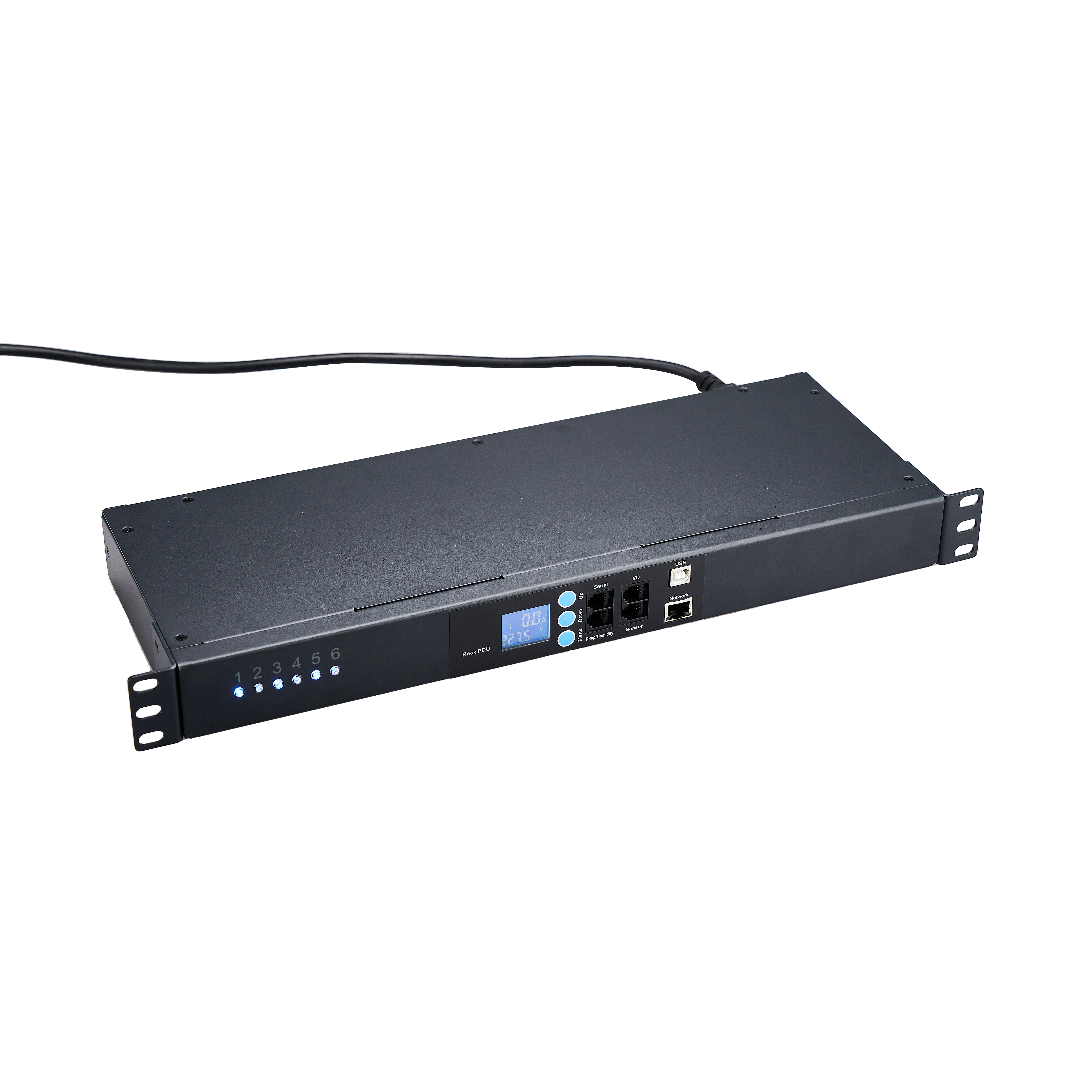
The ROI math: four value terms and the condition attached to each
The upgrade case is built from four terms, and the mistake is adding all four when only some of them are claimable at your site.
One, avoided energy. The waste you can now see and remove: idle servers left running, duplicated test load, a forgotten bench drawing power. The precondition is somewhere to switch the offending outlet, which means Type A, because a Type C unit can identify a wasting outlet and cannot switch it.
Two, avoided capacity. If your tariff carries a demand component, shedding load you have identified at peak moves the bill more than a small energy saving does. The precondition is again actuation: you must be able to switch a specific device at a specific time, not merely know it draws 180 W.
Three, avoided truck rolls. A remote power cycle on a hung server removes a site visit. The precondition is remote switching, and the granularity question changes here: if the symptom is a dead server, unit-level switching is enough and Type B may suffice. If the symptom is one bad PDU in a rack of twenty, you want Type A.
Four, avoided over-provisioning. Outlet attribution is what lets you size the next build on measured draw rather than nameplate, and it is the one term that pays back without anyone changing a running procedure. The precondition is design-time discipline rather than operation, and Type C is enough to claim it.
Because each term carries its own precondition, the honest payback is the one-time cost divided by the monthly value of the terms whose precondition is already true, and a buyer claiming all four on day one is usually claiming the two they cannot action.
Why outlet metering without switching is a different product
Type C is the most mis-specified product in this category, because it is bought as an upgrade and used as a report.
Outlet metering with no outlet switching gives per-outlet attribution and alarms, and it is genuinely valuable in two situations: a design team needing measured draw to size the next build, and an operations team with a change process but no remote actuation, where attribution is the input to a ticket rather than the trigger for one.
It is close to worthless in a third, which is the most common one. A site with no change authority, no scheduling and no remote reboot capability will receive per-outlet data, look at it once during commissioning, and fall back to the total. Because in that case the outlet channels cost money and change nothing, the correct specification is a unit-level metered and switched unit, and buying outlet metering is paying for a feature with no owner.
The cost side of the equation
The hardware delta is the line most people quote and the line least likely to be the largest.
A unit-to-outlet step adds measurement and switching hardware per channel, and on our range that sits inside the same enclosure and controller, so it is a specification change rather than a redesign. The larger lines are elsewhere: integrating the PDU into your DCIM or building management platform and proving the data lands in the system your people actually open; commissioning the sensors and alarms; and writing the operating procedure that says who may switch what, when, and how it gets logged.
A fourth cost appears only in the first year and decides whether the project survives: the risk of the change itself. Rolling out new switching authority at a live site means the first remote action is usually a mistake, and the cost of a mistake on a switched outlet is a server that did not come back.
Because the hardware has the smallest range of outcomes and the procedure and integration have the largest, a buyer evaluating only the unit price of a metered versus an outlet-metered PDU is optimising the one term they control least.
Making the saving claimable: accuracy, calibration and verification
An energy saving that cannot be verified is an opinion, and opinions do not survive a budget review.
The method is published. ISO 50015:2014, Energy management systems, Measurement and verification of energy performance of organizations, establishes general principles and guidelines for the process of measurement and verification of energy performance of an organization or its components, and applies to all types of energy. Because that standard asks you to fix the baseline and the measurement approach first, the honest sequence is to agree the baseline, the measurement plan and the sign-off route before the hardware is ordered, not to reconstruct them after the invoice.
Accuracy needs to be specified in a checkable form, and one distinction is worth keeping straight. Directive 2014/32/EU, the Measuring Instruments Directive, applies to active electrical energy meters as MI-003 in its Annex V, with accuracy classes set as essential requirements and conformity assessment carried out by notified bodies. That governs meters placed on the market as measuring instruments. A per-outlet channel inside a PDU is a monitoring device, not a revenue meter, and a supplier who blurs that distinction in a proposal is telling you something about the rest of the proposal.
Then the calibration chain. ISO/IEC 17025:2017 sets the general requirements for the competence of testing and calibration laboratories, and the question worth asking a supplier is not what accuracy their meter claims but which laboratory produced the number and whether it is traceable to a national standard. Our own published test regime, on our product advantages page, applies the same discipline to safety rather than metering: a 2,000 V hi-pot test, a ground and insulation resistance test, a 48-hour online aging test, a load test at 120% of rating, and 100% hi-pot testing on every outlet. Because a factory that publishes its safety test regime will usually publish its calibration method for metering if you ask in the right terms, the question is whether it answers or changes the subject.
Where the answer differs by buyer
The same four terms carry very different weight depending on who is buying, which is why a single “is outlet metering worth it” answer never lands.
- Colocation and wholesale operators live on the capacity and energy terms and have an in-house power team with the authority to act, so outlet switching is justified quickly. Your tenants’ billing is a separate, regulated question from your own metering.
- In-house data centre and enterprise IT are usually capacity-led, with a change process that absorbs remote actuation after the first quarter of false alarms.
- Edge and branch sites are usually truck-roll and remote-reboot led, often one unit per cabinet, where unit-level switching frequently satisfies the requirement and outlet-level metering rarely pays back.
- Resellers and OEM brands are not buying savings but a capability their customers can act on, so the honest specification advice is to sell the action rather than the channel count.
Five questions before you sign the upgrade
- Which of the four value terms are you actually going to claim, and which single action is attached to each?
- Does that action need per-outlet switching, or is per-outlet visibility with unit-level switching enough?
- What is the baseline, what is the measurement plan, and who signs off the saving?
- What accuracy is specified, against which standard, and what is the calibration chain behind the number?
- What is the one-time cost including integration, commissioning and the procedure change, not the unit price alone?
Because a project that cannot answer question one and question three in the same meeting will not produce a saving in the first year, and the hardware decision is the easy part of this conversation.
Frequently asked questions
Is outlet-level metering worth the extra cost compared with unit-level metering?
Only if you have an action that unit-level metering cannot support. Outlet metering identifies which device drew the power; without the ability to switch it, the value is diagnostic, which is real but slower and smaller. If your operation can act at rack level only, a unit-level metered and switched unit is the correct specification.
What is the difference between a metered PDU and an outlet-metered PDU?
Our published function models make it explicit. Type B is total metering with total switching, Type C adds individual outlet metering but no outlet switching, and Type A adds outlet switching as well. Type D is total metering only. All four report total load current, kW, kWh, voltage and frequency, and carry temperature and humidity sensing with door, smoke and water-logging alarms.
How do I calculate the payback period for a metered PDU upgrade?
Sum the monthly value of the terms you can actually claim, each net of its precondition, and divide the one-time cost by that figure. The one-time cost should include the hardware delta, DCIM or BMS integration, commissioning, the procedure and training change, and the rollout risk. The monthly value should come from your own avoided energy, capacity, site visits and over-provisioning, verified against a baseline fixed before the order, as ISO 50015 requires.
Is a PDU outlet meter accurate enough to bill tenants on?
That is a different question from whether it is accurate enough to operate a rack. Directive 2014/32/EU governs active electrical energy meters placed on the market as measuring instruments, with accuracy classes as essential requirements and conformity assessment by notified bodies. A per-outlet channel inside a PDU is a monitoring device. If revenue metering is the purpose, specify a revenue-grade instrument.
What accuracy should I ask a PDU supplier for?
Ask what the accuracy figure is referenced to and which laboratory produced it, not only what the number is. ISO/IEC 17025:2017 sets the general requirements for the competence of testing and calibration laboratories, and traceability to a national standard is what makes a figure usable in a measurement and verification process. On safety we publish our own regime, including a 2,000 V hi-pot test and a load test at 120% of rating.
Does an outlet-metered PDU replace a DCIM or building management system?
No, it feeds them. The controller publishes data over HTTP, SNMP v1 and v2, Modbus TCP/IP, Modbus RTU, FTP and IPv4, with firmware downloadable over the network, so the PDU is a data source, not the system that decides anything. The value of outlet-level data is realised in the platform and the procedure above it, which is why integration dominates the one-time cost.
Newsunn PDU Engineering Team
Senior PDU product engineering team at Newsunn, a designer and manufacturer of rack power distribution units for data centers, server rooms and mission-critical facilities, with more than ten years of PDU design and manufacturing experience, eight R&D engineers, eight PDU design patents and a 30,000 square metre production base in Cidong Industrial Zone, Cixi City near Ningbo port, with more than 200 staff across injection moulding, painting, aluminium machining, assembly, test and packing.
The team supplies standard rack units and fully customized intelligent power distribution systems, including switched and metered OEM programs such as the EESS Australian PDU, with outlets and inputs configured per project.
About the company · Who we are · Contact us
Post time: Nov-12-2026