

Introduction
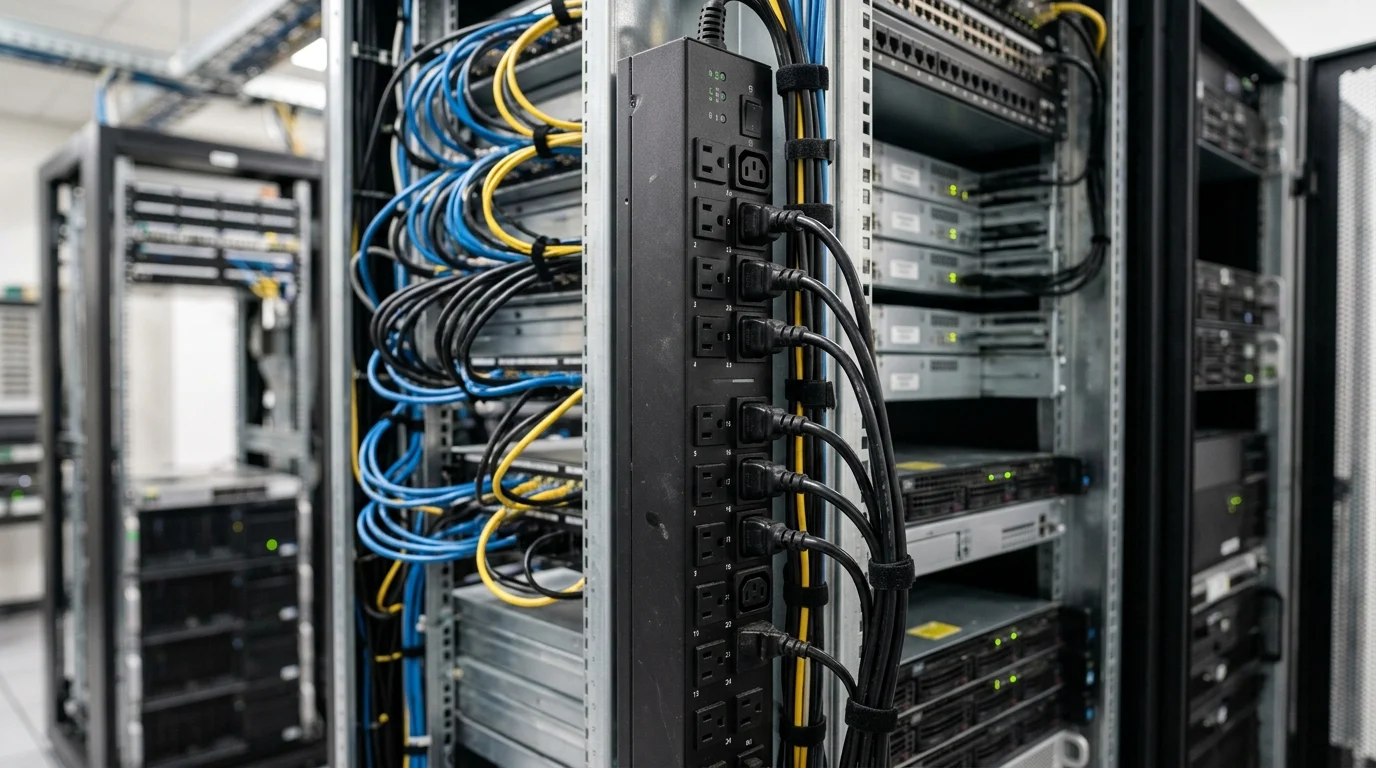
AI infrastructure places unusual stress on rack power design, especially as GPU servers push power density far beyond traditional enterprise levels. In this context, a high-capacity PDU power distribution unit becomes central to uptime, efficiency, and safe scaling rather than a simple accessory. This article explains why AI workloads change electrical requirements, what features matter most in PDUs for dense GPU environments, and how the right power distribution strategy helps prevent overloads, stranded capacity, and operational risk. From load handling to visibility and control, the discussion sets up the key technical factors behind reliable power delivery for modern AI deployments.
Why PDU Power Distribution Units Are Strategic
The rapid proliferation of artificial intelligence, machine learning, and large language models has fundamentally redefined data center infrastructure. At the core of this physical transformation is the critical need for robust, high-capacity power delivery. Traditional enterprise compute environments, characterized by predictable loads and moderate density, are giving way to hyperscale architectures where power density dictates facility design. In these extreme environments, the pdu power distribution unit is no longer merely a sophisticated power strip; it is a strategic asset essential for maintaining continuous operations, optimizing energy efficiency, and protecting multimillion-dollar hardware investments.
As organizations deploy dense clusters of GPU-accelerated servers, the margin for error in power management shrinks to zero. A poorly specified power distribution architecture can lead to stranded capacity, thermal throttling, or catastrophic localized outages. Consequently, data center operators are shifting their focus from basic connectivity to intelligent power management, evaluating PDUs based on their ability to handle unprecedented electrical loads while providing granular telemetry and remote management capabilities.
How AI Workloads Are Changing Rack Power Density
The most immediate impact of AI workloads on data center infrastructure is the exponential increase in rack power density. A decade ago, a standard enterprise server rack consumed between 5 kW and 10 kW of power. Today, a single rack fully populated with high-end AI training servers—such as those utilizing NVIDIA DGX or AMD Instinct platforms—routinely exceeds 40 kW, with next-generation liquid-cooled racks pushing the boundaries toward 100 kW to 120 kW per rack.
This massive escalation in power demand forces a redesign of the power chain. Standard dual 30A, 208V single-phase feeds are entirely insufficient for modern GPU clusters. Facilities are migrating to 60A and 100A three-phase 400V/415V distribution to deliver the necessary wattage without requiring unmanageably thick copper cabling. Delivering 50 kW to a single cabinet necessitates high-capacity PDUs capable of safely distributing continuous, heavy electrical loads across dozens of high-draw C19 receptacles, fundamentally altering how infrastructure engineers plan floor space and power routing.
Why Uptime, Utilization, and Energy Cost Depend on PDUs
In high-performance computing (HPC) and AI environments, the financial penalty for downtime is severe. Industry estimates often place the cost of unplanned data center outages at upwards of $9,000 per minute, a figure that is significantly magnified when interrupting weeks-long AI training models that may require complete restarts upon failure. High-capacity PDUs safeguard uptime by providing continuous monitoring of voltage, current, and environmental conditions, triggering automated alerts before a tripped breaker brings down a critical cluster.
Beyond simple uptime, advanced power distribution units are vital for maximizing resource utilization and managing energy costs. By capturing precise, outlet-level power consumption data, operators can identify underutilized servers, detect power supply inefficiencies, and calculate precise Power Usage Effectiveness (PUE) metrics. This telemetry allows facilities to safely run closer to their maximum power thresholds without risking overloads, effectively reclaiming stranded power capacity. In a facility with a 10 MW total power envelope, reclaiming just 5% of stranded capacity yields 500 kW of usable power—enough to deploy several additional high-density AI racks without expanding the facility’s utility footprint.
Technical Requirements for High-Capacity PDUs
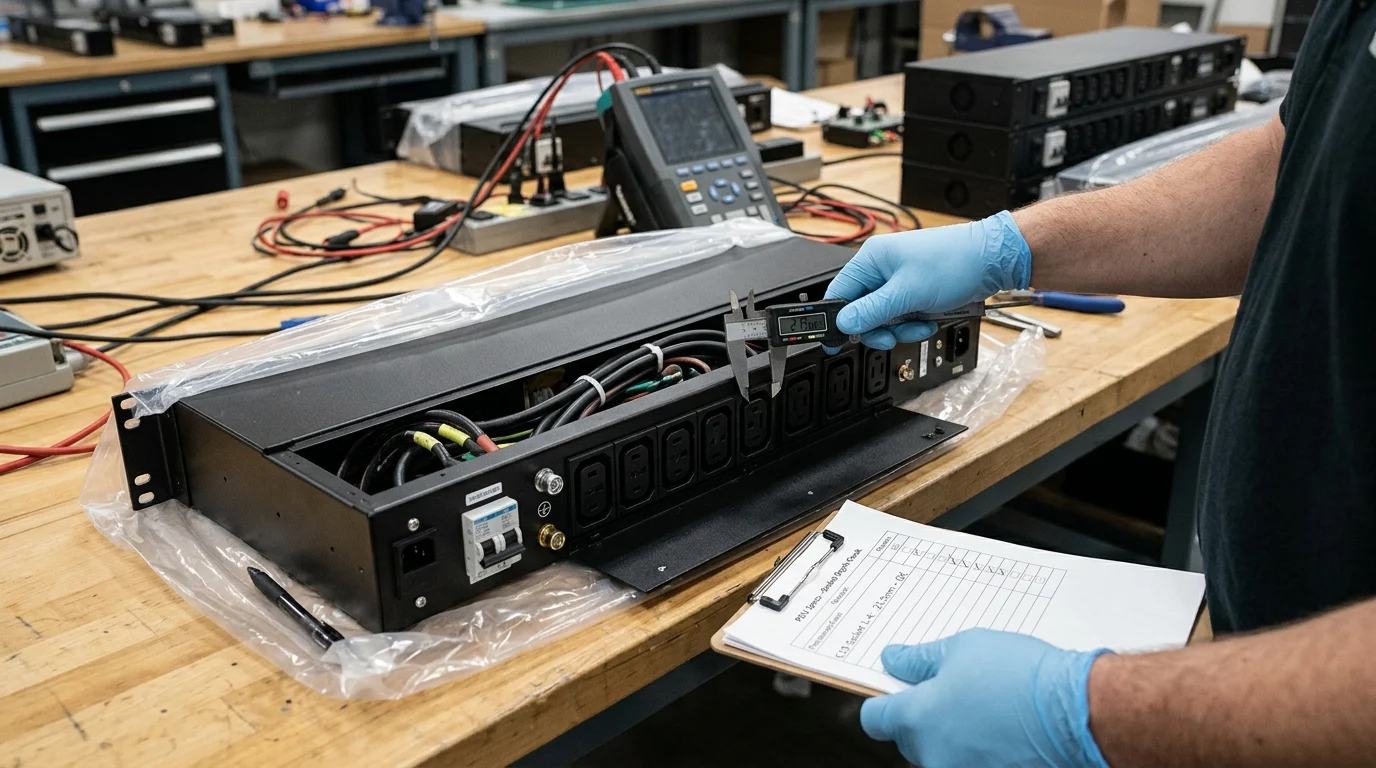
Deploying infrastructure for GPU-heavy clusters requires technical specifications that far exceed standard enterprise IT requirements. Engineers must evaluate PDUs through the lens of continuous, high-amperage utilization, stringent thermal tolerances, and the mechanical realities of managing heavy-gauge power cords in densely packed cabinets.
Key Electrical Specifications to Evaluate
When specifying high-capacity PDUs for AI workloads, the foundational metrics involve voltage, amperage, and phase configuration. Moving to 400V or 415V three-phase power is highly recommended for AI deployments, as it allows for roughly 17 kW of power delivery on a standard 30A circuit, or up to 34 kW on a 60A circuit. This higher voltage reduces transmission losses and decreases the physical size of the cabling required.
Crucially, operators must account for regulatory derating rules. In North America, the National Electrical Code (NEC) mandates an 80% continuous load rule for branch circuits. This means a PDU rated for 60A can only legally and safely supply 48A of continuous power. When a single GPU server can draw 10.5 kW at peak utilization, understanding these derating thresholds is critical to prevent nuisance tripping. Additionally, evaluating the Short-Circuit Current Rating (SCCR)—often required to be 10kA or higher in modern enterprise facilities—ensures the PDU can withstand sudden fault currents without catastrophic failure.
Intelligent vs Metered vs Switched PDUs
The choice between basic, metered, and intelligent units dictates the level of visibility operators have into their power chain. While basic units provide reliable raw power, they lack the telemetry required for modern AI clusters. Upgrading to an Intelligent PDU offers comprehensive network connectivity, allowing operators to monitor real-time power metrics via SNMP, Modbus, or RESTful APIs.
Intelligent units are typically subdivided into metered and switched categories. Metered PDUs offer high-accuracy power monitoring (often ±1% billing-grade accuracy) at the input phase, circuit breaker, or individual outlet level. Switched PDUs add the critical ability to remotely power-cycle individual outlets. In a large-scale AI deployment, if a GPU server completely locks up and becomes unresponsive to out-of-band management (like IPMI), a switched PDU allows administrators to perform a hard remote reboot, eliminating a costly and time-consuming physical trip to the data center floor.
Thermal, Mechanical, and Cable Management Factors
The thermal exhaust generated by 40 kW to 100 kW racks creates an exceptionally harsh operating environment at the rear of the cabinet, exactly where vertical (0U) PDUs are mounted. Standard IT equipment is typically rated for 45°C (113°F) ambient temperatures, which is inadequate for AI exhaust zones. High-capacity PDUs designed for GPU servers must feature a minimum operating temperature rating of 60°C (140°F) to prevent internal component degradation and premature failure.
Mechanical and cable management factors are equally critical. High-density PDUs must utilize high-retention receptacles or locking mechanisms (such as locking C13 and C19 outlets) to prevent accidental disconnections caused by vibration or maintenance activities. Furthermore, the physical footprint of the PDU—often available in ultra-low-profile 0U chassis designs—must be carefully evaluated to ensure it does not obstruct the massive airflow requirements of the server exhaust fans or interfere with the complex liquid cooling manifolds increasingly present in high-density racks.
How to Compare PDU Options
Selecting the optimal power distribution hardware requires a rigorous comparison of features, redundancy architectures, and total cost of ownership. Data center managers must balance the immediate capital expenditure of high-end intelligent units against the long-term operational savings and risk mitigation they provide.
Basic vs Metered vs Switched PDU Comparison
The functional differences between PDU categories dictate their appropriate use cases within a facility. While basic units are cost-effective, they are generally relegated to non-critical networking closets rather than high-stakes AI production floors. The table below outlines the comparative capabilities and typical cost bands for these devices.
| PDU Category | Monitoring Capability | Remote Control | Typical Cost Band (High-Capacity) | Primary Use Case |
|---|---|---|---|---|
| Basic PDU | None (or local LED only) | None | $300 – $800 | Lab environments, non-critical test clusters |
| Metered PDU | Input, Phase, Breaker, Outlet | None | $800 – $1,500 | Core data center, capacity planning, PUE tracking |
| Switched PDU | Input, Phase, Breaker, Outlet | Outlet-level On/Off | $1,500 – $3,000+ | Remote edge sites, critical AI training clusters |
For dense GPU deployments, the industry standard has firmly shifted toward Switched or highly granular Metered PDUs. The premium paid for intelligent features is rapidly offset by the ability to automate load shedding and perform remote troubleshooting.
A/B Feed Redundancy and Monitoring Considerations
AI hardware relies on 2N redundancy architectures (A/B feeds) to ensure continuous operation if one power path fails. When comparing PDUs, it is vital to ensure that the intelligent controllers themselves offer redundancy. Many modern high-capacity PDUs feature fault-tolerant daisy-chaining and dual network interfaces, ensuring that even if the primary network drops, telemetry data remains accessible.
Monitoring considerations also extend to polling latency. For critical AI loads, the network management card must support rapid polling intervals—often 1 second or less—to capture micro-spikes in GPU power draw. When evaluating options, engineers should assess how the PDU handles the protocol data unit payload over SNMPv3 or HTTPS, ensuring that rapid polling does not overwhelm the PDU’s internal processor or flood the management network.
Lifecycle Cost and Efficiency Drivers
When analyzing lifecycle costs, the initial purchase price of the PDU represents only a fraction of the Total Cost of Ownership (TCO). A high-capacity switched PDU may cost $2,500, compared to $600 for a basic model. However, the operational reality of managing AI infrastructure quickly justifies the expense.
Consider the cost of a “truck roll”—dispatching a technician to a remote data center simply to power-cycle a locked server. These dispatches typically cost between $300 and $500 per incident in labor and travel. If a switched PDU prevents just five truck rolls over its 5-to-7-year lifecycle, the hardware premium is entirely recovered. Furthermore, the efficiency drivers enabled by ±1% billing-grade accuracy allow operators to safely populate racks to 95% of their derated capacity rather than leaving a 20% safety buffer, drastically improving the overall return on floor space and utility provisioning.
Compliance, Sourcing, and Deployment Risk Reduction
Deploying hundreds of high-capacity PDUs across global data center footprints introduces significant compliance, supply chain, and commissioning risks. Mitigating these risks requires proactive engagement with suppliers, strict adherence to regional electrical codes, and a disciplined approach to physical deployment.
Regional Standards and Safety Certifications
Data centers operating internationally must navigate a fragmented landscape of electrical safety standards. In North America, PDUs must carry UL 62368-1 certification (which replaced the older UL 60950-1 standard for IT equipment). In the European Union, the equivalent CE mark and IEC 62368-1 compliance are mandatory. Failure to procure properly certified equipment can result in failed facility inspections, denied insurance coverage, and severe safety hazards.
Additionally, environmental compliances such as RoHS (Restriction of Hazardous Substances) and REACH are strictly enforced in many jurisdictions. When specifying high-amperage 3-phase PDUs, engineers must also verify the Short-Circuit Current Rating (SCCR). A standard rating of 10kA is common, but facilities with massive upstream transformers may require PDUs with custom fusing or breakers to achieve a 30kA to 60kA SCCR, ensuring the unit safely interrupts catastrophic power surges without causing a fire.
Supplier Capability, Lead Times, and Customization
The supply chain for high-capacity power infrastructure is frequently constrained. Unlike standard 15A/20A units that are kept in distribution stock, specialized 60A/100A three-phase PDUs often require custom configurations for cable lengths, specific input plugs (such as IEC 60309 or Hubbell CS8365C), and colored chassis for A/B feed identification.
Buyers must account for standard manufacturer lead times, which typically range from 6 to 12 weeks for custom or high-capacity units. Furthermore, manufacturers often impose Minimum Order Quantities (MOQs) of 50 to 100 units for specialized builds. Aligning the PDU procurement schedule with the notoriously long lead times of GPU servers is critical; a $300,000 AI server rack cannot be commissioned if the facility is waiting on a delayed $2,000 power distribution unit.
Deployment Steps for Commissioning and Load Balancing
Once the hardware arrives on site, the deployment phase introduces the challenge of load balancing. In three-phase power systems (L1, L2, L3), it is imperative to distribute the connected server power supplies evenly across all three phases. Poor load balancing results in high neutral currents and wasted upstream transformer capacity.
During commissioning, operators should utilize the intelligent PDU’s phase-level metering to monitor the draw as servers are powered on. Industry best practices dictate maintaining a phase imbalance of less than 10%. Advanced PDUs assist in this process by featuring alternating phase outlets down the length of the chassis, simplifying the physical cabling required to achieve a perfectly balanced rack. Phased commissioning, where loads are introduced in 10 kW increments, ensures that upstream breakers and cooling systems can handle the thermal and electrical shock of the new AI cluster.
How to Standardize on the Right PDU Platform
To achieve operational scale and resilience, data center architects must standardize their power distribution platforms. A fragmented environment featuring multiple PDU brands, disparate management interfaces, and varying form factors inevitably leads to configuration errors, security vulnerabilities, and increased training burdens for facility staff.
Matching Current and Future GPU Server Demand
Standardization begins with forecasting the power requirements of future hardware generations. The Thermal Design Power (TDP) of flagship GPUs continues to climb. While earlier generations operated around 300W to 400W per chip, current models draw 700W, and upcoming architectures are projected to exceed 1000W to 1200W per GPU. This trajectory means that a power distribution unit PDU specified today must have the headroom to support the hardware refresh cycles of tomorrow.
| Server Generation | Typical GPU TDP | Est. Rack Power (Standard Density) | Recommended PDU Capacity (Per Feed, 2N) |
|---|---|---|---|
| Legacy AI (e.g., V100) | 300W | 15 kW – 20 kW | 30A, 208V 3-Phase (8.6 kW usable x 2) |
| Current AI (e.g., H100) | 700W | 40 kW – 60 kW | 60A, 415V 3-Phase (34 kW usable x 2) |
| Next-Gen AI (Projected) | 1200W+ | 100 kW – 120 kW | 100A+, 415V 3-Phase or Busway Direct |
By standardizing on 60A or 100A 415V three-phase platforms now, facilities can upgrade their server hardware without ripping and replacing the underlying electrical distribution, thereby preserving capital and minimizing maintenance windows.
Selection Criteria for Resilient Power Infrastructure
Selecting the right platform for resilient power infrastructure extends beyond raw amperage. Decision-makers must evaluate the firmware security of the PDU fleet. Because intelligent PDUs sit on the management network and have the physical capability to shut down critical infrastructure, they are high-value targets for cyber threats. Standardizing on a vendor that supports secure protocols (SNMPv3, TLS 1.2/1.3, SSH, and RADIUS/TACACS+ authentication) and provides regular firmware patches is non-negotiable.
Finally, integration with Data Center Infrastructure Management (DCIM) software is the hallmark of a mature power architecture. A standardized PDU platform ensures consistent data structures, allowing DCIM tools to aggregate metrics seamlessly. This holistic visibility enables predictive failover modeling, highly accurate capacity planning, and the realization of extreme energy efficiencies—often pushing facility PUEs down toward 1.15 or lower. By treating the PDU as an intelligent, foundational node rather than a static commodity, organizations can confidently power the next generation of artificial intelligence.
Key Takeaways
- The most important conclusions and rationale for pdu power distribution unit
- Specs, compliance, and risk checks worth validating before you commit
- Practical next steps and caveats readers can apply immediately
Frequently Asked Questions
Why are high-capacity PDUs critical for GPU server racks?
GPU racks often exceed 40 kW, so standard rack PDUs may be undersized. High-capacity PDUs provide safer distribution, better load balancing, and monitoring that helps prevent overloads and unplanned outages.
What input power is commonly recommended for AI workloads?
For dense AI racks, 400V/415V three-phase power is commonly preferred. It delivers more usable power with lower losses and supports high-amperage PDUs needed for modern GPU servers.
How do intelligent PDUs improve AI cluster uptime?
They track voltage, current, and environmental conditions in real time. This helps operators spot overload risk early, send alerts, and take action before a breaker trip or rack-level outage occurs.
What outlet types should a PDU for GPU servers include?
Most high-density GPU deployments need multiple high-draw C19 outlets, often alongside some C13 outlets for auxiliary devices. Match outlet count and type to your exact server and network equipment power cords.
How can outlet-level metering reduce data center power waste?
Outlet-level metering shows which servers draw excessive or unusually low power. Operators can then rebalance loads, retire underused hardware, and reclaim stranded capacity for additional AI compute.
Post time: Jun-01-2026