

Key Takeaways
- Outlets are the largest single cost driver by share — IEC C13 and C19 outlets represent roughly one-fifth to one-third of factory cost in a basic PDU; copper is second at close to one-fifth to one-quarter.
- Copper is a smaller cost share than most buyers assume — a 1U 8-outlet PDU uses well under half a kilogram of copper; raw material cost is a low-single-digit percent of factory-gate price.
- MCB and surge modules add a mid-teens percentage but de-risk substantial downstream equipment — a single transient event without protection can destroy servers worth orders of magnitude more than the protective module.
- Aluminum chassis (vs sheet metal) costs moderately more but cuts weight substantially — relevant for vertical 0U PDU mounting where chassis spans one-and-a-half to two meters.
- Factory-direct China pricing runs markedly below US/EU brands — the gap is labor, distribution, brand premium, and certification renewal, not inferior materials.
- Custom OEM tooling amortizes above multi-thousand unit MOQ — below that, custom chassis extrusion drives unit cost above standard-SKU pricing.
Table of Contents
- What you actually pay for in a rack PDU
- Copper: busbar, jumpers, and outlet terminations
- MCB breakers and surge protection modules
- IEC C13/C19 outlets and the per-outlet cost curve
- Chassis: aluminum alloy vs sheet steel vs polycarbonate
- Switch, indicator, power cord, and plug
- Bill of materials: a 1U 8-outlet C13 PDU line-by-line
- Labor, overhead, and the factory-margin question
- Why China factory-direct runs markedly below US/EU brand pricing
- MOQ, custom tooling, and when to switch to OEM
- Frequently asked questions
The basic rack PDU looks like a commodity — a 1U strip with outlets, a power cord, and possibly a switch. From the buyer’s seat, the published price is the price. From the factory floor, however, the bill of materials spans roughly a dozen line items with very different cost elasticities. Copper busbar mass is set by the rated current. Outlet count is set by the customer. MCB choice is set by safety regulation. Chassis material is optional. Surge protection is optional. Labor and overhead are set by the factory location.
This guide unpacks each line item so procurement teams can evaluate a quoted price on engineering merit — not on whether the brand logo is recognizable. The data points below are calibrated against the Newsunn basic PDU catalog, specifically the 19″ IEC C13 C19 rack power distribution unit SKU range, and the underlying IEC 60320 appliance-coupler standard that governs C13, C19, and related outlet ratings.
What you actually pay for in a rack PDU
Five cost buckets cover roughly nine-tenths of a basic PDU’s factory-gate price. For a representative 1U 8-outlet C13 PDU rated at 10A with MCB and surge protection, the splits look like this:
| Cost bucket | Share of factory cost | Cost elasticity |
|---|---|---|
| IEC C13 / C19 outlets (8-12 units) | Low-twenties to mid-thirties percent | Linear with outlet count |
| Copper busbar + internal wiring | High teens to high twenties percent | Linear with rated current |
| Chassis (aluminum or sheet metal) | Low to high teens percent | Step-function with material choice |
| MCB breakers + surge protector | High single digits to high teens percent | Optional (but recommended) |
| Switch, indicator, plug, power cord, screws, labels | Mid single digits to low teens percent | Mostly fixed |
| Labor + factory overhead + margin | Mid teens to mid twenties percent | Region-dependent |
The single most common mistake in PDU procurement is treating the published price as a single number. Two PDUs that look identical from the outside can have radically different cost bases — and therefore different reliability profiles — if one is built with eight IEC C13 outlets and the other with a mix of C13 and C19 (C19 outlets cost a low-multiple of a C13), or one with aluminum chassis and the other with sheet steel.
Copper: busbar, jumpers, and outlet terminations
Copper is the most-misunderstood line item. Most buyers assume “a lot of copper = expensive.” The reality is that copper is a smaller cost share than outlets, breakers, or labor — even at current global copper cathode market levels.
For a 1U 8-outlet C13 PDU rated 10A, the busbar (the copper strip running the length of the chassis) is typically a few millimeters square in Cu-ETP (electrolytic tough-pitch) grade, total length in the tens of centimeters including jumpers to each outlet. Add the internal jumper wires (one pair per outlet at a small cross-section) and the outlet termination lugs, and the total copper mass lands well under half a kilogram per PDU.
The raw copper content is a low-single-digit percent of the factory-gate price — modest, but not the dominant cost driver. Once the copper is drawn into wire, stamped into outlet lugs, tinned for corrosion resistance, and assembled into the busbar, the in-process copper line rises modestly, still landing in the low-to-mid teens of total factory cost. The cost driver at this stage is stamping labor and yield loss at the wire-draw stage rather than the underlying copper commodity price.
What changes the copper cost line
- Rated current — a 32A three-phase PDU uses roughly two-and-a-half times the copper mass of a 10A single-phase unit. Busbar cross-section scales with ampacity per IEC 60320 ampacity tables.
- Outlet count — each outlet adds a fixed length of jumper wire plus the termination. A 24-outlet PDU uses substantially more copper than an 8-outlet PDU at the same rating.
- Copper grade — Cu-ETP (C11000) is the commodity grade. Cu-OFE (C10100, oxygen-free) is used in high-humidity or coastal environments at a low-double-digit premium. Cu-DHP (C12200) is the deoxidized grade for welded busbars.
- Tinning — bare copper oxidizes within months in humid environments. Tin-plated busbar adds a small percentage to copper cost but extends service life to over a decade.
Copper Specification Rule
For indoor data centers with controlled humidity (40-60% RH), specify Cu-ETP tin-plated busbar — the industry standard. For tropical data centers with sustained humidity above 75% RH, specify Cu-DHP or Cu-OFE. For coastal edge sites within 5 km of saltwater, jump straight to Cu-OFE tin-plated — corrosion of standard Cu-ETP at the outlet termination is the most common five-year failure mode in field returns.
MCB breakers and surge protection modules
Miniature circuit breakers (MCBs) and surge protection devices (SPDs) are the safety-critical components of a basic PDU. They are also the line items most often omitted from bargain-basement quotes — and the omission is what makes the bargain-basement quote unsafe.
MCB cost and selection
Per the IEC low-voltage circuit-breaker standard family, a 10A single-pole MCB in DIN-rail or panel-mount form factor is a low-cost component at modest quantity. A 16A single-pole MCB is incrementally higher. A 32A three-pole MCB (for three-phase PDUs) is the highest in the lineup, reflecting its higher interrupting capacity and three-pole construction.
For a basic PDU with a single 10A MCB protecting 8 C13 outlets at 10A total input, the MCB line is a single-digit percent of factory cost. For a metered or monitored PDU with one MCB per outlet pair, the MCB cost rises to low-double-digit percent of total.
The 1.13× factor is the IEC 60898 thermal trip threshold — the MCB holds rated current indefinitely but trips within one hour at 1.13× rated current. This is why a 10A MCB on a 10A PDU input is correct, and a 16A MCB is over-spec. Undersizing the MCB (e.g., 6A on a 10A input) causes nuisance trips at full load. Oversizing defeats the protection. Spec it tight.
Surge protection module cost
A Type 2 / Type 3 SPD module rated for 10 kA nominal discharge (In) and 20 kA maximum discharge (Imax) — the typical rating for a 230V single-phase PDU input — is a moderate-cost module at modest quantity. It includes the MOV (metal-oxide varistor) array, thermal fuse, and indicator LED.
SPD adds a low-double-digit percentage to PDU cost but protects downstream equipment from transient events. A single lightning-induced surge on a power line can propagate through an unprotected PDU and destroy server motherboards, switch power supplies, and storage controllers. The replacement cost of a fully populated server rack affected by a surge event is many times the cost of the protective module.
Case study: surge event in a Hong Kong colocation facility
A colocation provider deployed basic PDUs without surge protection across two cabinets. After a typhoon passed within tens of kilometers of the facility, lightning-induced transients on the utility feed damaged power supplies in a meaningful share of rack-mount servers and top-of-rack switches. Total equipment replacement cost was orders of magnitude above the cost of retrofitting surge protection across the same PDU population. Retrospective surge protection would have cost a fraction of the avoided damage. The provider now specifies Type 2 SPD as standard on every basic PDU.
IEC C13/C19 outlets and the per-outlet cost curve
Outlets are the single largest cost driver in a basic PDU — and the cost spread between outlet types is wide. Per the IEC 60320 appliance coupler standard, the common data-center outlets are:
| Outlet type | Current rating | Voltage rating | Relative unit cost | Typical application |
|---|---|---|---|---|
| IEC C13 | 10A | 250V AC | Baseline (lowest) | Servers, network switches, low-power IT loads |
| IEC C19 | 16A | 250V AC | Multiples of C13 | UPS, high-power servers, blade chassis, PDU input |
| IEC C13 with lock | 10A | 250V AC | Multiples of standard C13 | Vibration-sensitive, mobile carts, marine |
| IEC C19 with lock | 16A | 250V AC | Highest in C19 family | Critical UPS feeds, high-vibration industrial |
| NEMA 5-15R | 15A | 125V AC | Below or comparable to C13 | North America office/IT equipment |
| NEMA 5-20R | 20A | 125V AC | Slightly above 5-15R | North America higher-power IT |
| UK BS 1363 | 13A | 250V AC | Comparable to C13 | United Kingdom, Middle East, Singapore |
| Schuko CEE 7/4 | 16A | 250V AC | Comparable to C13 | Continental Europe |
| French Type E | 16A | 250V AC | Slightly above Schuko | France, Belgium, Poland |
| Universal (multi-standard) | 10-16A | 250V AC | Above region-specific single-standard | Multi-region export, hospitality |
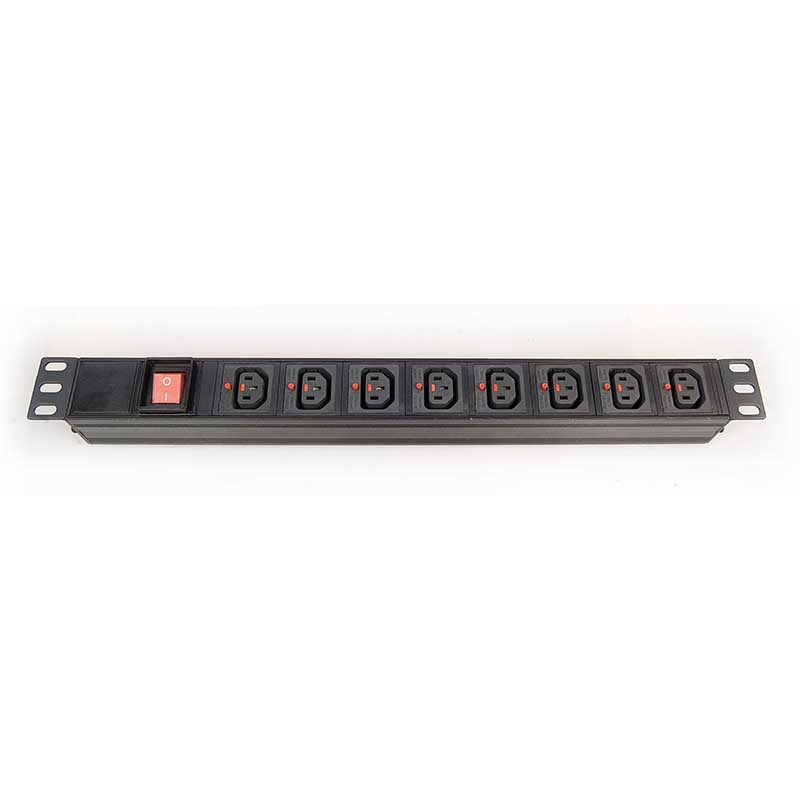
For the standard Newsunn 19″ lockable C13/C19 configuration, the per-PDU outlet cost line spans a wide range depending on outlet mix — from a low-cost C13-only configuration to a substantially higher C19-only or lockable-C19 configuration. The wide spread is why two superficially similar PDUs can differ in factory cost by a meaningful amount without any change in copper, MCB, or chassis.
The lockable outlet premium
C13 and C19 outlets are available in standard and lockable variants. The lockable version adds a mechanical latch that engages with a corresponding tab on the inlet cord, preventing accidental disconnection from vibration or cable tug. Per the IEC 60320 standard, the locking feature is independent of the electrical rating — a lockable C13 is still a 10A outlet — but the unit cost runs several times the standard version due to the additional latch mechanism and tooling.
For data-center and server-room deployments, lockable outlets are recommended on any outlet feeding equipment that cannot tolerate unplanned power loss. The cost premium of switching from standard C13 to lockable C13 across a full PDU is recovered many times over in avoided downtime. Cabinet layout and outlet density are typically specified against the TIA-942 telecommunications infrastructure standard, which defines PDU density, branch circuit protection, and grounding topology for rated-1 through rated-4 data centers.
Chassis: aluminum alloy vs sheet steel vs polycarbonate
Chassis material is the optional line item with the largest swing. Newsunn offers three chassis material options on the basic PDU line: aluminum alloy (default), sheet metal (cold-rolled steel), and polycarbonate (limited configurations). The cost, weight, and durability differ enough that chassis selection often drives the OEM buyer’s quote comparison.
| Material | Relative chassis cost (1U, 19″) | Relative chassis weight | Heat dissipation | EMI shielding |
|---|---|---|---|---|
| Aluminum alloy (6063-T5 extruded) | Higher than sheet metal baseline | Lowest | Excellent | Good |
| Sheet metal (cold-rolled steel, 1.2 mm) | Baseline | Highest | Good | Good |
| Polycarbonate (PC, glass-filled) | Lower than sheet metal baseline | Lowest | Fair | Poor |
For a 1U horizontal PDU, the chassis weight difference between aluminum and sheet steel is modest — not material to shipping cost. For a 0U vertical PDU that spans one-and-a-half to two meters, the weight difference is meaningful and materially affects rack mounting bracket selection and shipping crate weight. Aluminum is the standard choice for vertical 0U PDUs above one-and-a-half meters.
Chassis finish
- Anodized aluminum — the default. A modest process adder provides scratch resistance and a color match (silver, black, custom RAL on request).
- Powder-coated steel — the standard finish on sheet metal chassis. Cost included in base chassis. Less scratch-resistant than anodized aluminum but field-repairable.
- Custom color (RAL match) — setup fee per color applies, plus a small adder per chassis. Justified above low-thousand unit MOQ.
Switch, indicator, power cord, and plug
The “everything else” line item is a single-digit to low-teens percent of factory cost, but each sub-component is worth understanding because the buyer can usually negotiate these individually.
| Sub-component | Relative unit cost contribution | Notes |
|---|---|---|
| Illuminated rocker switch | Low | Standard 10A/250V; LED indicator integrated |
| Cord grip / strain relief | Low | Required for compliance with IEC 60320 |
| Power cord (1.8-3 m, 3×1.5 mm²) | Low-to-moderate | Length and plug type specified at order |
| Input plug (IEC C14, C20, NEMA, etc.) | Low-to-moderate | Region-specific |
| Indicator LEDs (power, surge status) | Low | 1-2 LEDs typically |
| Mounting brackets (horizontal L-bracket) | Low | Steel, powder-coated |
| Screws, labels, packaging | Low | Carton + foam insert |
The power cord is the most variable sub-component. A 1.8-meter cord with a C14 plug is a baseline-cost item; a longer cord with a twist-lock plug runs moderately higher. For industrial three-phase PDUs (32A input feeding a mix of C13 and C19 outlets), the input plug is typically an IEC 60309 blue coupler, which sits in the moderate-cost range as specified by the IEC 60309 industrial coupler standard. For OEM buyers deploying PDUs in cabinets with hardwired busways, the cord specification may be the most negotiated line item.
Bill of materials: a 1U 8-outlet C13 PDU line-by-line
The structure below itemizes a representative Newsunn 19″ 1U 8-outlet C13 basic PDU with MCB and surge protector. Each line item is shown in relative terms rather than absolute currency, because the absolute factory-gate price varies with copper market level, currency exchange, MOQ, and contract terms. The relative shares are stable across those fluctuations.
| Line item | Spec | Qty | Relative share |
|---|---|---|---|
| IEC C13 outlet | 10A, 250V, standard | 8 | Largest single line |
| Copper busbar | Cu-ETP, tin-plated | Under half a kg | Second-largest material line |
| Internal jumpers | 1.5 mm² Cu | 16 | Modest |
| MCB breaker | 10A single-pole | 1 | Low single-digit percent |
| SPD module | Type 2, 10 kA In, 20 kA Imax | 1 | Low-to-mid single-digit percent |
| Chassis | Aluminum 6063-T5, anodized | 1 | Material-level share |
| Illuminated rocker switch | 10A, 250V, integrated LED | 1 | Negligible |
| Indicator LEDs | Power, surge status | 2 | Negligible |
| Mounting brackets | Steel L-bracket, pair | 1 | Negligible |
| Power cord | 3×1.5 mm², 1.8 m, IEC C14 plug | 1 | Low single-digit percent |
| Screws, labels, packaging | M3×8 screws, foam insert, carton | set | Negligible |
| Material subtotal | Majority of factory cost | ||
| Direct labor (assembly + test) | Low-to-mid teens percent | ||
| Factory overhead (utilities, depreciation, QC) | Low double-digit percent | ||
| Factory margin (single-digit to low-teens percent) | Single-digit to low-teens percent | ||
| Factory-gate price (FOB Ningbo) | Sum of above | ||
At moderate-volume MOQ, this configuration lands at a competitive factory-gate price band. At higher-volume MOQ, the line items with quantity elasticity (outlets, copper, MCB) drop meaningfully, pushing factory-gate cost down. The material shares remain roughly stable; what changes is the absolute level and the labor share’s relative weight.
For comparison, the same configuration from a US or EU brand retails at a substantial markup — typically around half-again to double the factory-direct equivalent. The price gap and its drivers are documented in the next section.
Labor, overhead, and the factory-margin question
Labor and overhead together represent a mid-teens to mid-twenties percent of factory-gate cost — a smaller share than outlets or copper, but a line item that varies widely by factory location.
Direct labor breakdown
Assembly of a basic 1U PDU requires a moderate amount of direct labor at the workstation. The steps are: busbar cut and crimp, outlet mounting and wire dress, MCB and SPD installation, switch and indicator wiring, power-cord strain relief, continuity and hi-pot test, visual QC, and packaging. At a Chinese factory direct-labor rate that is markedly lower than US/EU equivalents, the labor cost is a low-single-digit to low-double-digit fraction of factory cost. The effective labor line includes a multiplier for QC re-test and rework that is normally absorbed in the standard rate.
Factory overhead
Overhead covers factory utilities, equipment depreciation, indirect labor (supervisors, QC, warehouse), and factory rent. For a Chinese PDU factory at a substantial production base with high annual output, the per-unit overhead is moderate. For a US or EU factory with one-tenth the output and substantially higher labor cost, the per-unit overhead is markedly higher.
Factory margin
Newsunn’s factory-direct margin on basic PDUs runs at a single-digit to low-teens percent of factory cost, consistent with the commodity-OEM model. By contrast, brand-name US/EU PDU distributors run at a much higher gross margin to cover sales engineering, channel partners, brand marketing, and round-the-clock field support. The total margin gap explains a meaningful share of the price spread between factory-direct Chinese PDUs and equivalent US/EU brands.
When to source factory-direct, when to source through distribution
Source factory-direct when: ① you have engineering staff who can specify and audit the BoM, ② your annual volume is at moderate scale, ③ your deployment geography does not require same-day field service, and ④ your application is not mission-critical (no SLA penalty for multi-day replacement). Source through a US/EU distributor when: ① you lack in-house PDU expertise, ② annual volume is low, ③ you need round-the-clock field service with rapid SLA, or ④ your deployment requires safety certifications that only the brand-name supply chain maintains on a per-lot basis.
Why China factory-direct runs markedly below US/EU brand pricing
The price spread between Chinese factory-direct PDUs and US/EU brand-name equivalents is substantial for an apples-to-apples basic 1U 8-outlet C13 PDU with MCB and SPD. The gap is consistent across all major cost buckets but driven by four factors:
- Direct labor: very wide gap. China factory rates are markedly below US/EU equivalents. Direct labor is a low single-digit percent of factory cost for China, low double-digit percent for US/EU.
- Factory overhead: substantial gap. China factory overhead is moderate per PDU; US/EU overhead is materially higher. Driven by labor cost, facility cost, and scale.
- Distribution and channel margin: China factory-direct ships FOB; US/EU brand typically adds a substantial distributor margin plus an additional reseller margin. Combined markup is meaningful.
- Brand premium and certification renewal: US/EU brands carry UL, ETL, TUV, and CE listings on every SKU, renewed annually. Certification renewal alone runs in the five-figure range per SKU per year. Amortized across typical US/EU volumes, this adds a small but visible share to each PDU.
The headline price gap therefore decomposes into roughly: labor a single-digit percent share, overhead a low-double-digit share, channel margin the largest share, brand and certification a smaller share. Material costs (outlets, copper, MCB, SPD, chassis, switch) are essentially identical across all geographies because the supply chain is global. The certification renewal line is the most often overlooked — third-party safety listings such as those administered by UL (Underwriters Laboratories) require annual factory audits and per-SKU renewal fees. China factory-direct PDUs can carry the same UL or ETL listings, but the buyer typically pays the certification cost up-front as a one-time project fee rather than amortized across annual per-SKU renewals.
MOQ, custom tooling, and when to switch to OEM
Standard SKUs at Newsunn ship at modest MOQ from existing tooling. Custom configurations require higher MOQs and may require new tooling investment. The decision matrix below covers the common OEM scenarios.
| Customization level | MOQ | Tooling cost | Lead time | Use case |
|---|---|---|---|---|
| Logo print on existing chassis | Low-hundreds | Negligible (digital print or laser) | Short | Brand-label standard SKU |
| Custom color (anodizing or powder coat) | Low-thousands | Low-to-mid four-figure setup | Short-to-moderate | Brand-aligned cabinet aesthetic |
| Custom outlet mix (e.g., C13 plus C19) | Mid-hundreds to low-thousands | Negligible (existing outlet SKUs) | Short-to-moderate | Application-specific mix |
| Custom cord length or plug type | Mid-hundreds to low-thousands | Negligible (stock cord SKUs) | Short-to-moderate | Regional plug, non-standard length |
| Custom chassis length (vertical 0U PDU) | Low-thousands | Negligible (extrusion die exists for standard lengths) | Moderate | Cabinet height match |
| Custom chassis cross-section (new extrusion) | Multi-thousand | Mid-five-figure extrusion die | Moderate-to-long | Unique form factor |
| Custom PCB for monitored/switched PDU | Low-to-mid-thousand | Mid-to-high-five-figure PCB tooling | Long | Intelligent PDU product launch |
Case study: OEM brand launch at moderate-volume MOQ
A US-based smart-rack accessory brand launched a private-label basic PDU line at a moderate-volume MOQ per SKU. The configuration was 1U 8-outlet C13 with MCB and SPD, in custom black chassis with logo laser-etched on the side. Total tooling cost was limited to a modest anodizing setup fee; no new extrusion die was required. Lead time from PO to first delivery was short. Factory-gate cost was in the low-cost band. The brand retailed the unit at a markup typical of accessory-brand distribution, funding ongoing SKU expansion without requiring further tooling investment.
Practical Procurement Note
The line items above are calibrated against the Newsunn basic PDU line at moderate-volume MOQ with FOB Ningbo Incoterms. For buyers sourcing other brands, the cost buckets remain structurally identical — outlets, copper, MCB, chassis, switch, labor, overhead — but the relative shares vary. Always request a BoM breakdown at the quote stage, not just a unit price. A buyer who can read the BoM can negotiate on the line items that have elasticity (outlets, copper, MCB, custom options) and accept the fixed-cost lines (chassis, switch, packaging) as quoted. To request a transparent BoM-quoted price on a configuration not listed above, contact the Newsunn sales engineering team with your outlet mix, current rating, chassis dimensions, and MCB/SPD requirements.
Frequently Asked Questions
What is the biggest cost driver in a basic rack PDU?
For a basic IEC C13/C19 rack PDU at 10-32A rating, the three largest cost drivers by share of factory cost are: the IEC C13 and C19 outlets themselves (typically one-fifth to one-third), the copper busbar and internal wiring (typically one-fifth to one-quarter), and the aluminum or sheet-metal chassis (typically one-tenth to one-fifth). MCB breakers and surge protection modules, if equipped, add a further mid-teens percentage. Chassis finishing, switch, indicator, plug, cord, and labor account for the remaining quarter to a third of cost.
How much copper is in a 1U 8-outlet PDU?
A 1U 8-outlet C13 PDU rated 10A typically uses well under half a kilogram of copper across the busbar, internal jumpers, and outlet terminations. The raw copper content is a low-single-digit percent of factory cost. Once the copper is drawn into wire, stamped into outlet lugs, tinned for corrosion resistance, and assembled into the busbar, the in-process cost rises modestly, still landing in the low-to-mid teens of total factory cost — driven primarily by stamping labor and yield loss at the wire-draw stage rather than raw copper commodity price.
Are cheap no-name PDUs safe to use in a data center?
A sub-spec PDU without verified MCBs, third-party safety listing, and surge protection is not data-center safe regardless of where you source it. Risks include undersized copper that runs hot at full load, no over-current protection that propagates faults downstream, no surge protection so transient events damage servers, and missing UL/CE/RoHS certification so the unit may not pass a datacenter audit. Always verify MCB rating matches outlet count, copper cross-section meets IEC 60320 ampacity, and the unit carries a third-party safety listing.
How does Newsunn factory-direct pricing compare with a US or EU brand?
For an apples-to-apples basic 1U 8-outlet C13 PDU with MCB and surge protector, US/EU brands typically retail at a substantial markup over factory-direct equivalents. The cost gap comes from regional labor, factory overhead, channel margin, and brand premium plus annual safety-certification renewal — not from inferior copper, MCBs, or chassis material. Material costs are essentially identical across geographies because the supply chain is global.
What MOQ should I expect for a custom OEM PDU?
Custom OEM PDUs at Newsunn typically start at low-hundreds MOQ for logo-printed standard SKUs, and scale to low-thousands MOQ for full-custom configurations (non-standard outlet mix, custom cable length, custom color, custom packaging). Tooling for new chassis dimensions requires multi-thousand unit MOQ to amortize the extrusion die cost, which sits in the low-to-mid five-figure range depending on chassis length and finish.
Do I need surge protection in a basic rack PDU?
For non-critical equipment in a stable grid, surge protection is optional. For servers, network switches, and storage in data centers, surge protection is strongly recommended because a single transient event can propagate through a basic PDU and damage downstream equipment whose replacement cost is orders of magnitude above the cost of the protective module. Surge modules add a low-double-digit percentage to the PDU cost but pay back many times over in avoided downtime.
Newsunn Editorial Team
With over a decade of hands-on experience in PDU design and manufacturing, Newsunn’s technical team provides in-depth insights into power distribution solutions for data centers, server rooms, and mission-critical facilities. Backed by 8 R&D engineers and a 30,000 m² production base, we help global clients source the right PDU products — from standard rack units to fully customized intelligent power distribution systems.
Post time: Aug-31-2026