

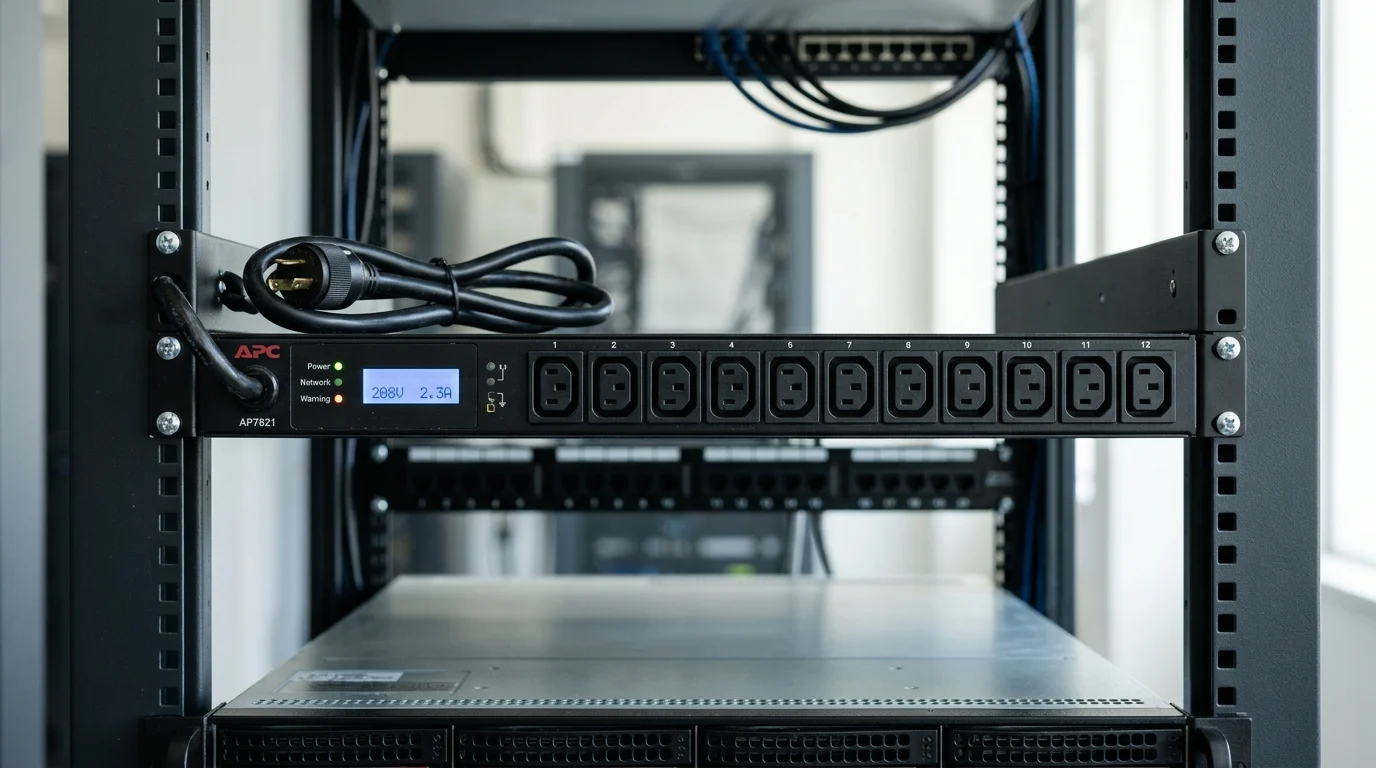
Rack PDU vs Data Center PDU: Key Distinction
In enterprise data center architecture, power distribution relies on a strict hierarchy to ensure continuous, clean electricity flows from the utility grid to the individual microprocessor. At the center of this infrastructure are two distinct classes of equipment that share an overlapping acronym but serve entirely different functions: the Data Center Power Distribution Unit and the Rack Power Distribution Unit.
A Data Center PDU operates at the facility level, managing massive electrical loads, stepping down high voltages, and routing power to distinct zones or rows within the white space. Conversely, the Rack PDU is an edge-level device mounted directly inside the server cabinet, taking the localized power feed and distributing it to individual IT components like servers, switches, and storage arrays. Confusing the two can lead to severe miscalculations in facility design, capital expenditure, and operational continuity.
Why the Difference Matters
Understanding the architectural distinction between these two systems is critical for proper capacity planning and electrical topology design. The power chain is inherently sequential. Electricity typically enters a facility at medium voltage, passes through uninterruptible power supply (UPS) systems, and arrives at the Data Center PDU. This upstream unit handles aggregate loads ranging from 50 kVA up to 800 kVA or more, acting as the primary demarcation point between the facility’s mechanical/electrical plant and the IT white space.
If engineers misalign their capacity models by conflating facility-level distribution with rack-level distribution, the consequences are catastrophic. Overprovisioning upstream Data Center PDUs results in stranded capital and inefficient transformer utilization, often yielding sub-optimal power usage effectiveness (PUE). Conversely, under-sizing the downstream Rack PDUs—which typically handle loads from 2.8 kVA to 22 kVA per cabinet—creates localized bottlenecks, preventing operators from deploying high-density compute clusters even if the facility has ample aggregate power.
Where Each PDU Fits
The spatial footprint and physical placement of these units further underscore their distinct roles. Data Center PDUs are massive, floor-standing enclosures that often occupy 24-by-42-inch or larger footprints on the raised floor. They are highly centralized, positioned at the end of cabinet rows (End of Row) or in dedicated electrical galleries. Their placement dictates the routing of under-floor power whips or overhead busway systems that transport electricity across the facility.
Rack PDUs reside entirely within the IT footprint. They are manufactured in specialized form factors, most commonly as 0U vertical strips mounted in the rear corners of a standard 19-inch server cabinet, or occasionally as 1U to 2U horizontal units. Because they sit inches away from the IT equipment, Rack PDUs are the final node in the electrical delivery chain. Their placement requires careful coordination with server rails, cable management arms, and cabinet exhaust zones to ensure they do not obstruct thermal airflow or impede hardware maintenance.
What Rack PDUs and Data Center PDUs Are
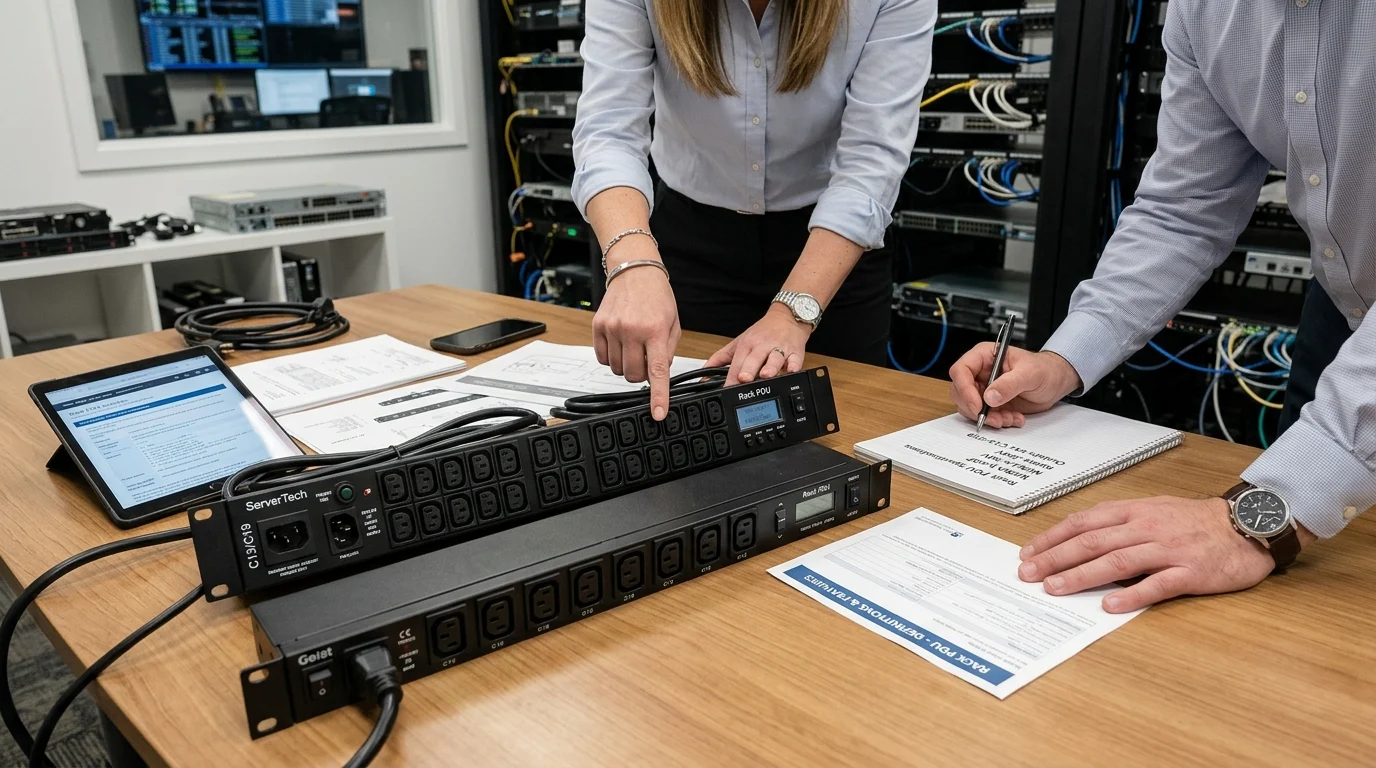
To properly engineer an electrical single-line diagram (SLD), facility operators must clearly define the hardware components comprising the power chain. While both devices manage electrical distribution, their internal components, engineering tolerances, and primary operational objectives differ vastly. A thorough breakdown of what constitutes a Rack PDU versus a Data Center PDU reveals the specialized engineering required at different stages of the power path.
Rack PDU Definition
A Rack PDU (often abbreviated as rPDU) is essentially an industrial-grade, intelligent power strip engineered for high-availability IT environments. It receives localized branch power—typically via a specialized locking plug like an IEC 60309 or NEMA L-series connector—and splits that input across multiple specific receptacles, such as IEC C13, C19, or the newer high-density Cx outlets.
Beyond mere distribution, modern Rack PDUs incorporate advanced microprocessors and network cards to provide telemetry. They are designed to operate in extreme thermal environments, routinely rated for ambient temperatures of up to 60°C (140°F) at the rear of the server rack. High-end models feature alternating phase outlets to simplify load balancing, hydraulic-magnetic circuit breakers to prevent nuisance tripping in high-heat zones, and locking receptacle mechanisms to prevent accidental cord disconnects.
Data Center PDU Definition
A Data Center PDU, frequently referred to as a Floor PDU or Computer Room PDU (CDPM), is a heavy-duty electrical distribution switchboard. Its primary internal component is often an isolation transformer designed to step down high input voltages (such as 480V 3-phase) to the utilization voltages required by the IT racks (typically 208V/120V or 415V/240V).
Inside the massive steel enclosure, a Data Center PDU houses main input breakers, surge protection devices (SPDs), and multiple distribution panelboards. These panelboards can contain anywhere from 42 to 84 individual branch circuit breaker pole positions. From these breakers, electricians run heavy-gauge power whips under the raised floor or route power to overhead busways, which ultimately deliver electricity to the Rack PDUs.
Why Vendor Naming Can Be Confusing
The terminology surrounding power distribution is notoriously fragmented, often leading to procurement errors and design miscommunications. Legacy IT hardware vendors frequently market advanced Rack PDUs as ‘Smart PDUs’ or ‘Intelligent PDUs,’ omitting the word ‘rack.’ Simultaneously, traditional electrical manufacturers refer to their floor-standing transformers as ‘PDUs,’ ‘Power Distribution Centers,’ or ‘Power Management Modules.’
This ambiguity is compounded when operators transition to modern architectures like 415V three-phase distribution. In these setups, the step-down transformer is often removed from the data center floor and integrated directly into the upstream UPS, meaning the ‘Data Center PDU’ becomes a simple remote power panel (RPP) without a transformer. To navigate this, engineering teams must standardize their internal nomenclature, strictly distinguishing between ‘floor-mount distribution’ and ‘cabinet-level distribution’ in all specification documents.
Key Specification Differences
The technical specifications of power distribution equipment reflect their position in the electrical hierarchy. Comparing the engineering constraints, capacity thresholds, and telemetry capabilities of Rack PDUs against Data Center PDUs highlights the vast difference in scale. Operators must evaluate both voltage handling and data granularity to ensure a resilient infrastructure.
Capacity, Voltage, Phase, and Breakers
Capacity and voltage handling demonstrate the most stark contrast between the two systems. Data Center PDUs are engineered to handle massive amperage, with input ratings typically ranging from 400A to 1200A. They are designed to accept medium-voltage inputs—commonly 480V or 600V in North America—and utilize heavy-duty K-factor transformers to manage the harmonic currents generated by downstream switching power supplies.
Conversely, Rack PDUs manage the final, localized load. Standard rack capacities traditionally hovered around 5 kW to 10 kW, requiring 30A or 32A inputs. However, with the advent of high-density computing, modern Rack PDUs now routinely handle 16A to 63A inputs at 208V or 415V three-phase, delivering up to 22 kW to 45 kW per cabinet. The internal breakers on a Rack PDU are strictly for localized branch circuit protection, ensuring a short circuit in a single server does not cascade and trip the upstream floor PDU breaker.
Monitoring, Metering, and Switching
Both classes of equipment offer sophisticated monitoring, but their focus differs. Data Center PDUs utilize Branch Circuit Monitoring Systems (BCMS) to track aggregate power metrics. They measure voltage, current, kW, kVA, and power factor at the main input and across each of the 84 panelboard circuits. This macro-level data is crucial for facility managers to balance phases across the entire data hall and prevent transformer saturation.
Rack PDUs provide micro-level telemetry. High-end intelligent Rack PDUs offer 1% billing-grade accuracy down to the individual server outlet. This granularity allows IT administrators to track the exact power draw of a specific switch or storage array, calculate the true cost of computing per application, and identify zombie servers. Furthermore, Switched Rack PDUs contain bistable relays that allow remote power cycling of individual outlets—a feature entirely absent (and highly dangerous if implemented) at the floor PDU level.
Rack PDU vs Data Center PDU Comparison Table
To clearly delineate the engineering and operational boundaries, the following comparison highlights the primary specification differences between facility-level and cabinet-level distribution.
| Specification / Feature | Data Center PDU (Floor-Mount) | Rack PDU (Cabinet-Mount) |
|---|---|---|
| Typical Capacity Range | 50 kVA to 800+ kVA | 2.8 kVA to 45 kVA |
| Form Factor | Large floor-standing enclosure | 0U vertical, 1U/2U horizontal |
| Input Voltage | 480V, 600V (3-phase) | 120V, 208V, 415V (1-phase / 3-phase) |
| Primary Function | Step-down voltage, aggregate distribution | Final outlet distribution to IT equipment |
| Metering Scope | Main input, sub-panel branch circuits | Aggregate cabinet, phase, or per-outlet |
| Remote Switching | Main breaker only (rarely automated) | Individual outlet-level power cycling |
| Typical Lifespan | 15 to 25 years | 5 to 10 years |
Operational and Compliance Considerations
Deploying power infrastructure requires strict adherence to operational protocols, electrical codes, and supply chain management. Because Data Center PDUs and Rack PDUs occupy different physical and electrical domains, the labor required to install them, the safety standards governing their manufacture, and their procurement lifecycles differ significantly.
Installation Scope, Maintenance, and Redundancy
Installation of a Data Center PDU is a major construction event. It requires licensed electricians to route rigid conduit, pull heavy-gauge copper wire, and physically rig cabinets weighing upwards of 2,000 to 4,000 pounds. Maintenance is equally complex; performing infrared thermography scans or replacing a faulty main breaker often requires engaging maintenance bypasses or scheduling facility-wide maintenance windows. Redundancy at this level is typically achieved through 2N or N+1 system architectures, utilizing dual utility feeds and separate A/B floor units.
Rack PDU installation is comparatively lightweight and is often performed by IT technicians rather than licensed electricians. Because they are edge devices, they are generally ‘plug-and-play,’ connecting to existing under-floor whips via standardized industrial connectors. Rack-level redundancy is achieved by deploying two distinct Rack PDUs (an A-feed and a B-feed) within the same cabinet, ensuring that if one upstream floor PDU fails, the dual-corded IT equipment remains operational via the secondary Rack PDU.
Safety Standards and Certification Requirements
Regulatory compliance dictates different testing standards for each device type. Data Center PDUs are classified as industrial switchgear or panelboards. In North America, they must adhere to stringent standards such as UL 891 for switchboards or UL 1558 for low-voltage power circuit breaker switchgear. These standards focus heavily on arc flash mitigation, short-circuit withstand ratings (often up to 65 kAIC), and transformer insulation integrity.
Rack PDUs are classified as Information Technology Equipment (ITE). They are governed by safety standards such as UL 62368-1 (which replaced the legacy UL 60950-1). Compliance at the rack level focuses heavily on fire enclosure ratings, touch currents, and ensuring that the localized hydraulic-magnetic breakers can safely interrupt a fault without causing a fire inside the server cabinet. Global deployments must also ensure compliance with CE marking in Europe and specific local electrical codes regarding cord lengths and connector types.
Cost, Lead Times, and Spare Parts Strategy
The financial and logistical strategies for procuring these systems dictate entirely different supply chain approaches. A Data Center PDU represents a significant capital expenditure (CapEx), with unit costs ranging from $15,000 to over $50,000 depending on kVA ratings and transformer types. Due to their custom engineering, lead times for floor PDUs frequently stretch from 12 to 24 weeks, requiring procurement to happen during the initial facility design phase.
Rack PDUs are high-volume commodity items with unit costs ranging from $300 for basic models to $2,500 for highly intelligent, high-density switched models. Lead times are generally shorter, typically 2 to 6 weeks, though supply chain volatility can impact this. Because of their shorter lifespan (5 to 10 years) and higher failure rate compared to passive transformers, operators must maintain an active on-site spare parts inventory of Rack PDUs to quickly swap out failed units without disrupting rack availability.
How to Choose the Right PDU
Selecting the right power distribution equipment requires aligning the macro-level facility capacity with the micro-level demands of the IT hardware. While engineers generally specify Data Center PDUs during the initial facility build, Rack PDU selection is an ongoing operational task driven by hardware refresh cycles and shifting compute densities.
Load Mapping and Selection Steps
The first step in selecting rack-level power is accurate load mapping. Operators must calculate the maximum theoretical draw (nameplate rating) and the expected continuous draw of the hardware slated for the cabinet. Standard enterprise deployments typically require 5 kW to 10 kW per rack, whereas high-performance computing (HPC) and localized AI clusters are pushing boundaries to 30 kW, 50 kW, or even 100 kW per cabinet.
Once the kilowatt load is mapped, operators must select the appropriate input phase and voltage. Moving from single-phase 120V to three-phase 208V or 415V drastically increases the power density delivered to the rack while simultaneously reducing the copper required in the upstream whips. The selection of the Rack PDU must perfectly match the receptacle type provided by the upstream Data Center PDU to ensure physical compatibility.
Basic, Metered, Monitored, or Switched Rack PDUs
Rack PDUs are categorized into four primary tiers of intelligence, each serving a specific operational maturity level. Choosing the right tier balances capital cost against the need for remote management and telemetry.
| PDU Classification | Telemetry & Metering | Remote Switching Capability | Best Use Case |
|---|---|---|---|
| Basic | None | No | Low-cost environments, labs, non-critical localized edge nodes. |
| Metered | Aggregate level (Input/Phase) | No | Standard enterprise racks where phase balancing is required but outlet tracking is not. |
| Monitored | Outlet-level tracking | No | Colocation and cloud environments requiring 1% accuracy for tenant billing and capacity planning. |
| Switched | Outlet-level tracking | Yes (Per-outlet relays) | Remote ‘lights-out’ data centers requiring hard reboots of locked hardware without truck rolls. |
Final Decision Framework
The final decision framework must integrate both upstream constraints and downstream requirements. Upgrading to high-density Switched Rack PDUs is only effective if the Data Center PDU has the breaker capacity and cooling infrastructure to support the increased thermal load. Conversely, investing heavily in a highly intelligent Data Center PDU with granular BCMS may negate the need for expensive per-outlet monitoring at the rack level, allowing operators to deploy simpler, more cost-effective Metered Rack PDUs.
Ultimately, power distribution is an ecosystem. Organizations should plan their Rack PDU procurement around a 5 to 10-year hardware refresh cycle, ensuring that the units purchased today have the voltage flexibility and network security protocols (such as SNMPv3 and IPv6 support) to handle the next generation of server deployments. By maintaining a strict boundary between facility-level infrastructure and rack-level distribution, operators guarantee a resilient, scalable, and highly efficient data center environment.
Key Takeaways
- Use Data Center PDUs for upstream facility or row-level distribution and Rack PDUs for cabinet-level power delivery to individual IT devices.
- Size Data Center PDUs around aggregate loads such as 50 kVA to 800 kVA or more, but size Rack PDUs around per-cabinet loads typically ranging from 2.8 kVA to 22 kVA.
- Choose 0U vertical Rack PDUs for most 19-inch server cabinets to preserve rack space and keep outlets close to servers, switches, and storage systems.
- Plan Rack PDU placement around airflow, cable management arms, server rails, and maintenance access to avoid thermal and operational problems.
- Select intelligent or metered Rack PDUs when remote monitoring, outlet-level control, energy data, or high-density capacity planning is required.
- Avoid treating Rack PDUs and Data Center PDUs as interchangeable because doing so can cause sizing errors, stranded capacity, or rack-level power bottlenecks.
Frequently Asked Questions
What is the main difference between a Rack PDU and a Data Center PDU?
A Data Center PDU distributes power at the facility or row level, often handling 50 kVA to 800 kVA or more. A Rack PDU mounts inside a server cabinet and distributes the local feed to servers, switches, and storage devices.
Where is a Rack PDU installed?
A Rack PDU is installed inside a server rack, typically as a 0U vertical unit in the rear of a 19-inch cabinet or as a 1U/2U horizontal unit. It should not block airflow, cable management, or equipment access.
When should I use an intelligent Rack PDU?
Use an intelligent Rack PDU when you need remote monitoring, outlet-level control, energy metering, environmental visibility, or better capacity planning. It is especially useful in high-density racks and multi-site data center operations.
How much power does a Rack PDU typically handle?
Rack PDUs commonly support cabinet-level loads from about 2.8 kVA to 22 kVA, depending on input voltage, phase type, outlet configuration, and circuit rating.
Can a Rack PDU replace a Data Center PDU?
No. A Rack PDU is the final distribution point inside the cabinet, while a Data Center PDU manages upstream facility-level distribution. They serve different parts of the power chain and are often used together.

Newsunn
Post time: Jun-23-2026