

Why Intelligent PDUs Matter for Rack Power
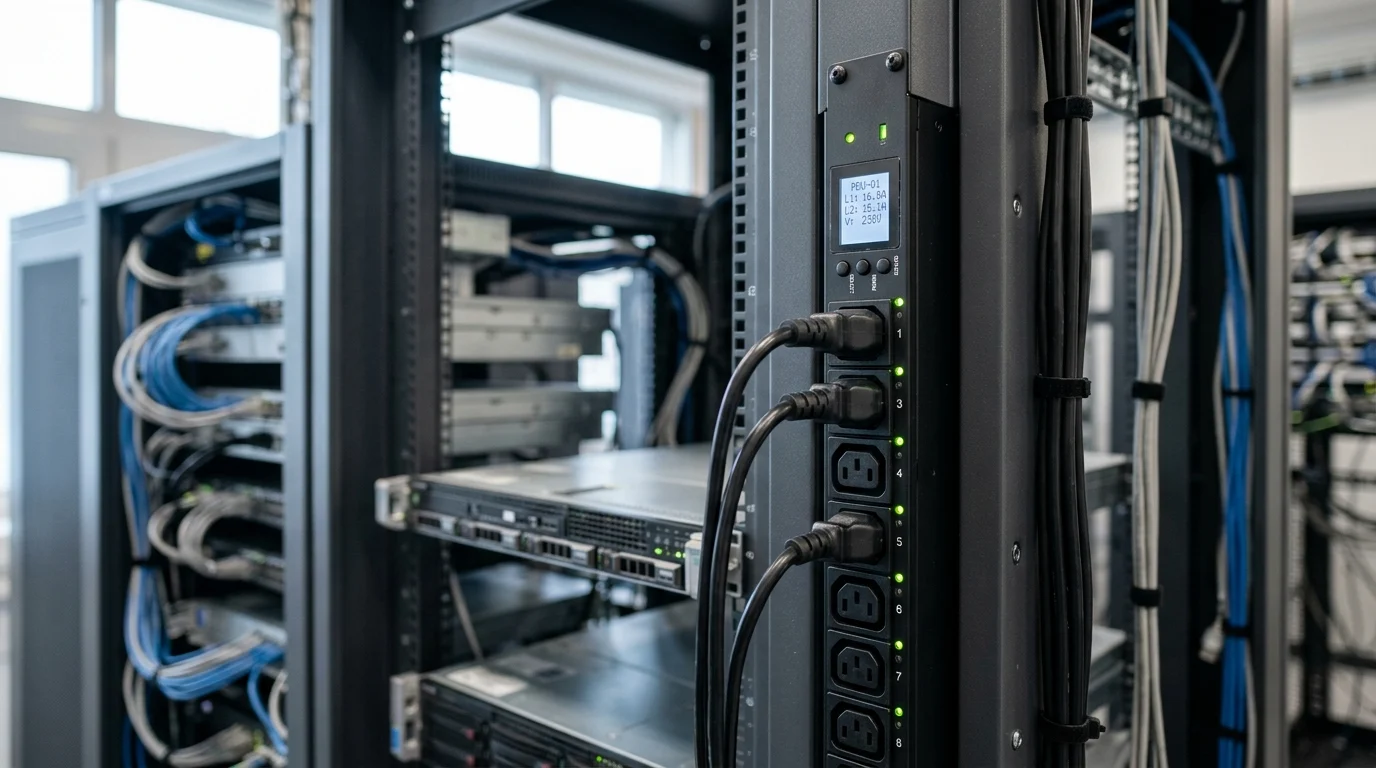
The evolution of data center infrastructure has relegated the basic power strip to legacy status, replacing it with the intelligent Power Distribution Unit (iPDU). As facilities manage escalating compute densities, strict service level agreements, and complex thermal envelopes, power distribution at the rack level requires sophisticated telemetry and active management capabilities. Intelligent PDUs bridge the gap between facility power pathways and IT equipment, functioning as critical data-gathering nodes rather than mere electrical receptacles.
Modern power architectures demand an integrated approach where the rack is no longer a blind spot in the facility’s electrical topology. By embedding microprocessors, network interfaces, and high-precision sensors directly into the power distribution hardware, intelligent PDUs provide operators with the necessary insights to optimize capacity, enforce security, and maintain the uninterrupted operation of mission-critical hardware.
Rack power visibility
Granular power visibility is the foundational advantage of intelligent power distribution. Modern iPDUs utilize embedded microprocessors to capture real-time electrical metrics, including voltage, current, active power (kW), apparent power (kVA), power factor, and total energy consumption (kWh). High-end models guarantee ±1% billing-grade accuracy, adhering to strict ANSI and IEC standards.
This level of precision enables data center operators to accurately allocate energy costs to specific departments or colocation tenants, shifting from estimated power usage to exact consumption billing. Furthermore, tracking power factor degradation at the rack level helps electrical engineers identify inefficient server power supplies before they introduce excessive harmonic distortion into the facility’s broader electrical grid.
Higher density and uptime demands
Hardware miniaturization and the proliferation of accelerated computing—particularly AI, machine learning, and high-performance computing (HPC) workloads—have radically altered rack thermal and power profiles. Standard rack power densities have surged from historical averages of 5–10 kW to extreme thresholds exceeding 40–50 kW per rack.
Intelligent PDUs are engineered to handle these immense loads while maintaining phase balance and preventing circuit overloads. By continuously monitoring phase loads, operators can distribute high-density servers evenly across three-phase PDUs, mitigating the risk of tripping upstream breakers. Advanced units also monitor internal temperatures, ensuring the PDU itself does not become a point of failure when subjected to the extreme exhaust heat generated by dense GPU clusters.
Remote operations and control
The trend toward decentralized infrastructure and “lights-out” data centers necessitates robust remote management protocols. Intelligent PDUs drastically reduce the mean time to repair (MTTR) by allowing administrators to diagnose power anomalies and execute remediation strategies without dispatching technicians to the physical rack.
Through secure web interfaces or centralized management software, operators can identify unresponsive servers and initiate hard reboots from thousands of miles away. This remote capability eliminates costly truck rolls—which routinely exceed hundreds of dollars per dispatch—and ensures continuous operational oversight regardless of facility staffing levels. In environments where uptime is tied to harsh financial penalties, this remote control is an indispensable risk mitigation tool.
Core Intelligent PDU Functions
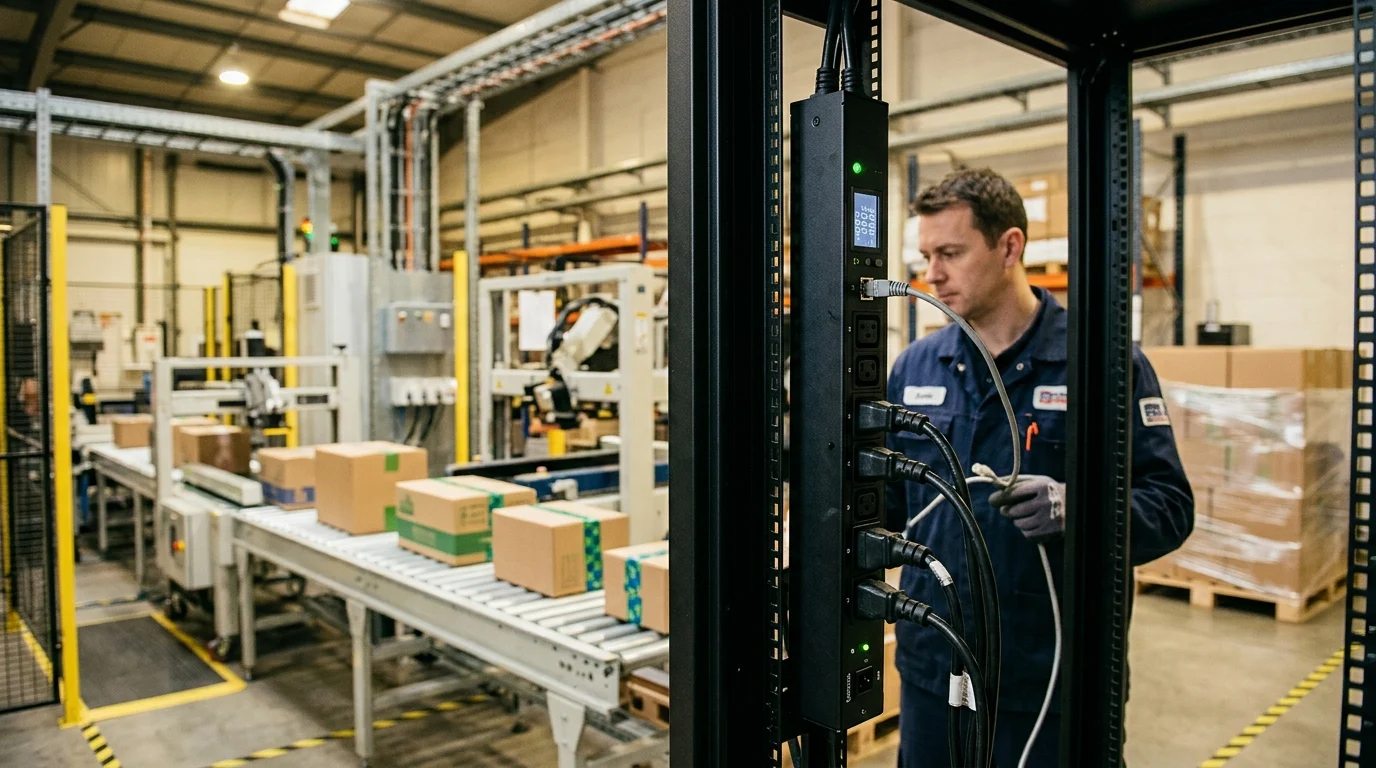
An intelligent PDU operates as a specialized network appliance integrated directly into the power distribution pathway. Its architecture comprises heavy-duty electrical components paired with a sophisticated controller module that houses the network interface, memory, and logic circuits.
This dual-purpose design enables a suite of core functions that transform passive power delivery into an active, manageable resource. The synergy between the electrical buswork and the digital controller allows the unit to perform complex logic operations, automated alerting, and environmental monitoring without disrupting the critical load.
Metering and monitoring
Continuous environmental and electrical sampling forms the core of iPDU functionality. Beyond tracking power draw at the input feed or branch circuit level, intelligent units support plug-and-play environmental sensors. These sensors monitor localized temperature, humidity, airflow, and differential air pressure directly at the rack level.
Given that modern data centers frequently utilize hot-aisle containment strategies where exhaust temperatures can safely reach 60°C (140°F), real-time sensor data is critical. Integrating this granular thermal data allows automated cooling systems to dynamically adjust Computer Room Air Handler (CRAH) fan speeds and chilled water flow, optimizing the facility’s Power Usage Effectiveness (PUE) without risking thermal runaway.
Outlet switching and control
Advanced iPDUs incorporate specialized bistable relays at each receptacle. Unlike traditional relays that require constant voltage to maintain their state, bistable relays remain latched in their current position (open or closed) even if the PDU’s control board loses power or undergoes a firmware reboot. This mechanical design ensures uninterrupted power to critical IT loads during maintenance operations.
Furthermore, outlet switching allows administrators to sequence the power-up of servers. By programming a 1- to 5-second delay between outlet activations, the PDU prevents massive inrush currents that could trip upstream branch circuit breakers when an entire rack boots simultaneously after a facility power loss. This sequenced activation is critical for stabilizing the electrical grid during disaster recovery operations.
Network, firmware, and alerting features
The network module is the communication nexus of the iPDU. Enterprise-grade units support robust management protocols including SNMPv3, RESTful APIs, and Redfish, facilitating seamless programmatic interaction with automated orchestration tools.
To minimize the financial burden of allocating a dedicated Top-of-Rack (ToR) switch port to every power strip, intelligent PDUs employ cascading or daisy-chaining technologies. Administrators can link 16 to 32 PDUs together using standard Ethernet cables, managing the entire array through a single IP address. Dual network ports are also standard on high-end models, providing redundant communication paths or allowing logically separated management access for facility operations teams and isolated colocation tenants.
Intelligent PDU Types and Comparisons
The market categorizes intelligent PDUs into distinct tiers based on their telemetry granularity and control capabilities. Selecting the appropriate classification requires balancing the capital expenditure of the hardware against the operational insights required by the facility.
Electrical input specifications also dictate the physical design and ultimate capacity of the unit. Understanding the nuances between these configurations prevents costly provisioning errors and ensures the infrastructure can support future hardware refresh cycles.
Basic, metered, monitored, and switched PDUs
While basic PDUs offer no internal intelligence, the “intelligent” category spans metered, monitored, and switched variants. Metered PDUs provide a local LED/LCD display for at-the-rack load balancing but lack network connectivity. Monitored PDUs transmit this telemetry data over a network for remote aggregation. Switched PDUs add the critical ability to remotely toggle individual receptacles, while fully managed units combine both granular monitoring and switching.
| PDU Classification | Local Display | Network Telemetry | Outlet Switching | Primary Use Case |
|---|---|---|---|---|
| Metered | Yes | No | No | Local phase balancing during physical installation |
| Monitored | Yes | Yes | No | Enterprise capacity planning and PUE tracking |
| Switched | Yes | Yes | Yes | Remote edge sites requiring hard server reboots |
| Monitored & Switched | Yes | Yes | Yes | High-density deployments needing absolute control |
Single-phase, three-phase, and high-voltage options
Electrical input requirements heavily influence PDU selection. Legacy enterprise environments traditionally relied on 120V or 208V single-phase power, which severely limits maximum rack density. To accommodate modern hardware, facilities have largely transitioned to 208V or 400V/415V three-phase power distribution architectures.
Deploying a 415V three-phase intelligent PDU allows facilities to deliver up to 17 kW on a standard 24A circuit, or an immense 43 kW on a 60A circuit. Delivering higher voltages directly to the rack reduces step-down transformer losses and allows for thinner copper cabling. This yields significant material cost savings and improves under-floor or overhead airflow by reducing cable bulk.
Outlet-level versus unit-level management
Within monitored and switched PDUs, buyers must choose between unit-level (or phase-level) and outlet-level management granularity. Unit-level monitoring provides aggregate data for the entire PDU or individual branch circuits, which is sufficient for general capacity planning and preventing breaker trips.
Outlet-level monitoring, while increasing the unit’s cost by 20% to 40%, embeds metering chips at every individual receptacle. This extreme granularity is essential for colocation providers executing per-server billing, or enterprise operators hunting for “zombie servers”—comatose hardware that continuously consumes baseline power (often 150W to 300W) without executing useful computational workloads.
Specification, Installation, and Integration
Procuring and deploying intelligent PDUs requires rigorous electrical engineering and IT systems integration. A PDU is a permanent infrastructure fixture; sizing it incorrectly can throttle rack deployments, while failing to integrate it securely into management platforms negates the value of its intelligence.
Successful implementation bridges the gap between facility management and IT operations, requiring adherence to strict electrical codes alongside modern cybersecurity best practices.
Load profiling and capacity planning
Sizing an intelligent PDU involves more than summing the nameplate power ratings of the IT equipment. Engineers must calculate the actual anticipated draw and apply strict regulatory derating factors. Under the National Electrical Code (NEC) in North America, continuous loads—defined as running for three hours or more—must be derated to 80% of the circuit breaker’s maximum capacity.
Therefore, an intelligent PDU connected to a 30A branch circuit is legally and safely constrained to a maximum continuous draw of 24A. Capacity planning must also account for redundancy; in a standard 2N (A/B feed) deployment, each PDU must be capable of carrying the rack’s entire power load if the parallel feed fails, meaning steady-state utilization should never exceed 40% of the breaker’s rating under normal conditions.
DCIM and BMS integration
Telemetry data generated by intelligent PDUs holds minimal value if it remains siloed. Integration with Data Center Infrastructure Management (DCIM) or Building Management Systems (BMS) is paramount. iPDUs utilize standard industrial and IT protocols, such as Modbus TCP, BACnet/IP, and SNMP, to push or pull data into centralized single-pane-of-glass dashboards.
In highly optimized environments, polling intervals are configured to pull metrics every 60 to 120 seconds. The DCIM software aggregates these millions of data points to generate predictive heat maps, calculate stranded power capacity across the data hall, and trigger automated alerts when phase imbalances approach critical thresholds. Full IPv6 support ensures these devices remain accessible as internal network architectures evolve.
Safety, compliance, and cybersecurity
As network-attached devices governing critical power infrastructure, iPDUs are prime targets for cyberattacks and strict regulatory scrutiny. Physically, units must comply with international safety standards, notably UL/EN 62368-1 for IT equipment, ensuring they can safely operate in high-temperature containment zones.
On the digital front, modern iPDUs implement rigorous cybersecurity frameworks. This includes secure boot mechanisms to prevent malicious firmware loading, TLS 1.3 encryption for web interfaces, and integration with enterprise RADIUS, TACACS+, or LDAP servers for centralized role-based access control. Disabling legacy, unencrypted protocols like Telnet, HTTP, and SNMPv1/v2 by default is now a mandatory security baseline for intelligent power distribution.
How to Choose the Right Intelligent PDU
Determining the optimal intelligent PDU configuration is a strategic exercise that blends electrical topology, operational workflows, and budgetary constraints. A one-size-fits-all approach inevitably leads to either overspending on unnecessary features or bottlenecking future IT deployments with inadequate power infrastructure.
Procurement teams must view the iPDU not as a consumable accessory, but as a core component of the IT lifecycle that dictates the flexibility and resilience of the compute hardware it supports.
Use cases for enterprise, edge, and colocation sites
Deployment environments heavily dictate feature prioritization. In colocation facilities, tenant billing accuracy is paramount, making outlet-level metered PDUs with strict ±1% tolerance essential. Edge computing sites—such as telecom huts or regional micro-datacenters—often operate with zero permanent on-site IT staff.
For these remote edge deployments, switched PDUs are non-negotiable. The ability to execute remote hard reboots justifies the higher capital cost by eliminating excessive travel expenses and minimizing downtime. Conversely, centralized enterprise data centers generally prioritize unit-level monitored PDUs, focusing heavily on phase load balancing and macro-level PUE optimization rather than individual server control.
Lifecycle cost and supplier support
The total cost of ownership (TCO) for an intelligent PDU extends far beyond its initial purchase price. The physical copper, chassis, and relay components of a high-quality PDU typically boast a lifespan of 10 to 15 years, whereas the embedded network controllers may become obsolete, insecure, or unsupported within 5 to 7 years.
To combat this discrepancy, leading manufacturers offer hot-swappable network modules. This design allows data center technicians to upgrade the intelligence, security, and communication protocols of the PDU without disconnecting power to the critical IT loads. Factoring in module replaceability, color-coded chassis options for A/B feed identification, and the vendor’s track record for providing regular firmware security patches is critical to minimizing long-term OPEX.
Decision framework for buyers
Procurement teams should utilize a structured evaluation matrix to align PDU specifications with facility goals. Beyond basic electrical matching (plug types, voltage, amperage), buyers must weigh the operational benefits of advanced features against their deployment scale and specific workload requirements.
| Evaluation Criteria | High-Density AI Cluster | Remote Edge Deployment | Standard Enterprise Rack |
|---|---|---|---|
| Phase & Voltage | 415V Three-Phase (High kW) | 120V/208V Single-Phase | 208V Three-Phase |
| Outlet Receptacles | High-Temp / High-Amperage | Standard C13/C19 | Standard C13/C19 |
| Monitoring Level | Outlet-Level (Granular) | Unit-Level | Unit-Level / Phase-Level |
| Switching Needed? | Optional | Mandatory (Remote Reboot) | Optional |
| Environmental Sensors | High (Temp/Airflow/Leak) | Medium (Temp/Humidity) | Low to Medium |
Key Takeaways
- Use intelligent PDUs to monitor real-time rack metrics such as voltage, current, kW, kVA, kWh, and power factor instead of relying on estimated load data.
- Choose high-accuracy metering, up to ±1% on advanced models, when energy billing, tenant allocation, or departmental chargeback is required.
- Plan rack power for rising densities, as modern AI and HPC deployments can push loads beyond 40–50 kW per rack compared with older 5–10 kW averages.
- Balance equipment across three-phase PDUs to reduce breaker-trip risk and improve capacity utilization in high-density cabinets.
- Deploy remotely manageable or switched intelligent PDUs to reboot unresponsive servers, reduce truck rolls, and shorten mean time to repair.
- Monitor PDU and rack environmental conditions so dense GPU or compute clusters do not turn heat or overload into a single point of failure.
Frequently Asked Questions
What makes a PDU “intelligent”?
An intelligent PDU adds embedded sensors, a processor, and network connectivity to rack power distribution, allowing real-time monitoring of voltage, current, kW, kVA, kWh, power factor, and sometimes outlet-level status or control.
How does an intelligent PDU improve rack uptime?
It helps prevent overloads, phase imbalance, and overheating by sending alerts before conditions become failures. Switched models also allow remote power cycling of locked-up equipment, reducing MTTR and avoiding unnecessary site visits.
Is a metered PDU the same as an intelligent PDU?
Not always. A metered PDU shows or reports power usage, while an intelligent PDU typically includes network monitoring, alerts, environmental inputs, user access controls, and sometimes remote outlet switching.
When should a rack use a 3-phase intelligent PDU?
A 3-phase intelligent PDU is recommended for high-density racks, especially where loads approach modern AI or HPC levels. It helps distribute equipment evenly across phases and reduces the risk of tripping upstream breakers.
Can intelligent PDUs support energy billing or tenant allocation?
Yes. Advanced models can provide high-accuracy energy data, sometimes at ±1% billing-grade accuracy, enabling data centers and colocation providers to allocate power costs by rack, department, or tenant.

Newsunn
Post time: Jun-23-2026