

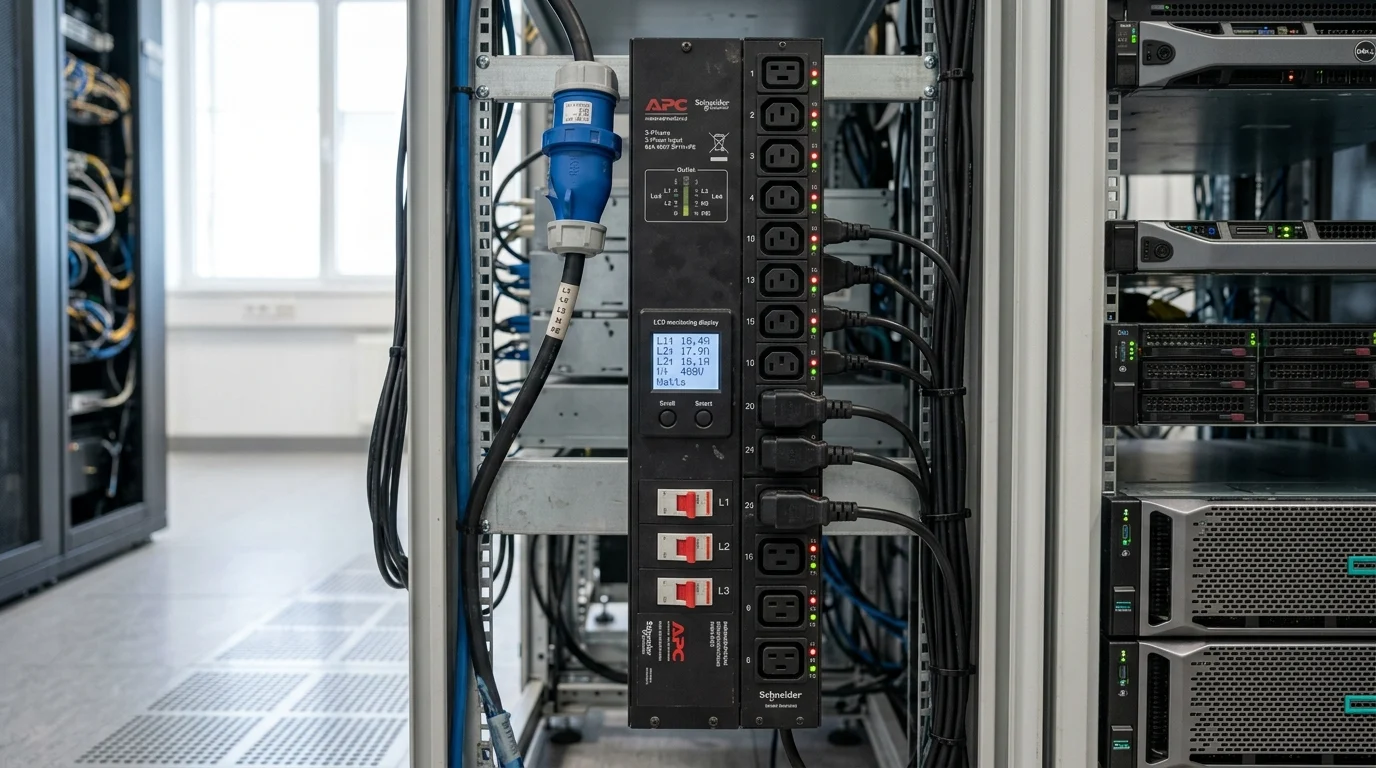
Why a 3 Phase PDU Is a Strategic Power Architecture
As data centers transition from traditional enterprise workloads to high-density environments supporting artificial intelligence (AI), machine learning (ML), and high-performance computing (HPC), legacy power architectures face severe limitations. The exponential growth in thermal design power (TDP) of modern processors and GPUs dictates a fundamental shift in how electrical power is distributed at the rack level. A 3 phase power distribution unit (PDU) has emerged as the strategic foundation for these modern facilities, offering unparalleled capacity, operational efficiency, and spatial optimization.
Unlike single-phase systems that transmit power over a single alternating current, 3 phase PDUs utilize three distinct alternating currents that are offset by 120 electrical degrees. This continuous, overlapping wave of power delivery ensures a more consistent and robust energy flow to mission-critical hardware, allowing data center operators to significantly increase compute density per square foot without overwhelming the facility’s upstream electrical infrastructure.
Supporting High-Density Racks
The primary driver for adopting a 3 phase PDU architecture is the necessity to support high-density server racks. Historically, standard enterprise racks consumed between 3 kW and 5 kW of power, easily managed by single-phase 120V or 208V circuits. However, modern GPU-accelerated clusters and hyperconverged infrastructure routinely demand 15 kW to 30 kW per cabinet, with advanced AI training racks pushing past the 50 kW threshold. Attempting to power a 30 kW rack with single-phase 208V power would require running an impractical number of high-amperage whips to a single cabinet, consuming valuable under-floor or overhead space and complicating cable management.
By deploying a 3 phase PDU, data center engineers can consolidate power delivery into fewer, higher-capacity circuits. For instance, a single 3 phase 415V/240V circuit rated at 60 amps can deliver approximately 43.1 kW of total power to a rack. This consolidation minimizes the physical footprint of electrical distribution equipment, allowing operators to deploy multiple high-density blade chassis or GPU servers within a single 42U or 48U enclosure while maintaining a clean, manageable physical topology.
Improving Efficiency and Capacity Headroom
Beyond raw capacity, a 3 phase PDU architecture inherently improves the overall electrical efficiency of a data center, directly impacting the Power Usage Effectiveness (PUE) metric. In many traditional North American data centers, 480V 3-phase power is delivered to the facility floor and then stepped down to 208V/120V via floor-mount Power Distribution Units containing isolation transformers. These step-down transformers introduce energy losses typically ranging from 2% to 4% in the form of heat, which in turn requires additional mechanical cooling overhead.
Modern 3 phase PDUs, particularly those leveraging a 415V/240V Wye configuration, eliminate the need for these local step-down transformers. Power is brought directly to the rack at 415V 3-phase, and servers natively operate on the 240V single-phase power extracted between any single phase and the neutral line. This higher voltage transmission reduces the required copper wire gauge—often lowering facility cabling costs by 20% to 30%—while significantly minimizing line losses over long cable runs. Furthermore, the 120-degree phase offset provides a smoother overall power profile, reducing the internal component strain on server power supply units (PSUs) and contributing to extended hardware lifespans.
What Defines a 3 Phase PDU
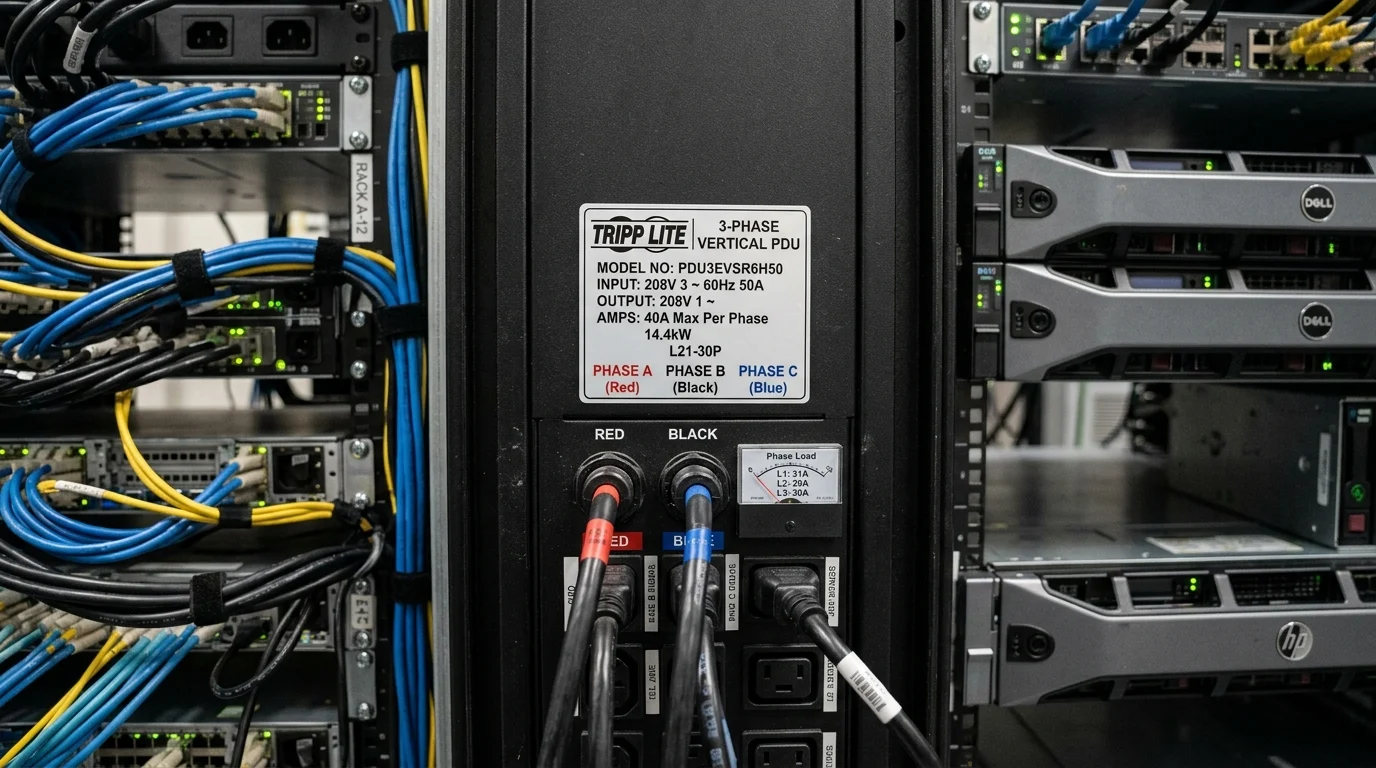
Defining a 3 phase PDU requires looking beyond the basic form factor to understand the internal wiring configurations, load distribution capabilities, and onboard intelligence. At a hardware level, these devices act as the final critical link in the electrical chain, stepping power from the facility’s busway or subpanel directly into the individual IT appliances. The architecture of a 3 phase PDU dictates how voltage is divided, how electrical faults are contained, and how administrators interact with the power infrastructure.
A defining characteristic of these PDUs is their ability to route massive amounts of energy safely through a compact, zero-U vertical enclosure. Achieving this requires rigorous engineering regarding internal phase wiring, specialized high-retention receptacles, and sophisticated logic boards capable of operating in extreme thermal conditions without failure.
Voltage, Amperage, Phase Balancing, and Outlet Types
The internal architecture of a 3 phase PDU is largely determined by its voltage input and whether it utilizes a Delta or Wye wiring configuration. In North America, a 208V 3-phase Delta configuration utilizes three hot wires and a ground, delivering 208V to the IT equipment. Conversely, a 400V or 415V Wye configuration includes three hot wires, a neutral, and a ground. The Wye setup allows the PDU to supply 240V single-phase power to individual outlets by tapping one hot phase and the neutral line, which is highly efficient for modern IT power supplies that accept wide-range inputs (100V–240V).
Phase balancing is a critical operational requirement when utilizing these PDUs. If one phase is heavily loaded while others remain idle, it can lead to excess current on the neutral wire (in Wye systems) or trip upstream breakers prematurely. To address this, high-quality 3 phase PDUs utilize alternating phase outlet technology, where consecutive outlets (e.g., L1, L2, L3) are staggered down the length of the PDU. This simplifies load balancing for technicians during deployment. Additionally, modern 3 phase PDUs are increasingly equipped with high-density C39 outlets, which accept both standard C14 and higher-amperage C20 plugs, eliminating the need to spec exact ratios of C13 to C19 receptacles prior to hardware installation.
Basic, Metered, Monitored, and Switched PDUs
Beyond electrical specifications, a 3 phase PDU is defined by its level of onboard intelligence and network connectivity. The industry categorizes these devices into four distinct tiers, each serving different operational maturity models and budget constraints.
| PDU Category | Local Display | Remote Network Monitoring | Outlet-Level Control | Typical Application |
|---|---|---|---|---|
| Basic | No | None | None | Low-cost, static environments with external monitoring |
| Metered | Yes | None | None | Small-scale deployments requiring local load balancing |
| Monitored | Yes | Yes (SNMP, API) | None | Enterprise data centers requiring PUE tracking and alerting |
| Switched | Yes | Yes (SNMP, API) | Yes (Remote Reboot) | Lights-out edge sites and highly dynamic colocation spaces |
Selecting the right intelligence tier heavily influences operational expenditure (OpEx). Monitored and Switched 3 phase PDUs typically feature billing-grade power metering with +/- 1% accuracy, allowing colocation providers to accurately charge tenants for power usage. Switched variants offer the added benefit of remote power cycling, which can save hundreds of dollars per incident by eliminating the need for a technician to perform a physical “remote hands” reboot.
3 Phase PDU vs Single-Phase Power
The decision to implement a 3 phase PDU over traditional single-phase power is one of the most consequential architectural choices a facility manager makes. While single-phase power is ubiquitous in residential and light commercial settings, scaling it to meet the demands of a high-density data floor introduces severe logistical and financial bottlenecks. Comparing the two approaches reveals stark differences in physical infrastructure requirements, copper utilization, and long-term scalability.
Understanding this comparison requires looking at the holistic cost of power delivery, not just the capital expenditure of the PDU itself. The upstream breakers, the length and gauge of the power whips, and the physical space consumed within the electrical panel all heavily favor 3-phase architectures as rack densities scale upward.
Key Comparison Points
The fundamental mathematical advantage of 3-phase power lies in its ability to deliver 1.732 (the square root of 3) times more power than a single-phase circuit of the same voltage and amperage. This multiplier drastically alters the infrastructure required to power a row of cabinets. For example, a single-phase 208V, 30A circuit delivers approximately 4.99 kVA of usable continuous power. To power a 15 kW rack, an operator would need to run three separate single-phase whips, consuming three breaker positions and cluttering the cable pathways.
| Circuit Specification | Voltage | Amperage | Usable Continuous Power (80% Derated) | Breaker Poles Required |
|---|---|---|---|---|
| Single-Phase 208V | 208V | 30A | 4.99 kVA | 2 |
| 3-Phase 208V Delta | 208V | 30A | 8.64 kVA | 3 |
| 3-Phase 415V Wye | 415V | 30A | 17.2 kVA | 3 |
As the table illustrates, moving to a 3-phase 415V system allows a single 30-amp circuit to deliver over 17 kVA of usable power while only consuming three breaker poles. This consolidation drastically reduces the amount of copper wiring required in the facility floor plenum, improving airflow and significantly reducing the capital cost of electrical installation.
When 3 Phase Power Delivers Measurable Value
The threshold at which 3 phase power delivers undeniable measurable value typically sits around the 7 kW to 8 kW per rack mark. Below this threshold, single-phase 208V systems can function adequately without overwhelming the physical infrastructure. However, once a facility crosses 8 kW per cabinet, the cost of running redundant single-phase circuits (A and B feeds) becomes economically unviable compared to installing a single pair of 3 phase PDUs.
Furthermore, 3 phase power delivers value in the form of operational headroom. Data centers are rarely static; hardware refresh cycles typically introduce servers with higher power draws. A rack originally provisioned for 10 kW might need to support 14 kW two years later. A 3 phase 415V/30A PDU provides the built-in overhead to accommodate this growth without requiring costly retrofits to the facility’s busway or electrical panels. This future-proofing aspect makes 3 phase architecture a standard requirement for hyperscale deployments, colocation facilities, and any enterprise planning for AI workload integration.
How to Deploy a Reliable 3 Phase PDU
Deploying a 3 phase PDU requires meticulous planning, precise mathematical calculations, and strict adherence to electrical safety standards. Unlike single-phase deployments where load calculations are relatively straightforward, 3 phase systems demand careful attention to phase balancing to maximize usable capacity and prevent localized overloads. A poorly planned deployment can lead to stranded power capacity, tripped breakers during failover events, or severe thermal anomalies within the rack.
Successful deployment bridges the gap between electrical engineering and IT operations. It involves calculating continuous load thresholds, selecting appropriate cord lengths and connector types, and integrating the PDU’s environmental sensors into the broader Data Center Infrastructure Management (DCIM) ecosystem.
Calculating Rack Load and Phase Balance
Calculating the actual load capacity of a 3 phase PDU requires factoring in regulatory safety margins. In North America, the National Electrical Code (NEC) mandates that continuous loads—defined as maximum current expected to continue for three hours or more—must not exceed 80% of the circuit’s rated capacity. Therefore, a 3 phase 208V PDU rated for 60 amps is mathematically capable of 21.6 kVA (208 * 60 * 1.732 / 1000), but the usable continuous limit is strictly 17.2 kVA (21.6 * 0.80). Failing to account for this 80% derating rule is a common cause of unexpected breaker trips during peak processing loads.
Equally important is the practice of phase balancing. In a 3-phase system, the total rack load must be distributed as evenly as possible across the three phases (L1-L2, L2-L3, L3-L1 in Delta, or L1-N, L2-N, L3-N in Wye). If a 15 kW total load is skewed so that Phase 1 carries 10 kW while Phases 2 and 3 carry 2.5 kW each, the breaker for Phase 1 may trip even though the total PDU capacity has not been exceeded. Administrators must use the PDU’s onboard metering or DCIM software to actively monitor phase loads during hardware installation, physically moving server power cords to different outlet banks to maintain a balance variance of less than 10% across all three phases.
Safety, Compliance, Monitoring, and Environment
The physical environment of a high-density rack is hostile, making safety and compliance certifications paramount. Modern 3 phase PDUs must be rated to operate in elevated ambient temperatures, as containment systems often push exhaust aisle temperatures above 50°C. Enterprise-grade PDUs are typically certified for 60°C (140°F) continuous operation, ensuring that the logic boards and internal relays do not fail under thermal stress. Procurement teams must verify compliance with strict safety standards, notably UL 62368-1 (which replaced the older UL 60950-1 standard for IT equipment) and regional directives like CE and RoHS.
Comprehensive deployment also integrates environmental monitoring directly into the 3 phase PDU. Most monitored and switched models support plug-and-play sensor ports for temperature, humidity, fluid detection, and cabinet door access switches. By daisy-chaining these sensors through the PDU, facilities avoid running separate dedicated network drops for environmental monitoring. The aggregated power and environmental data is then securely transmitted to the DCIM platform using encrypted protocols such as SNMPv3 or RESTful APIs, providing operators with a real-time, granular view of the data center’s health and security.
How to Choose the Right 3 Phase PDU
Choosing the right 3 phase PDU involves balancing immediate technical requirements with long-term operational flexibility and supply chain realities. The market offers thousands of SKUs, varying by input plug, outlet configuration, intelligence level, and physical dimensions. A misstep in procurement can lead to incompatible power connections, physical interference with server chassis rails, or delayed facility launches due to extensive manufacturing lead times.
To navigate this complexity, data center managers must establish strict procurement criteria that align with both the facility’s electrical topology and the IT department’s hardware roadmap. This requires collaborative planning between facility engineers, network architects, and procurement officers to ensure the selected hardware meets all operational and budgetary constraints.
Procurement Criteria for 3 Phase PDU Sourcing
When sourcing a 3 phase PDU, lead time and Minimum Order Quantities (MOQs) are critical logistical factors. Standard, off-the-shelf PDUs typically ship within 2 to 4 weeks. However, highly customized units—featuring specific whip lengths, non-standard outlet layouts, or custom chassis colors for A/B feed identification—can extend lead times to 12 or even 16 weeks and may require an MOQ of 50 units or more. Facilities must weigh the operational benefits of custom color-coding and exact cord lengths against the potential impact on project timelines.
Warranty and vendor support also play a significant role in the sourcing process. Given the critical nature of power distribution, enterprise buyers should look for manufacturers offering a minimum 3-year standard warranty, with options to extend to 5 years. Furthermore, evaluating the vendor’s firmware update cadence is vital for networked PDUs. A reliable manufacturer will provide regular security patches and feature updates for the PDU’s network management card (NMC), ensuring the device remains resilient against evolving cybersecurity threats over its 7- to 10-year operational lifespan.
Turning Technical Requirements Into a Final Decision
Turning technical specifications into a final purchasing decision requires evaluating features that reduce long-term operational friction. High-retention outlets or locking power cords should be a mandatory requirement for any modern deployment. Accidental cord disconnects during routine rack maintenance account for a significant percentage of localized downtime; locking mechanisms (such as IEC C13/C19 locking receptacles) can reduce these incidents by over 99%. Additionally, the physical profile of the PDU must be verified against the rack geometry to ensure it does not block hot-swappable server fans or PCIe slots.
Ultimately, the decision rests on matching the PDU’s capacity and intelligence to the specific workload. For a static enterprise storage array, a metered 208V 30A 3 phase PDU may suffice. However, for a dynamic, multi-tenant AI cluster experiencing volatile power draws, investing in a switched 415V 60A 3 phase PDU with alternating phase C39 outlets provides the necessary capacity, granular control, and phase-balancing simplicity. By rigorously mapping these technical features to the facility’s overarching density goals, operators ensure a resilient, scalable, and highly efficient power foundation.
Key Takeaways
- Use 3 phase PDUs when rack power demand rises from traditional 3–5 kW levels to modern 15–30 kW or higher high-density loads.
- Plan 3 phase power distribution for AI and GPU racks because advanced training cabinets can exceed 50 kW and overwhelm single-phase architectures.
- Consider 415V/240V 3 phase delivery because a 60A circuit can provide approximately 43.1 kW to a rack.
- Reduce transformer-related energy waste by using 415V/240V Wye architectures that can avoid 2% to 4% losses from local step-down transformers.
- Improve cable management and lower infrastructure costs by consolidating power feeds and reducing copper cabling requirements by up to 20% to 30%.
Frequently Asked Questions
What is a 3 phase PDU?
A 3 phase PDU is a rack power distribution unit that uses three alternating current phases to deliver higher, steadier power to servers, storage, networking equipment, and high-density IT racks.
Why do modern data centers need 3 phase PDUs?
Modern AI, ML, HPC, and GPU racks often require 15 kW to 30 kW or more per cabinet. A 3 phase PDU supports this density with fewer circuits, better load capacity, and cleaner cable management.
How much power can a 3 phase PDU deliver to a rack?
Capacity depends on voltage and amperage. For example, a 415V/240V 3 phase circuit rated at 60 amps can deliver about 43.1 kW, making it suitable for high-density rack deployments.
Are 3 phase PDUs more efficient than single-phase PDUs?
They can be more efficient in high-density environments because higher-voltage 3 phase distribution reduces line losses and may eliminate step-down transformer losses, which can typically account for 2% to 4% energy waste.
Do 3 phase PDUs help reduce cabling costs?
Yes. Higher-voltage 3 phase power can reduce required copper wire gauge and consolidate power feeds, potentially lowering facility cabling costs by 20% to 30% while improving rack-level organization.

Newsunn
Post time: Jun-24-2026