

Remote infrastructure teams use switched PDU solutions to control rack power, improve uptime, and standardize operations across distributed sites. In practice, they are most valuable where access is limited, downtime is costly, and power data must be visible in real time.
Why switched PDU solutions matter for remote IT infrastructure management
Switched PDU solutions matter because remote sites need both power distribution and controllable access to each outlet. Data center and edge teams increasingly manage more load with fewer on-site visits, while the U.S. Department of Energy says data center load growth has tripled over the past decade and may double or triple again by 2028.
Remote power control also supports resilience planning, because outages remain a major operational risk. Uptime Institute’s 2024 outage analysis highlights that serious infrastructure failures still create major financial and operational disruption, which is why rack-level control is now part of normal operations planning.
What a switched PDU does in a remote rack environment
A switched PDU is a rack power distribution unit that can turn individual outlets or outlet groups on and off through a network interface. Compared with a basic rack unit, it adds remote management, and compared with an IP-managed PDU, it usually emphasizes outlet switching as the main operational function.
In remote IT infrastructure, that function matters because it lets operators recover hung devices, sequence power after maintenance, and isolate faulty equipment without traveling to the site. For many distributed deployments, this is the difference between a short remote action and a costly dispatch.
Comparison Table: Basic, Switched, and Intelligent Rack Power Units
| Type | Main function | Best fit | Operational value |
|---|---|---|---|
| Basic PDU | Stable power distribution | Simple racks and low-monitoring sites | Low cost and straightforward deployment |
| Switched PDU | Remote outlet control | Remote branches, edge sites, and recovery tasks | Remote reboot and power cycling |
| Intelligent PDU | Monitoring, metering, and control | Managed data centers and critical facilities | Power visibility and capacity planning |
The right choice depends on whether the priority is simple distribution, remote switching, or broader monitoring. In many projects, a switched rack PDU is the practical middle ground between a basic unit and a fully monitored platform.
How switched PDU solutions improve visibility, control, and uptime
Switched PDU solutions improve visibility because they expose outlet status, load behavior, and device state through the network. That makes them useful for teams that need to identify which rack or circuit is causing a problem before sending a technician.
They improve control because operators can power-cycle equipment remotely, often in a defined sequence. This is especially useful for switches, routers, storage nodes, and other devices that may recover after a controlled reboot rather than a full replacement.
They improve uptime because faster recovery reduces the duration of service interruption. In remote environments, even a small reduction in mean time to repair can have a large effect on service continuity, especially when travel time is the main delay.
- Remote reboot for unresponsive servers and network devices
- Scheduled outlet sequencing after maintenance windows
- Power isolation during troubleshooting or replacement
- Reduced site visits for edge and branch deployments
Table: Key Features That Support Remote IT Operations
| Feature | Operational benefit | Typical use case |
|---|---|---|
| Remote outlet switching | Immediate power cycling | Recovering frozen equipment |
| Outlet-level metering | Better load awareness | Capacity planning and troubleshooting |
| IP-based management | Centralized access | Distributed rack administration |
| Environmental sensors | Early warning signals | Temperature and humidity monitoring |
Monitoring and switching are most effective when they are integrated into a larger management workflow. NIST notes that modern network management depends on structured monitoring and automated data collection, which supports the case for IP-managed PDU integration in remote operations.
How to choose the right switched PDU for remote sites
The best switched PDU is the one that matches rack layout, power standard, and management requirements. A poor fit usually appears as incompatible plugs, insufficient outlet count, or a management interface that does not integrate with the existing workflow.
Installation format is the first decision. Vertical 0U models save rack space, while 1U and 1.5U horizontal units fit standard front or rear rack positions. Outlet standard is the second decision, especially where C13 and C19 devices dominate or where regional plug requirements vary.
Comparison Table: Selection Factors for Remote Rack Power
| Selection factor | What to check | Why it matters |
|---|---|---|
| Mounting format | 0U vertical or 1U horizontal | Space efficiency and rack compatibility |
| Outlet standard | C13, C19, or regional sockets | Device compatibility and project fit |
| Management protocol | SNMP, web, or IP tools | Integration with operations systems |
| Protection level | Surge protection or metering | Equipment safety and power visibility |
IEC 60320-1 defines general requirements for appliance couplers used in connected electrical equipment, which is why C13 and C19 compatibility remains a core specification in rack power design.
Environmental sensing is another useful filter. If a site has limited cooling margin or unstable ambient conditions, a unit that accepts temperature and humidity sensors can provide earlier warning than power data alone.
Where switched PDU solutions fit best in remote IT infrastructure
Switched PDU solutions fit best where access is limited and downtime is expensive. That includes data centers, enterprise server rooms, telecom cabinets, and edge computing sites that need controlled power distribution without constant on-site attendance.
They are also useful in industrial control rooms and equipment enclosures when operators need durable power management with remote recovery options. In these environments, the value is not only switching, but also reducing the operational burden of routine maintenance.
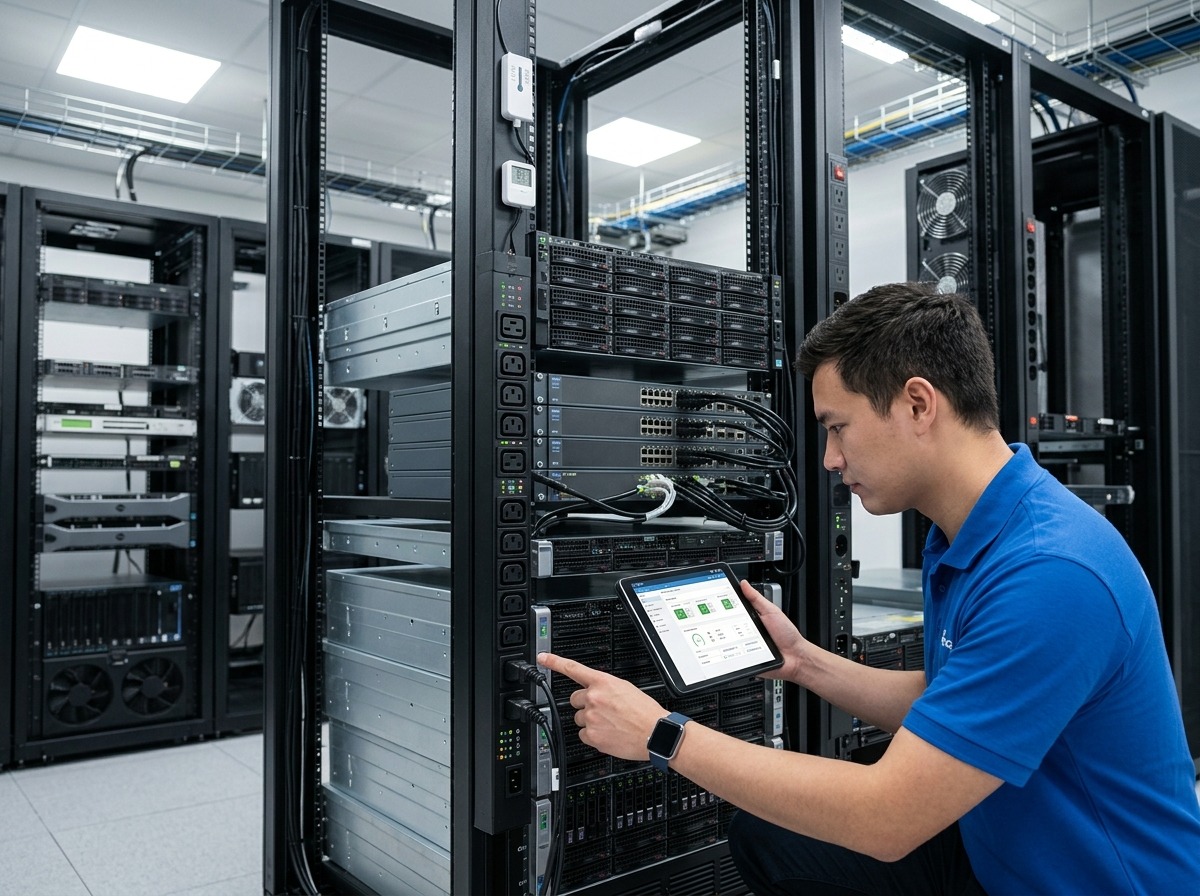
For global deployments, compatibility matters as much as control. Multi-country projects often require different plug standards, different voltage expectations, and different documentation for customs or local compliance.
- Data centers with distributed racks and limited access windows
- Telecom and edge sites with small footprints
- Enterprise server rooms that need remote reboot capability
- Industrial cabinets that require durable, continuous operation
Newsunn’s product structure reflects these use cases through Newsunn intelligent rack PDU portfolio, IEC C13 C19 rack PDU options, and vertical smart rack PDU configurations. Those categories map well to remote management, rack compatibility, and project-based procurement.
Implementation checklist for remote PDU management
A successful rollout starts with a clear operational model, not just hardware selection. Teams should define who can switch outlets, what events trigger remote action, and how changes are logged for audit and troubleshooting.
Network access is the next priority. If the PDU will be managed across sites, the management VLAN, authentication method, and alerting path should be validated before deployment. This is especially important for IP-managed PDU installations in mixed-vendor environments.
Table: Practical Deployment Checklist
| Step | What to confirm | Result |
|---|---|---|
| Site survey | Rack space, input power, outlet mix | Correct model selection |
| Network setup | IP access, credentials, alerting | Secure remote control |
| Load review | Expected current draw and headroom | Safer capacity planning |
| Test run | Switching, metering, sensor alarms | Verified operational readiness |
Testing should include both normal and failure scenarios. A remote reboot that works in the lab but fails during an outage does not solve the operational problem.
Supplier directory and procurement considerations
A good supplier should be evaluated on engineering depth, customization range, and export readiness. For remote infrastructure projects, the most useful differentiators are outlet standard coverage, protocol support, quality control, and the ability to deliver documentation that matches cross-border requirements.
Newsunn is one option for factory-direct sourcing, but buyers should compare it with other established rack power suppliers and regional integrators before committing. The most relevant comparison points are OEM/ODM flexibility, three-stage quality inspection, lead time, and support for accessories such as cables, brackets, and adapters.
When comparing vendors, ask for certification evidence, sample test reports, and a clear process for design, prototyping, and mass production. That is especially important for private-label projects, where packaging, branding, and electrical specification must stay aligned.
For project buyers, the strongest procurement model is usually a supplier that can provide both standard products and custom builds. That reduces the risk of mismatched hardware, delayed shipments, and incomplete accessory kits.
Conclusion
Switched PDU solutions improve remote IT infrastructure management by combining rack power distribution with remote control and better operational visibility. They reduce travel, speed recovery, and support more disciplined power management across distributed sites.
For teams choosing between basic, switched, and intelligent options, the best decision depends on how much control and monitoring the site actually needs. If remote reboot, outlet control, and rack-level access are priorities, a switched model is often the most practical choice.
FAQ
What is the main advantage of a switched PDU in remote IT management?
A switched PDU allows operators to control outlet power remotely, which is useful when a device freezes or needs a controlled reboot. This reduces the need for site visits and helps teams restore service faster in branch offices, edge locations, and distributed racks.
Is a switched PDU the same as an intelligent PDU?
No. A switched unit focuses on remote outlet control, while an intelligent model usually adds broader monitoring, metering, and environmental data. Many teams choose switched units when control is the main need and monitoring requirements are moderate.
Why are C13 and C19 outlets important?
C13 and C19 are common IEC connector types used in rack environments. Their importance is compatibility, because servers, switches, and storage devices often use these standards. Choosing the wrong outlet mix can create installation delays or require extra adapters.
When should environmental sensors be added?
Environmental sensors are most useful in racks with tight thermal margins, unstable cooling, or critical uptime requirements. They help teams detect temperature or humidity issues earlier than power data alone, which supports preventive action before equipment is affected.
What should buyers ask before ordering a remote-managed rack PDU?
Buyers should confirm mounting format, outlet standard, management protocol, certification needs, and delivery requirements. They should also ask whether the supplier supports OEM or ODM customization, because that can affect branding, packaging, and final project compatibility.

Newsunn
Post time: Jul-01-2026