


That is the real reason AI clusters standardize on three-phase rack PDUs. Not because three phase is fashionable, and not because the connector is more modern. Because it is the only configuration that delivers a given power through a conductor and a breaker the building can actually accommodate.
There is a correction to make before anything else, and it matters enough to lead with it. You will see “240V” and “415V” paired together in conversations about three-phase rack PDUs, usually by people repeating each other. They are not the same kind of number, and a specification written from that pairing is a specification written from a misunderstanding.
415V is the line-to-line voltage of a three-phase system in the UK, Australia and much of Asia. The single-phase leg voltage inside that same system is 230V. 240V is not a three-phase voltage at all. It belongs to the North American single-phase world, alongside 120V, and where North American three-phase systems appear in rack power discussions they are usually 208V line-to-line. Meanwhile the 240V that does appear in data centre electrical contexts tends to be DC, in 240VDC rack rails or 380VDC blade power architectures, which is a completely different distribution problem from a 240V three-phase AC feed.
So the pairing does not describe a standard product. It describes two different voltage families, one of which does not exist in the configuration the sentence is describing. If your procurement document says “415V/240V three-phase rack PDU,” no supplier can quote it, because the specification contains no coherent machine.
What follows is what a correct three-phase specification actually looks like, drawn from the published technical records of a manufacturer that builds these units, with the arithmetic and the failure modes made explicit.
The capacity arithmetic that forces the decision
The decision is arithmetic before it is electrical. Start from the rack.
The three-phase AI rack PDUs range and the published AI rack guidance from this manufacturer set out the density step plainly: traditional 19-inch racks consumed roughly 5kW to 10kW, while AI training racks are commonly engineered at 40kW and above. A published 30kW AI rack specification for North American deployment draws more than 80A per phase at 208V three-phase, which is why the input side of that class of rack is a NEMA L21-30P or L22-30P, or an IEC 60309 32A or 63A industrial plug, and specifically never a residential NEMA 5-15.
The single-phase-versus-three-phase decision is set out in full in this manufacturer’s published single phase versus three phase buyers guide, which covers the voltage systems in each region and the derating arithmetic behind each.
Run that against the alternative and the reason for three phase becomes arithmetic rather than preference.
A single-phase 208V circuit at 30A, applying the 80% continuous loading rule, yields roughly 5kW of usable capacity. The same 30A in three-phase 208V yields about 10kW, and the same 30A in three-phase 415V yields about 17.7kW, because three-phase power is the product of line-to-line voltage, current and the square root of three. A single-phase 230V circuit at 32A gives about 5.9kW at 80%.
Three-phase roughly triples the power through the same current rating on the same connector family. That is the whole argument. A building’s branch circuit capacity, its breaker series, its cable gauge and its floor-space allocation all stay roughly constant, while the delivered power steps up by a factor close to three.
The 80% continuous loading rule applies to both single and three phase, and it is the single most-forgotten number in rack PDU discussions. The published guidance is unambiguous: a 32A three-phase PDU rated at 22kW should not be loaded above 17.7kW for sustained operation. Specifying to the nameplate and operating at nameplate is how a PDU becomes a thermal event.
Phase balance is the second forgotten number. The published AI rack specification guidance states that phase imbalance must stay below 5% for hyperscale AI racks, because imbalance in a three-phase feed means one phase runs hotter while the others run short. Unbalanced load is not an efficiency loss; it is a conductor and breaker derating loss that quietly reduces the margin you believed you had.
Three-phase is a range, not a single product
Once the decision for three phase is made, the next mistake is treating it as one product. It is a family, and the family members differ on voltage, current, input connector and, critically, metering topology.
The three-phase AI rack PDUs range published by this manufacturer covers the segment properly, and the specific three-phase intelligent remote control PDU configuration is worth reading closely. It accepts an input voltage range spanning 100V to 277V AC on the lower band and 312V AC to 418V AC on the upper band, with 63A maximum total load current. That upper band is what carries 380V and 400V and 415V systems, and the published output standard covers IEC C13, C19, German, UK, American and IEC 60309 industrial outlets, with up to 48 outlets at maximum.
The same architecture appears in the 0U vertical intelligent rack PDU, three phase, metered by outlet with switching, 63A configuration, which carries the outlet-count and monitoring pattern into a vertical form factor.
The important architectural point is the second one, and it is the difference that actually matters for AI cluster deployment. A 30kW-class rack in North America runs on 208V three-phase with a NEMA or IEC 60309 input, and the EU and Australian SKUs share the same engineering envelope on 400V three-phase. That is why regional variants of the same platform exist at all: the input connector and internal wiring differ by region, while the outlet panel standardises.
One caveat a careful buyer will notice. The same published technical parameter block lists input type as AC three-phase and then also includes DC input bands of 100VDC to 240VDC and negative 43VDC to negative 56VDC, with DC output ratings including 240VDC and 336VDC. Those are DC distribution rails for telecom and blade-class equipment, present on the same platform because the enclosure and monitoring architecture are shared. If your requirement is three-phase AC at 400V or 415V, that is a different line in the same specification table, and it is worth saying so explicitly in a purchase order so the vendor quotes the AC configuration rather than the DC one.
The 80% rule, phase balance, and what to write in the RFQ
A three-phase specification fails in predictable ways, and every one of them is prevented by writing it down.
State the system voltage, not the leg voltage. Write 415V three-phase, or 400V three-phase, or 208V three-phase. Never write 415V/240V, and never leave the voltage family implicit in a supplier’s catalogue name. Voltage compatibility is not negotiable: connecting a 120V PDU to a 230V circuit damages the unit and creates a fire hazard, and the same principle applies at three-phase scale.
State the continuous load ceiling, not the rated capacity. Name the amperage, name the system voltage, and state the maximum sustained load after applying the 80% rule. A 32A three-phase PDU on a 400V system is a 22kW nameplate unit and a 17.7kW continuous unit. Suppliers and installers will otherwise agree on the larger number, which is the number that causes the problem.
State the phase balance tolerance. Below 5% for hyperscale AI racks, written into the acceptance criteria, is a materially stronger statement than hoping the commissioning engineer notices.
State the input connector explicitly. NEMA L21-30P or L22-30P for the US; IEC 60309 32A or 63A for EU, UK and Australia. These are not interchangeable, and specifying the connector prevents the substitution that happens when a part is sourced on price.
State the monitoring protocol, not just the monitoring. For an intelligent PDU destined for an AI cluster, the published protocol set on this range includes HTTP, SNMP v1 and v2, Modbus TCP/IP, Modbus RTU over RS-485, FTP, IPv4 and telnet, with firmware downloadable over the network so fielded units can be updated. SNMPv3 and RESTful API access are what a modern facility management system will actually integrate with, so the question is not whether the unit meters, but which protocol your building management system will speak. There is a security dimension worth stating plainly as well: telnet is a remote administration path, and whether it is enabled should be a deliberate decision rather than a default inherited from the firmware.
State the outlet mix, not just the outlet count. The published PDU spec checklist for 30kW AI GPU racks puts the typical outlet count at 24 to 42 per rack in a mix of C13 and higher-current connectors, and the reasoning is specific. IEC 60320 C13 at 10A and 250V AC serves networking, storage controllers and lower-wattage nodes. C19 at 16A and 250V AC is the standard GPU server primary PSU connection under IEC and VDE practice, and in North America the same C19 form factor is certified for 20A. The higher-temperature variants matter for current-generation nodes: C15 at 10A and 250V AC is the high-temperature C13 form used by network switches and some PSUs, and C21 at 16A and 250V AC is the high-temperature C19 form used by newer accelerator nodes.
The current and temperature limits behind those connector choices are treated in this manufacturer’s published guidance on high-current IEC C19 outlets in 19-inch racks, including the IEC versus UL and CSA split in how the same C19 form factor is rated.
A PDU with plenty of outlets but the wrong distribution of them is an unusable PDU, and that is a specification problem rather than a manufacturing problem.
What regional variants actually change
The instinct to treat “three-phase PDU” as a single globally portable product is the most expensive assumption in this category. The published platform principle is worth stating because it explains the entire product structure: IEC C13 and C19 outlet standards are universal across regions, so the same rack hardware can serve global deployments, and what changes between regions is the input connector, the internal wiring configuration and the circuit breaker rating.
That is a narrow, specific difference, and it has consequences.
The UK, German and French three-phase variants are the clearest example of a regional build. This manufacturer’s 3-phase UK-type PDU range is built to a 16A, 250V AC power rating with different European outlets, surge protection, a working indicator and an H05VV-F 1.5mm2 three-core cord. That is a different product from a 63A three-phase unit on an IEC 60309 input, and it is not a smaller version of it. A buyer who assumes a UK three-phase PDU and an AU three-phase PDU are the same part with a different plug will discover at commissioning that the conductor sizing and protection arrangement differ.
North American three-phase variants take NEMA L21-30P or L22-30P inputs, with the L22 specified where higher-voltage deployment requires it, and mate to IEC 60309 on the PDU side.
EU, UK and Australian variants take IEC 60309 32A or 63A inputs at 400V three-phase.
Three families, three input arrangements, three protection regimes. Ordering one and deploying it in another region does not produce a plug adapter problem; it produces a compliance and safety problem that surfaces at inspection.
The regional certification route differs too, and it is worth knowing who signs what. For North America the relevant certification for high-current C19 operation is UL or CSA listing at 20A. For the European Economic Area, EN/IEC 60320-1 compliance validated by agencies such as VDE, TÜV or ENEC is required for 16A operation. Those are different documents, held by different bodies, and a supplier holding one does not hold the other.
Where the value actually sits
A buyer comparing three-phase PDU suppliers will usually lead with price per unit. That comparison is nearly meaningless, and the published product categories explain why.
The range is split across basic rack PDUs, intelligent PDUs with metering and switching, desktop socket units and feature accessories. The basic rack range covers horizontal 1U and 1.5U and vertical 0U configurations with IEC C13/C19, UK, US, German, French and universal outlets in an aluminium housing with optional surge protection. The intelligent tier adds the monitoring and control layer.
The honest assessment is that on a three-phase AI cluster deployment, the monitoring and control layer is not an accessory. The published rationale for intelligent PDUs in new builds is that metering and switching enable remote power monitoring and outlet-level control, and in an AI cluster that resolves into several concrete requirements. Outlet-level metering granularity is specified at outlet level with one percent accuracy in the published AI rack guidance, which is a different instrument from unit-level or phase-level metering. Alerting on overload per outlet, temperature and humidity excursions, smoke, water ingress and door opening is what turns a PDU from a passive distribution strip into an instrument that can participate in a facility’s incident response. Upgradeable firmware on fielded units matters when a fleet is being standardised across sites.
Newsunn backs that engineering scope, as set out on the company’s about page, with with published capability: a technical team with over a decade of hands-on experience in PDU design and manufacturing, eight R&D engineers, and a 30,000 square metre production base, supplying products to more than 100 countries across five continents. For a buyer comparing quotes, that is the difference between a supplier who builds to a specification you sent and a supplier who can tell you why your specification will fail on a real floor.
The published AI rack power solution pages are where this range-level thinking shows, and the products catalogue is where the specific configurations are listed.
Two failure modes that kill three-phase deployments
The first is the specification error already covered: a voltage pairing that describes no real machine, leading to a unit that is either unsuitable or simply never quoted because no supplier can interpret it.
The second is subtler and more expensive. It is deploying a three-phase PDU whose internal protection and monitoring were configured for a different load profile than the one the AI rack will present.
Three-phase units are frequently specified at the maximum of their range because the arithmetic says the rack needs it. Then the actual deployment loads each phase unevenly, because IT load is not evenly distributed across phases by default. Phase imbalance beyond tolerance, combined with operation at or near nameplate rather than at the derated continuous figure, produces exactly the condition a breaker and a busbar are least tolerant of. The failure does not appear as a dramatic trip. It appears as a unit running hot at the connections, and connections are where the failures happen.
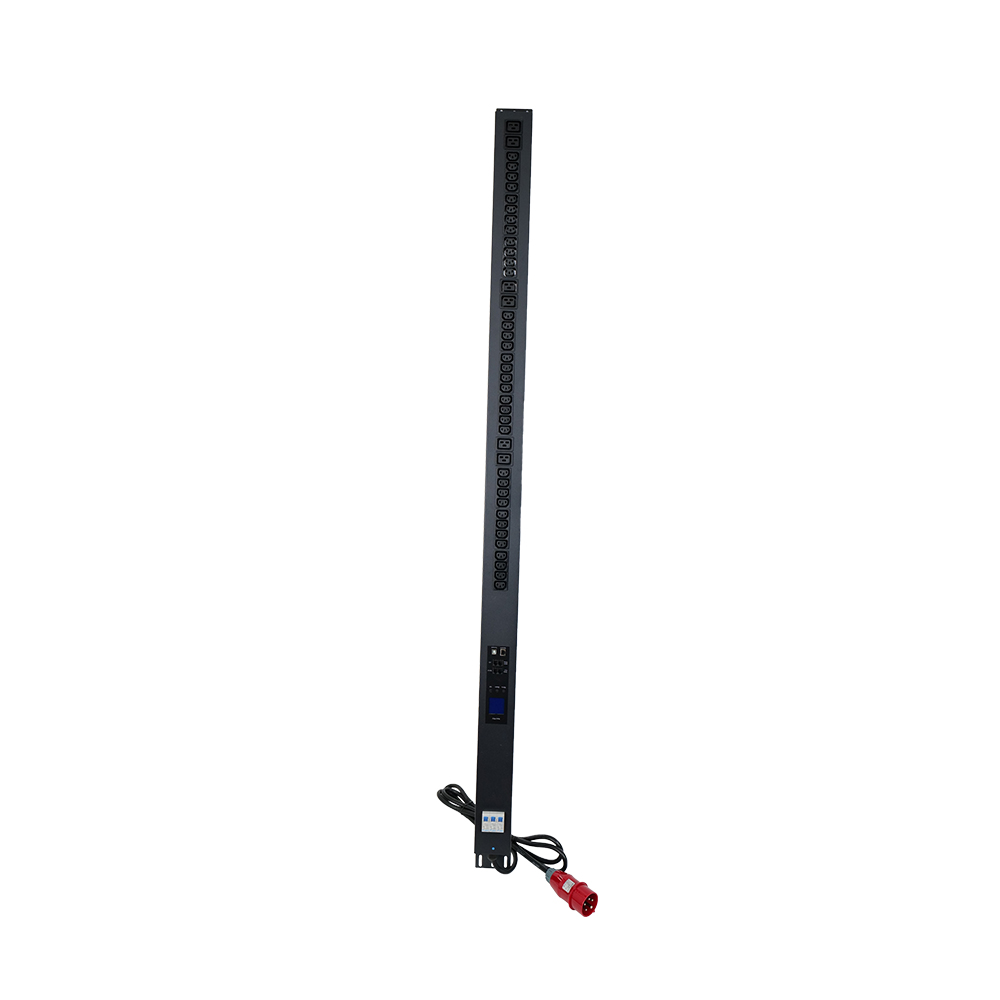
Two specifications prevent it. Write the continuous ceiling with the 80% rule applied. Write the phase balance tolerance with a measurement method attached, and require the measurement in the commissioning acceptance criteria rather than as a general aspiration. Both are one line in a purchase order, and both are the difference between a rack PDU that is an asset and one that is a future incident report.
Conclusion
AI clusters standardize on three-phase rack PDUs because the arithmetic forces it. Rack density has risen far enough that single-phase delivery would require heavier cable, larger breakers and more floor space to move the same power, and three-phase delivers roughly three times the capacity through the same connector family and the same breaker series.
But the standard is three-phase generally, not one voltage pairing. 415V three-phase and 240V three-phase do not describe a single product, and writing them together produces a specification no supplier can quote. The real choices are 208V three-phase for North America and 400V or 415V three-phase for Europe, the UK and Australia, and the decision among them is a decision about which electrical system the building already has.
Get three things right and the rest follows. State the system voltage and the continuous load ceiling after the 80% rule, never the nameplate. State the phase balance tolerance with a measurement method. State the outlet mix by connector and by amperage, because C13 and C19 serve genuinely different loads and the high-temperature C15 and C21 variants exist because current-generation accelerator nodes need them.
The rest is supplier diligence: confirm the input connector and the regional certification route, confirm the monitoring protocol your facility management system actually speaks, and confirm the production engineering behind the platform.
The bodies to check those claims against are public. The IEC webstore publishes the appliance coupler and installation standards that define the connector and voltage families discussed here, NFPA publishes the electrical installation codes governing circuit loading and continuous load, and OSHA publishes the workplace electrical safety requirements a commissioning team works to. Certification quality itself rests on IAF accreditation documents and on the product standards catalogues maintained by ASTM International and BSI, while UL Solutions and Intertek are two of the certification bodies whose marks appear on PDU documentation. For measurement traceability behind the metering claims, NIST maintains the reference standards the instrumentation chain is calibrated against, and NERC publishes bulk power system reliability standards that shape the upstream grid decisions a cluster’s utility feed depends on. That diligence is what separates a three-phase PDU that is a component from one that is part of a rack that stays up.
Frequently Asked Questions
Q1: Is there such a thing as a 415V/240V three-phase rack PDU?
Q2: Why have AI data centers moved to three-phase power distribution?
Q3: What is the 80% continuous loading rule for rack PDUs?
Q4: Which input connector does a three-phase rack PDU use?
Q5: What phase imbalance is acceptable for a hyperscale AI rack?
Post time: Oct-22-2026